• Fri frakt över 249 kr
  • •
  • Snabba leveranser
  • •
  • Billiga böcker
Kundservice

Du är på sajten för privatpersoner.

Företag, bibliotek eller offentlig verksamhet?

Du handlar på classic.bokus.com, där alla dina funktioner finns intakta.
Till classic.bokus.com
Bokus logotyp. Gå till startsidan.
  • Erbjudanden
  • Nyheter
  • Student
  • Topplistor
  • Barn & ungdom
  • Bokus Play
  • E-böcker
  • Pocketböcker
  • Spel & pussel

10% rabatt på allt med kod: NYSTART10 →

Sidfot

Mina sidor

    Hjälp

    • Kundservice
    • Vanliga frågor och svar
    • Frakt och leverans
    • Retur vid ångerrätt
    • Reklamera vara
    • Betalning
    • Köpvillkor
    • Allmänna villkor
    • Information om webbplatsens tillgänglighet

    Om Bokus

    • Om oss
    • Pressrum
    • För studenter
    • För företag
    • För bibliotek och offentlig verksamhet
    • För leverantörer
    • Hållbarhet

    Populärt

    • Aktuella erbjudanden
    • Presentkort
    • Studentlitteratur
    • Nya böcker
    • Topplistor
    • Signerade böcker
    • Engelska böcker

    Inspiration

    • Boktips
    • BookTok
    • Populära bokserier
    • Barnbokskaraktärer
    • Populära författare
    Logotyp för Bokus
    Följ oss på Facebook (extern länk)Följ oss på Instagram (extern länk)Följ oss på YouTube (extern länk)Följ oss på TikTok (extern länk)
    bokus @ CookiesAnpassa cookiesIntegritetspolicyKöpvillkor
    Till Citymail hemsida (extern länk)Till Budbee hemsida (extern länk)Till Postnord hemsida (extern länk)Till Schenker hemsida (extern länk)Till Early Bird hemsida (extern länk)Till Walleys hemsida (extern länk)
    1. Samhälle och politik
    2. Sociologi och antropologi
    3. Antropologi

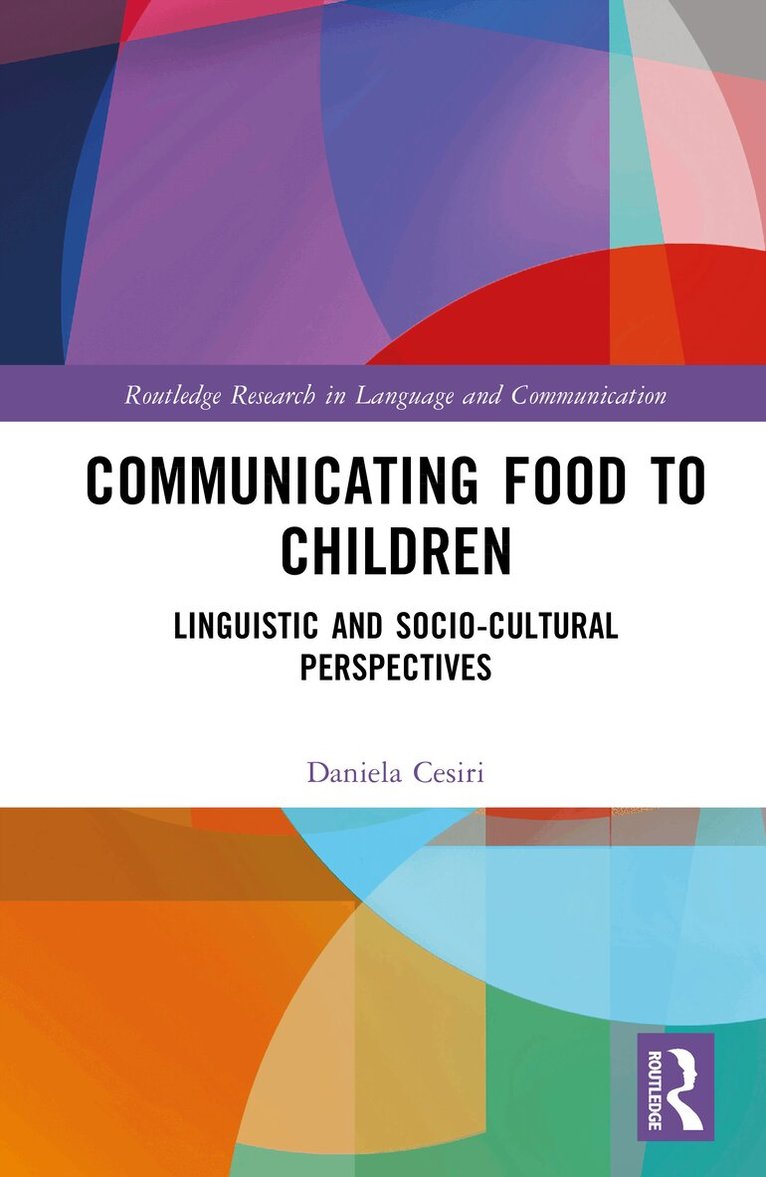
    Communicating Food to Children

    Linguistic and Socio-Cultural Perspectives

    AvDaniela Cesiri

    Inbunden, Engelska, 2025

    Del i serien Routledge Research in Language and Communication

    2 423 kr

    Beställningsvara. Skickas inom 10-15 vardagar. Fri frakt över 249 kr.

    Fler format och utgåvor

    E-bok

    805 kr

    E-bok

    805 kr

    Beskrivning

    This book offers a systematic account of communication on food aimed at children, investigating verbal and visual strategies used in food media in English from synchronic and diachronic perspectives.While there is a wide body of research on food discourse, there has been little to date on children as a particular category of actors within food-related communication. Cesiri integrates work from corpus linguistics, genre analysis, and multimodality to analyze verbal and visual components in media that transmit specialist knowledge and familiarize children with foundational food concepts, the extra-linguistic factors that shape food-related communication, and the ways in which different genres represent culinary traditions to children. The volume features an extensive corpus of technical products such as cookbooks, commercial products such as advertisements, and institutional products such as leaflets from international institutions. In applying a multi-layered perspective to a diverse range of food-related communication materials, Cesiri seeks to unpack whether potential differences in communicative strategies can be attributed to the source culture of interactants or those shared by a specific community of actors, and in turn, further insights into the nature of domain-specific discourse.This volume will appeal to scholars in discourse analysis, multimodality, corpus linguistics, and childhood studies.

    Produktinformation

    • Utgivningsdatum:2025-09-28
    • Mått:152 x 229 x 14 mm
    • Vikt:480 g
    • Format:Inbunden
    • Språk:Engelska
    • Serie:Routledge Research in Language and Communication
    • Antal sidor:162
    • Förlag:Taylor & Francis Ltd
    • ISBN:9781032394350

    Utforska kategorier

    • Antropologi inom Samhälle och politik
    • Språkvetenskap och lingvistik inom Språk och ordböcker
    • Kulturvetenskap inom Samhälle och politik

    Mer om författaren

    Daniela Cesiri holds a PhD in English Language and Linguistics. She is currently an associate professor in English language, linguistics, and translation in the Department of Linguistics and Comparative Cultural Studies at Ca’ Foscari University of Venice (Italy). Her main research interests are applied linguistics, pragmatics, the use of corpora for discourse analysis, computer-mediated communication, knowledge dissemination, metaphors in specialised discourse, and the study of ESP/EAP in different settings, domains, and genres. She has published numerous articles for national and international publishers on these topics. She also published a monograph in 2012 entitled Nineteenth-Century Irish English: A Corpus-Based Linguistic and Discursive Analysis. A second monograph entitled The Discourse of Food Blogs: Multidisciplinary Perspectives was published in 2020 by Routledge, while in 2015, the textbook Variation in English across Time, Space and Discourse: An Introductory Textbook was published.

    Recensioner i media

    "For scholars in childhood studies, media studies, and health communication, it provides a useful examination of how everyday food communication participates in broader social and ideological processes".- Lyan Abdullah Alkhalifah, Qassim University, Saudi Arabia

    Innehållsförteckning

    • List of figuresList of tablesIntroduction0.1. General Premise0.2. Literature Review0.2.1. Food, culture, and media0.2.2. Socio-cultural factors in food-related communication0.2.3. Culinary Linguistics0.3. This book: rationale, structure, intended audienceReferencePart 1. Food and Children: Representations and ProductsChapter One. Food and Children. An Overview1.1. General Introduction1.2. Food for Children: Shaping Identities, Representations and Consumers’ Choices1.2.1. Marketing Food to Children: selling products and shaping lifestyles1.2.2. Food in Media for Children: opposing the trend and promoting healthy food choices 1.3. Representing Food to Children1.3.1. Food in Children’s Literature1.3.2. The Discourse of Food for Children in Linguistics and Communication StudiesReferencesChapter Two. Dataset and Methods 2.1. Introduction2.2. The Dataset2.3. Organization of the Volume2.4. Methods of Investigation2.4.1. Critical Discourse Analysis2.4.2. Multimodal Discourse Analysis2.4.3. Corpus-Based AnalysisReferencesPart 2. Food and Children: Technical ProductsChapter Three. Case Study One: A Critical Discourse Analysis of Gender-Based Stereotypes in Food Blog Recipes 3.1. Introduction3.2. Critical Discourse Analysis3.3. The Language in the Kitchen is Gendered: State-Of-The-Art3.4. The Case Study: Rationale and Dataset3.4.1. The ‘About Sections’ in Food Blogs3.5. Analysis3.5.1. General Observations3.5.2. The Weelicious3.5.3. Healthy Little Foodies3.5.4. My Kids Lick The Bowl3.5.5. Yummy Toddler Food3.5.6. Kids Cook Real Food3.5.7. Happy Kids Kitchen3.6. Discussion3.7. ConclusionsReferencesPart 3. Food and Children: Commercial ProductsChapter Four. Promoting nutritional and socio-cultural values through convenience products: a diachronic, contrastive multimodal discourse analysis of Nutella®’s advertisements as a case study4.1. Introduction4.1.1 Convenience Products and a History of Nutella®4.2. Multimodal Discourse Analysis4.3. The Dataset4.4. Analysis4.4.1. Advertisements in Italian (1964-1969)4.4.2. Advertisements in Italian (1970-1979)4.4.3. Advertisements in Italian (1980-2020)4.4.4. Advertisements in English4.5. Discussion4.6. ConclusionsReferencesPart 4. Food and Children: Institutional ProductsChapter Five. Institutional Communication to Families with Children: Communicating International Guidelines through Digital Booklets and Webpages5.1. Introduction5.1.1. The World Health Organization (WHO)5.1.2. The Food and Agriculture Organization (FAO) 5.1.3. The World Food Programme (WFP)5.2. Dataset and Method of Investigation5.2.1. Reference Corpus: Uses and Information5.3. Quantitative Analysis5.4. Qualitative Analysis5.4.1. Key keywords in the WHO Sub-Corpus5.4.2. Concordance Analysis – WHO Sub-Corpus5.4.3. Key keywords in the FAO Corpus 5.4.4. Concordance Analysis – the FAO Corpus5.4.5. Key keywords in the WFP Corpus5.4.6. Concordance Analysis – the WFP Corpus5.5. Concordance Analysis of Child/Children in the Orgs Corpus5.6. Discussion5.7. ConclusionsReferencesConclusionsIndex