• Fri frakt över 249 kr
  • •
  • Snabba leveranser
  • •
  • Billiga böcker
Kundservice

Du är på sajten för privatpersoner.

Företag, bibliotek eller offentlig verksamhet?

Du handlar på classic.bokus.com, där alla dina funktioner finns intakta.
Till classic.bokus.com
Bokus logotyp. Gå till startsidan.
  • Erbjudanden
  • Nyheter
  • Student
  • Topplistor
  • Barn & ungdom
  • Bokus Play
  • E-böcker
  • Pocketböcker
  • Spel & pussel

10% rabatt på allt med kod: NYSTART10 →

Sidfot

Mina sidor

    Hjälp

    • Kundservice
    • Vanliga frågor och svar
    • Frakt och leverans
    • Retur vid ångerrätt
    • Reklamera vara
    • Betalning
    • Köpvillkor
    • Allmänna villkor
    • Information om webbplatsens tillgänglighet

    Om Bokus

    • Om oss
    • Pressrum
    • För studenter
    • För företag
    • För bibliotek och offentlig verksamhet
    • För leverantörer
    • Hållbarhet

    Populärt

    • Aktuella erbjudanden
    • Presentkort
    • Studentlitteratur
    • Nya böcker
    • Topplistor
    • Signerade böcker
    • Engelska böcker

    Inspiration

    • Boktips
    • BookTok
    • Populära bokserier
    • Barnbokskaraktärer
    • Populära författare
    Logotyp för Bokus
    Följ oss på Facebook (extern länk)Följ oss på Instagram (extern länk)Följ oss på YouTube (extern länk)Följ oss på TikTok (extern länk)
    bokus @ CookiesAnpassa cookiesIntegritetspolicyKöpvillkor
    Till Citymail hemsida (extern länk)Till Budbee hemsida (extern länk)Till Postnord hemsida (extern länk)Till Schenker hemsida (extern länk)Till Early Bird hemsida (extern länk)Till Walleys hemsida (extern länk)
    1. Samhälle och politik
    2. Politik och statsskick
    3. Politiska partier
    • Nyhet

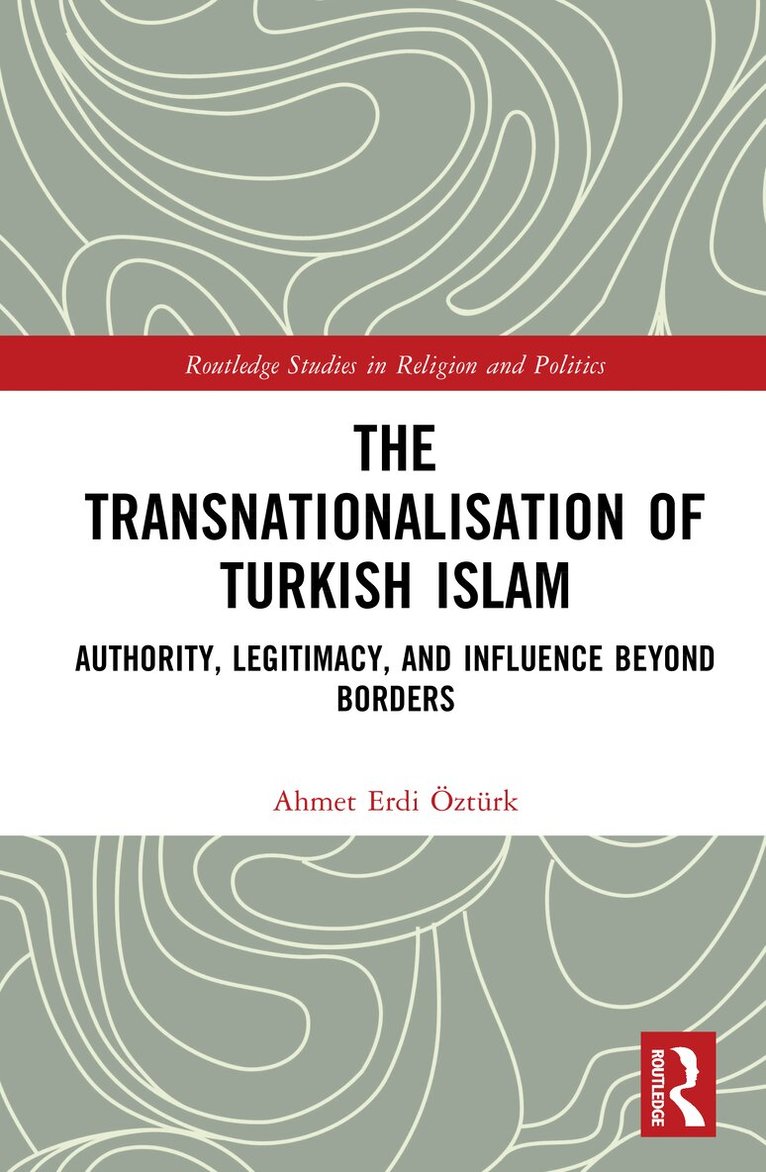
    Transnationalisation of Turkish Islam

    Authority, Legitimacy, and Influence Beyond Borders

    AvAhmet Erdi Öztürk

    Inbunden, Engelska, 2026

    Del i serien Routledge Studies in Religion and Politics

    2 421 kr

    Beställningsvara. Skickas inom 10-15 vardagar. Fri frakt över 249 kr.

    Beskrivning

    The Transnationalisation of Turkish Islam builds on current academic debates pertaining to the use of religion in global politics. By examining how and why religion is used as a tool for foreign policy aims, as well as for perpetuating a state’s identity and institutional capacity at home and abroad, the book presents a theory-informed discussion on contemporary Turkey’s transnational politics of religion from a comparative perspective. The country’s use of religion as a political tool outside of its borders has been studied in Continental Europe, Africa, Asia, and the Balkans thanks to extensive fieldwork and interviews conducted between 2016 and 2020. The book investigates how and why Turkey has implemented similar tools with different aims in different geographic territories and the underlying material and normative motivations for this pursuit. The main argument presented in the study is that Turkey, under the rule of the Adalet ve Kalkınma Partisi (AKP) (Justice and Development Party), employs religion for three fundamental reasons: to bolster its regional and global influence, to access regions or groups that are difficult to reach through traditional foreign policy tools, and to alter domestic political balances or amass power. The Transnationalisation of Turkish Islam will appeal to students and scholars of political science, international relations, and public policy.

    Produktinformation

    • Utgivningsdatum:2026-07-27
    • Mått:156 x 234 x 13 mm
    • Vikt:500 g
    • Format:Inbunden
    • Språk:Engelska
    • Serie:Routledge Studies in Religion and Politics
    • Antal sidor:172
    • Förlag:Taylor & Francis Ltd
    • ISBN:9781032410111

    Utforska kategorier

    • Politiska partier inom Samhälle och politik
    • Internationella relationer inom Samhälle och politik
    • Religion: allmänt inom Filosofi och religion

    Mer om författaren

    Ahmet Erdi Öztürk is Reader in Politics and International Relations at London Metropolitan University and a non-resident fellow at ELIAMEP (Hellenic Foundation for European and Foreign Policy). He serves as Section Chair of the International Studies Association’s (ISA) Ethnicity, Nationalism, and Migration Studies (ENMISA) section and is co-editor of the Edinburgh University Press series on Modern Turkey and the journal Southeast European and Black Sea Studies. Between 2021 and 2023, he held a Marie Skłodowska-Curie Individual Fellowship at Coventry University (UK) and the German Institute for Global and Area Studies (GIGA). Previously, he was a Swedish Institute doctoral and postdoctoral fellow at Institute for Research on Migration, Ethnicity and Society (REMESO) (Linköping University) and a post-doctoral scholar in residence at the University of Notre Dame’s Kroc Institute for International Peace Studies. He received his PhD in political science from the University of Strasbourg (highest distinction) in 2018. His research examines the intersection of religion, politics, and international relations, with a focus on transnational religious governance, foreign policy, and conflict/peace processes. He is the author, co-author, or editor of 10 books, more than 70 peer-reviewed journal articles, and 25 book chapters and has published policy reports with institutions including the Berkeley Center, RUSI, and the Middle East Institute. His commentary has appeared in outlets such as openDemocracy, The Conversation, HuffPost, and France 24. He is a recipient of the International Studies Association’s Emerging Scholar Award (2021, 2022, 2023), London Metropolitan University’s Rising Star Award (2021), and the Centre for Turkey Studies (CEFTUS) Academic of the Year (2024).

    Recensioner i media

    "Incorporation of religion into Turkish foreign policy has been one of the most consequential novelties since the Islamism-originated Justice and Development Party, led by Recep Tayyip Erdoğan, came to power in 2002. Defining this novelty as “positive instrumentalization” or “repurposing” of religion congruent with the historical patterns of state-religion relations in “secular” Turkey, The Transnationalization of Turkish Islam meticulously examines how religion has been functionalized as a medium of civilizational performance to claim the status of a central Muslim power, guarding a broader religious-cultural heritage than that of the nation. By engaging with post-secular international relations, soft power, field theory and civilizational politics, A. Erdi Öztürk distills his ethnographic research, involving representatives of Turkey’s official, semi-official and non-official religious functionaries, Turkish diplomats, and selected local religious leaders and community actors, in a wide geography spanning from post-Soviet Eurasia to the Anglo-Saxon world. The consequent analysis is a sophisticated one revealing how religion is strategically utilized to attain legitimacy, amplify influence, and enhance civilizational prestige, while simultaneously isolating dissenters both domestically and abroad; how this mobilization is varied/differed depending on the audiences, institutional interlocutors and geopolitical constraints involved; and how in the process religion is defined, owned and authorized by the very political force claiming to have submitted itself to serving it. The Transnationalization of Turkish Islam is an essential reading for students and scholars of Turkish politics, Islamism, civilizational states, comparative politics and international relations, providing critical insights into the complex interplay of religion and statecraft in contemporary Turkey, shedding light on a pivotal aspect of Turkish foreign policy, and contributing to a broader understanding of the role of religion in global politics today."Menderes Çınar, Professor of Political Science and International Relations, Başkent University, Ankara

    Innehållsförteckning

    • Introduction Chapter 1. Religion, Secularization, Identity, and Power in World Politics Chapter 2. Scrutinising Turkey’s history along the axis of religion Chapter 3. Imagined Proximity, Real Contestation: Turkey’s Religious Outreach across the Balkans Chapter 4. Western Europe: From Pastoral Care to Diaspora Control? Chapter 5. Entering Late, Playing Different: Transnational Religion-Making and Turkish Diaspora Governance in the Anglo-Saxon World Chapter 6. Africa as a Post-Imperial Frontier: Turkey’s Religious Statecraft, Competitive Influence, and the Limits of Neo-Ottoman Outreach Chapter 7. Eurasia’s Post-Soviet Religious Field: Turkey’s Diyanet, Turkic Solidarity, and the Islamism–Turkism Fusion Conclusion. Religion as Transnational Statecraft, and the Ambivalence of Influence