• Fri frakt över 249 kr
  • •
  • Snabba leveranser
  • •
  • Billiga böcker
Kundservice

Du är på sajten för privatpersoner.

Företag, bibliotek eller offentlig verksamhet?

Du handlar på classic.bokus.com, där alla dina funktioner finns intakta.
Till classic.bokus.com
Bokus logotyp. Gå till startsidan.
  • Erbjudanden
  • Nyheter
  • Student
  • Topplistor
  • Barn & ungdom
  • Bokus Play
  • E-böcker
  • Pocketböcker
  • Spel & pussel

10% rabatt på allt med kod NYSTART10 →

Sidfot

Mina sidor

    Hjälp

    • Kundservice
    • Vanliga frågor och svar
    • Frakt och leverans
    • Retur vid ångerrätt
    • Reklamera vara
    • Betalning
    • Köpvillkor
    • Allmänna villkor
    • Information om webbplatsens tillgänglighet

    Om Bokus

    • Om oss
    • Pressrum
    • För studenter
    • För företag
    • För bibliotek och offentlig verksamhet
    • För leverantörer
    • Hållbarhet

    Populärt

    • Aktuella erbjudanden
    • Presentkort
    • Studentlitteratur
    • Nya böcker
    • Topplistor
    • Signerade böcker
    • Engelska böcker

    Inspiration

    • Boktips
    • BookTok
    • Populära bokserier
    • Barnbokskaraktärer
    • Populära författare
    Logotyp för Bokus
    Följ oss på Facebook (extern länk)Följ oss på Instagram (extern länk)Följ oss på YouTube (extern länk)Följ oss på TikTok (extern länk)
    bokus @ CookiesAnpassa cookiesIntegritetspolicyKöpvillkor
    Till Citymail hemsida (extern länk)Till Budbee hemsida (extern länk)Till Postnord hemsida (extern länk)Till Schenker hemsida (extern länk)Till Early Bird hemsida (extern länk)Till Walleys hemsida (extern länk)
    1. Ekonomi och Ledarskap
    2. Nationalekonomi
    3. Mikroekonomi

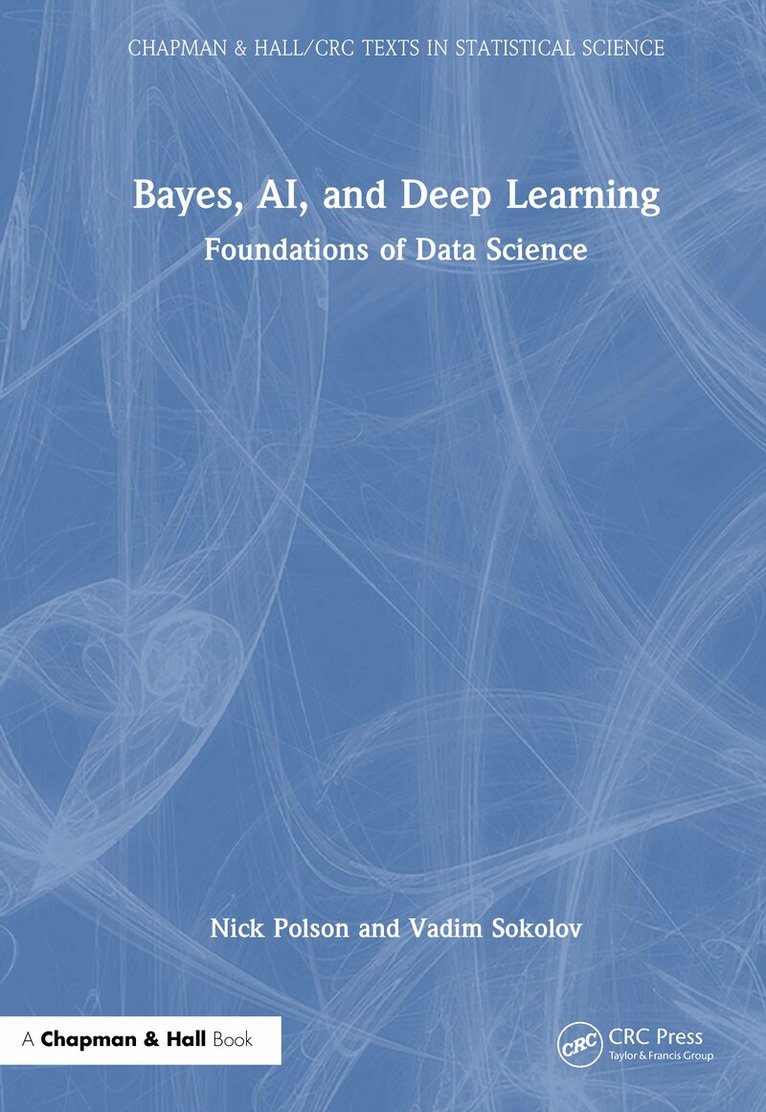
    Bayes, AI, and Deep Learning

    Foundations of Data Science

    AvNick Polson,Vadim Sokolov

    Inbunden, Engelska, 2026

    Del i serien Chapman & Hall/CRC Texts in Statistical Science

    2 647 kr

    Slutsåld

    Beskrivning

    From Alan Turing breaking the Enigma code to ChatGPT reshaping how we work and create, artificial intelligence has always been powered by a single unifying principle: learning from data under uncertainty. This book reveals the mathematical machinery behind modern AI, weaving together Bayesian probability, statistical learning, and deep neural networks into a coherent intellectual framework. Whether you seek to understand why large language models hallucinate, how recommendation systems predict your preferences, or what makes reinforcement learning agents master complex games, this book equips you with both the theoretical foundations and practical intuitions that define the modern AI playbook.Key Features:Builds Bayesian reasoning from first principles through historical examples like submarine search and WWII code-breakingBridges classical statistics and deep learning, connecting linear regression to transformersCovers the complete AI stack: probability, decision theory, Gaussian processes, neural networks, CNNs, NLP, and LLMsEmphasizes uncertainty quantification—building systems that know what they don't knowPractical applications across finance, healthcare, operations, and autonomous systemsEmerging topics: AI agents, RLHF, and retrieval-augmented generationWritten for graduate students, data scientists, and quantitatively-minded practitioners, this book assumes comfort with calculus and basic probability while building sophisticated intuitions progressively. Business analysts will appreciate the decision-theoretic framing; engineers will value the architectural insights; researchers will find rigorous foundations for further study. Whether used as a course textbook, professional reference, or intellectual companion for understanding the AI revolution transforming every industry, this book delivers the rare combination of mathematical depth and accessible exposition that makes complex ideas genuinely understandable.

    Produktinformation

    • Utgivningsdatum:2026-12-15
    • Mått:178 x 254 x undefined mm
    • Vikt:453 g
    • Format:Inbunden
    • Språk:Engelska
    • Serie:Chapman & Hall/CRC Texts in Statistical Science
    • Antal sidor:818
    • Förlag:Taylor & Francis Ltd
    • ISBN:9781032471228

    Utforska kategorier

    • Mikroekonomi inom Ekonomi och Ledarskap
    • Matematisk statistik inom Naturvetenskap och teknik
    • Elektronik och kommunikationer inom Naturvetenskap och teknik

    Mer om författaren

    Vadim Sokolov is Associate Professor in the Department of Systems Engineering and Operations Research at George Mason University, where he develops Bayesian methods, machine learning algorithms, and deep learning architectures for complex systems. His research spans statistical learning theory, probabilistic modeling, and intelligent transportation systems, with publications in leading journals including Bayesian Analysis, Transportation Research, and IEEE Transactions on Intelligent Transportation Systems.Before joining Mason in 2016, Sokolov served as Visiting Assistant Professor of Statistics at the University of Chicago Booth School of Business and Principal Computational Scientist at Argonne National Laboratory, where he led the development of POLARIS, a large-scale agent-based transportation simulation framework, and the GREET life-cycle analysis model used by over 800 organizations worldwide.Sokolov earned his Ph.D. in Computational Mathematics from Northern Illinois University and holds a diploma in Applied Mathematics with High Honors from Rostov State University, Russia. His work bridges rigorous statistical foundations with practical applications in energy systems, urban analytics, and data-driven decision-making. He is a member of INFORMS, the International Society for Bayesian Analysis, and the American Statistical Association.Nicholas Polson is the Robert Law, Jr. Professor of Econometrics and Statistics at the University of Chicago Booth School of Business, where he has shaped modern Bayesian statistics and machine learning since 1991. A leading authority on probabilistic modeling, his research encompasses Markov chain Monte Carlo methods, particle learning, financial econometrics, and deep learning theory, with foundational contributions to stochastic volatility modeling, sparse Bayesian estimation, and high-dimensional inference.Polson's influential work includes developing particle filtering algorithms for sequential learning and Bayesian regularization methods ranging from Tikhonov to horseshoe priors. His article "Bayesian Analysis of Stochastic Volatility Models" was recognized as one of the most influential papers in the 20th anniversary issue of the Journal of Business and Economic Statistics. He co-authored AIQ: How People and Machines Are Smarter Together (2018), exploring the synergy between human intelligence and artificial intelligence.Polson earned his master's degree with First Class Honours from Worcester College, Oxford University, and his Ph.D. from the University of Nottingham. His work bridges theoretical foundations in probability and statistics with practical applications in finance, forecasting, and data science, establishing him as a pioneer in connecting classical Bayesian methods to modern deep learning.

    Innehållsförteckning

    • 1 Probability and Uncertainty. 2 Bayes Rule. 3 Bayesian Learning. 4 Utility, Risk and Decisions. 5 A/B Testing. 6 Bayesian Hypothesis Testing. 7 Stochastic Processes. 8 Gaussian Processes. 9 Reinforcement Learning. 10 Unreasonable Effectiveness of Data. 11 Pattern Matching. 12 Linear Regression. 13 Logistic Regression and Generalized Linear Models. 14 Tree Models. 15 Forecasting. 16 Model Selection. 17 Statistical Learning Theory and Regularization. 18 Neural Networks. 19 Theory of Deep Learning. 20 Gradient Descent. 21 Quantile Neural Networks. 22 Convolutional Neural Networks. 23 Natural Language Processing. 24 Large Language Models. 25 AI Agents.