• Fri frakt över 249 kr
  • •
  • Snabba leveranser
  • •
  • Billiga böcker
Kundservice

Du är på sajten för privatpersoner.

Företag, bibliotek eller offentlig verksamhet?

Du handlar på classic.bokus.com, där alla dina funktioner finns intakta.
Till classic.bokus.com
Bokus logotyp. Gå till startsidan.
  • Erbjudanden
  • Nyheter
  • Student
  • Topplistor
  • Barn & ungdom
  • Bokus Play
  • E-böcker
  • Pocketböcker
  • Spel & pussel

10% rabatt på allt med kod: NYSTART10 →

Sidfot

Mina sidor

    Hjälp

    • Kundservice
    • Vanliga frågor och svar
    • Frakt och leverans
    • Retur vid ångerrätt
    • Reklamera vara
    • Betalning
    • Köpvillkor
    • Allmänna villkor
    • Information om webbplatsens tillgänglighet

    Om Bokus

    • Om oss
    • Pressrum
    • För studenter
    • För företag
    • För bibliotek och offentlig verksamhet
    • För leverantörer
    • Hållbarhet

    Populärt

    • Aktuella erbjudanden
    • Presentkort
    • Studentlitteratur
    • Nya böcker
    • Topplistor
    • Signerade böcker
    • Engelska böcker

    Inspiration

    • Boktips
    • BookTok
    • Populära bokserier
    • Barnbokskaraktärer
    • Populära författare
    Logotyp för Bokus
    Följ oss på Facebook (extern länk)Följ oss på Instagram (extern länk)Följ oss på YouTube (extern länk)Följ oss på TikTok (extern länk)
    bokus @ CookiesAnpassa cookiesIntegritetspolicyKöpvillkor
    Till Citymail hemsida (extern länk)Till Budbee hemsida (extern länk)Till Postnord hemsida (extern länk)Till Schenker hemsida (extern länk)Till Early Bird hemsida (extern länk)Till Walleys hemsida (extern länk)
    1. Psykologi och pedagogik
    2. Pedagogik
    3. Högskola och universitet
    • Nyhet

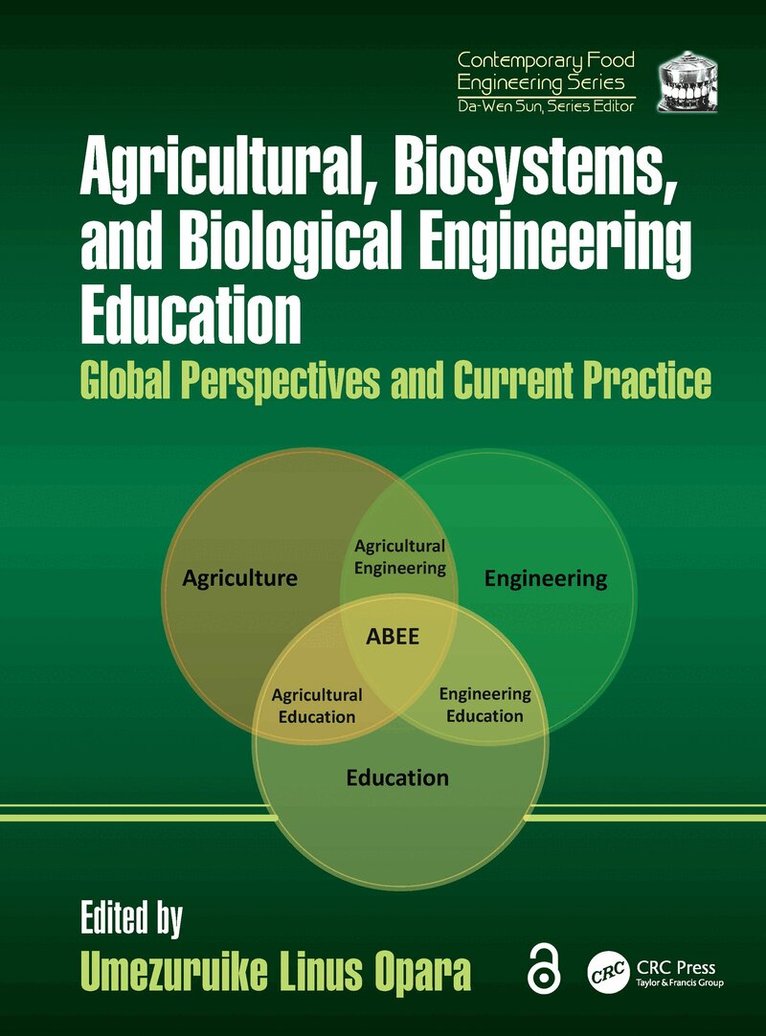
    Agricultural, Biosystems, and Biological Engineering Education

    Global Perspectives and Current Practice

    AvUmezuruike Linus Opara

    Häftad, Engelska, 2026

    Del i serien Contemporary Food Engineering

    1 130 kr

    Beställningsvara. Skickas inom 10-15 vardagar. Fri frakt över 249 kr.

    Beskrivning

    Agricultural engineering, developed as an engineering discipline underpinned by physics, applies scientific principles, knowledge, and technological innovations in the agricultural and food industries. During the last century, there was exponential growth in engineering developments, which has improved human wellbeing and radically changed how humans interact with each other and our planet. Among these, “Agricultural Mechanization” is ranked among the top 10 in a list of 20 Top Engineering Achievements of the last century that have had the greatest impact on the quality of life.While many success stories abound, the problems of low appeal among students, identity crises, and limited job opportunities in many climes continue to trouble the discipline’s future in many parts of the world. Yet agriculture and agricultural engineering remain fundamental to assuring food and nutrition security for a growing global population.Agricultural, Biosystems, and Biological Engineering Education provides the first comprehensive global review and synthesis of different agricultural, biosystems, and biological engineering education approaches, including a detailed exposition of current practices from different regions.Key Features: Describes novel approaches to curriculum design and reformOutlines current and emerging epistemology and pedagogies in ABBE educationProvides a framework to grow agricultural engineering in Africa and other developing regionsHighlights the role of ABBE education in the context of the SDGsPresented in 3 parts and containing 42 chapters, this book covers the historical evolution of agricultural engineering education and discusses the emergence of biological and biosystems engineering education. It will appeal to engineers and other professionals, education planners and administrators, and policy makers in agriculture and other biological industries.Chapters 4, 11, 19, 32, and 41 of this book are freely available as a downloadable Open Access PDF at http://www.taylorfrancis.com under a Creative Commons Attribution-Non Commercial-No Derivatives (CC-BY-NC-ND) 4.0 license.

    Produktinformation

    • Utgivningsdatum:2026-08-27
    • Mått:210 x 280 x 31 mm
    • Vikt:1 110 g
    • Format:Häftad
    • Språk:Engelska
    • Serie:Contemporary Food Engineering
    • Antal sidor:578
    • Förlag:Taylor & Francis Ltd
    • ISBN:9781032496078

    Utforska kategorier

    • Högskola och universitet inom Psykologi och pedagogik
    • Undervisning i specifika ämnen inom Psykologi och pedagogik
    • Agronomi och lantbruk inom Naturvetenskap och teknik

    Mer om författaren

    Umezuruike Linus Opara is a Distinguished Professor at Stellenbosch University, South Africa, where he also holds the Chair of the South African Research Chairs Initiative (SARChI) in Postharvest Technology, and the founding Director of the Africa Institute for Postharvest Technology (AIPhT). He graduated with degrees in Agricultural Engineering (BEng, First Class Honors; MEng, cum laude) from the University of Nigeria, Nsukka, a PhD in Agricultural Engineering from Massey University, Palmerston North, New Zealand and a Certificate in Innovation for Economic Development, from the Executive Education program at Harvard Kennedy School, Harvard University, USA. He is a Chartered Engineer, Certified Food Scientist, and has leading memberships of several professional agricultural engineering societies, including Fellow of the International Academy of Agricultural and Biosystems Engineering, Institution of Agricultural Engineers (UK), South African Institution of Agricultural Engineers, Nigerian Institution of Agricultural Engineers, and Life Membership of the American Society of Agricultural and Biological Engineers, Asian Association for Agricultural Engineering, and the Indian Society of Agricultural Engineers.Prof. Opara is currently developing the UNESCO International Centre for Biotechnology in Nsukka, Nigeria, a Category II Centre under the auspices of UNESCO, for advancing biotechnology research and high-level capacity building in the Africa region in the areas of food security, tropical diseases, and bioresources conservation.

    Innehållsförteckning

    • PART 1: HISTORICAL EVOLUTION AND IMPORTANCE OF AGRICULTURAL ENGINEERING1. Introduction – Revisiting and Rethinking Agricultural and Biosystems/ Biological Engineering Education for Sustainable Development2. Emergence and Advancement of Agricultural Engineering Education, Research and Practice – A Historical Perspective3. Agricultural Engineering in the Context of SDGs: A Quest for Global Relevance 4. Top 100 Questions of Importance to the Future of Agricultural Engineering Education, Research, and Practice in Africa5. Enhancing the Role of Agricultural and Biological Engineering through Education: Perspective from FAO PART 2: CURRICULA DESIGN AND REFORM6. Curriculum Design and Application in ABE Education 7. Curricula Design and Reform of Agricultural and Biosystems Engineering (ABE) in EU Member and Candidate States8. Bioresource Engineering Curriculum and Reform at McGill University, Montreal, Canada9. Designing Agricultural and Biosystems Engineering Education to Transform Agricultural and Food Systems in Sub-Saharan Africa: Insights from the University of Zimbabwe10. Reshaping Agricultural and Biosystem Engineering Degree Programs for Student Success and Retention11. Essential Contextual Knowledge for Agriculture and Biosystems Engineering Education in Low-income Countries12. Novel Models for Delivering Agricultural and Biosystems Engineering Education in Developing Countries: Trends, Challenges and Future Prospects13. Current and Future Trends in Agricultural Engineering Education in Nigeria 14. The Need for an Equipment Engineering Course in ABE Education15. Accreditation Program for Engineering Education in Japan Applicable to Agricultural and Rural Engineering Education16. Process for Improvement and Evaluation of the Agricultural Engineering Curriculum at the Instituto Tecnológico de Costa Rica17. Agricultural Engineering Education at Sultan Qaboos University, Sultanate of Oman – Historical Evolution, Curriculum Design and Reform, Students’ Perceptions, and Future Prospects18. Agricultural Engineering Education at Michael Okpara University of Agriculture Umudike, Nigeria19. Agricultural Biosystems Engineering Education in Indonesia – A Journey20. Agricultural and Food Engineering Education in Hungary21. Food Engineering Education in Nigeria22. Agricultural Engineering Higher Education in Turkey23. Agricultural and Biosystems Engineering Education in Ghana24. ABE@Illinois25. A Profile of Agricultural and Biosystems Engineering Education in Indonesia26. Evolution and Status of Agricultural and Bioresources Engineering Education at the University of Nigeria27. Development of the Agricultural and Biosystems Engineering Programme at the Botswana University of Agriculture and Natural Resources (BUAN)PART 3: PEDAGOGY, EPISTEMOLOGY AND EMERGING TRENDS28. Developing Faculty Competency for the Delivery of Active Learning Methods29. Educating the Compleat Biological Engineer 30. Innovation in Bioengineering Education31. Nomograph-based Models for Introductory Undergraduate Teaching and Research in Selecting Agricultural Power and Machinery Ownership Systems in Developing Countries32. The Role of Inclusion, Diversity, Equity, and Access (IDEA) in Agricultural and Biological Engineering33. AgTecCollection – Repository Approach to Rescue Analog Agricultural Engineering Knowledge34. A Need to Incorporate Intelligent Food Drying Systems in ABE Education – A Recipe for Reducing Global Food Losses and Waste35. The Need to Incorporate Ergonomics in Smart Agriculture and Organic Farming in Agricultural and Biological Engineering Education36. CAM-SAM: A Computer-aided Tool for Education and Research on Sustainable Agricultural Mechanization Development37. Information and Operational Technologies Curricula in Agricultural Engineering Studies38. Technological-based Resources as Support to Agricultural and Biosystems Engineering studies39. Present Content and Trial Approaches of Student Experiments for ABEE in Japan40. Practical Engineering Education to Address Sustainability and Food Security41. Growing Agricultural Engineering in Africa: Students’ Attitudes, Perceptions, and Expectations on Agricultural Engineering Education 42. Prospects for Agricultural and Biosystems Engineering Education and Research for Knowledge-intensive, Data-driven, Climate-smart, and Sustainable Agriculture