• Fri frakt över 249 kr
  • •
  • Snabba leveranser
  • •
  • Billiga böcker
Kundservice

Du är på sajten för privatpersoner.

Företag, bibliotek eller offentlig verksamhet?

Du handlar på classic.bokus.com, där alla dina funktioner finns intakta.
Till classic.bokus.com
Bokus logotyp. Gå till startsidan.
  • Erbjudanden
  • Nyheter
  • Student
  • Topplistor
  • Barn & ungdom
  • Bokus Play
  • E-böcker
  • Pocketböcker
  • Spel & pussel

10% rabatt på allt med kod: NYSTART10 →

Sidfot

Mina sidor

    Hjälp

    • Kundservice
    • Vanliga frågor och svar
    • Frakt och leverans
    • Retur vid ångerrätt
    • Reklamera vara
    • Betalning
    • Köpvillkor
    • Allmänna villkor
    • Information om webbplatsens tillgänglighet

    Om Bokus

    • Om oss
    • Pressrum
    • För studenter
    • För företag
    • För bibliotek och offentlig verksamhet
    • För leverantörer
    • Hållbarhet

    Populärt

    • Aktuella erbjudanden
    • Presentkort
    • Studentlitteratur
    • Nya böcker
    • Topplistor
    • Signerade böcker
    • Engelska böcker

    Inspiration

    • Boktips
    • BookTok
    • Populära bokserier
    • Barnbokskaraktärer
    • Populära författare
    Logotyp för Bokus
    Följ oss på Facebook (extern länk)Följ oss på Instagram (extern länk)Följ oss på YouTube (extern länk)Följ oss på TikTok (extern länk)
    bokus @ CookiesAnpassa cookiesIntegritetspolicyKöpvillkor
    Till Citymail hemsida (extern länk)Till Budbee hemsida (extern länk)Till Postnord hemsida (extern länk)Till Schenker hemsida (extern länk)Till Early Bird hemsida (extern länk)Till Walleys hemsida (extern länk)
    1. Samhälle och politik
    2. Samhälle och kultur
    3. Sociala och etiska frågor
    • Nyhet

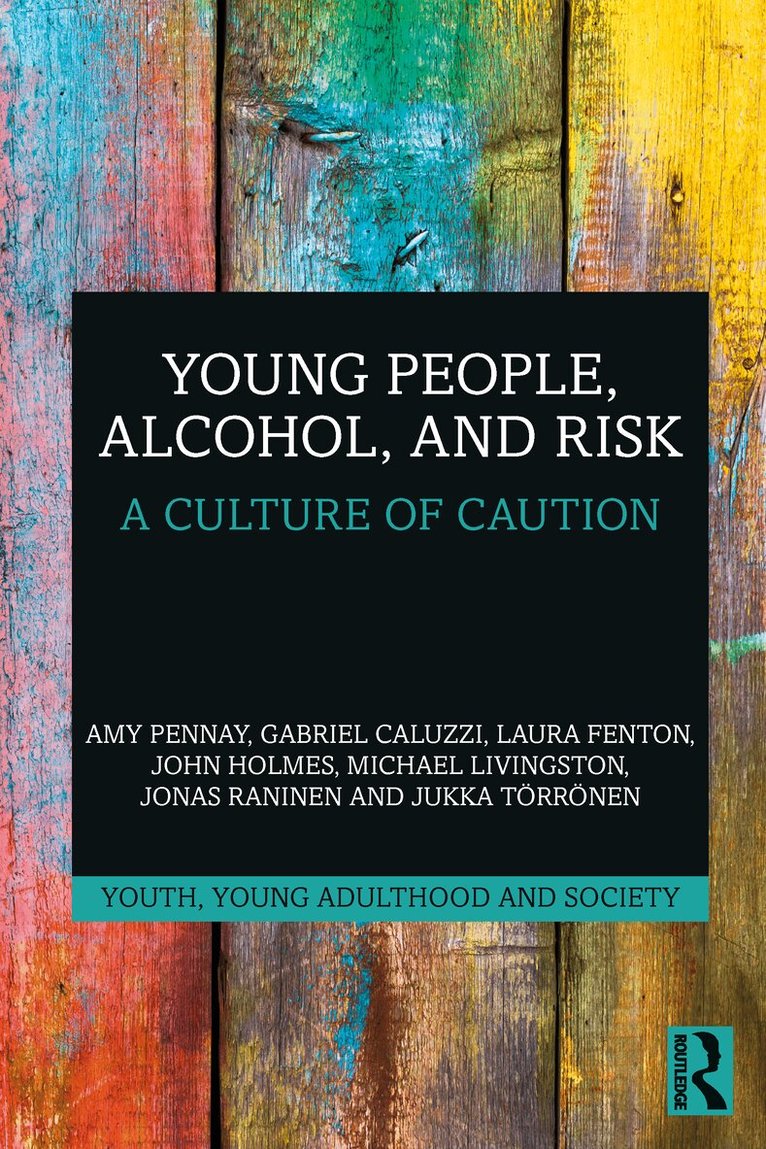
    Young People, Alcohol, and Risk

    A Culture of Caution

    AvAmy Pennay,Gabriel Caluzzi

    Häftad, Engelska, 2026

    Del i serien Youth, Young Adulthood and Society

    681 kr

    Beställningsvara. Skickas inom 10-15 vardagar. Fri frakt över 249 kr.

    Fler format och utgåvor

    Inbunden

    2 495 kr

    Beskrivning

    Young People, Alcohol, and Risk theorises the social, cultural and economic shifts that have underpinned significant declines in young people’s drinking in high- income countries.Since the early 2000s, alcohol use among young people has declined significantly in most high- income countries. Situated within a theoretical framework of ‘social generations’ and ‘risk’, this book explores the key interrelated factors that have cumulatively shifted the social and cultural position of alcohol for young people in these countries. Drawing on interviews and survey data from the authors’ research in Australia, Sweden and the UK, as well as the broader international literature, the book explores the importance of changes in attitudes to alcohol, shifting family and parenting practices, digital technology use and changes in leisure practices, neoliberalism and individualism, health and wellbeing, and gendered practices. These factors have made salient the notion of risk for young people, resulting in a culture of caution. This book will be of interest to students and scholars across the social sciences, in particular those studying substance use, youth sociology, cultural studies and public health. It will be of use to policy makers and practitioners working with young people.

    Produktinformation

    • Utgivningsdatum:2026-07-20
    • Mått:156 x 234 x 9 mm
    • Vikt:310 g
    • Format:Häftad
    • Språk:Engelska
    • Serie:Youth, Young Adulthood and Society
    • Antal sidor:156
    • Förlag:Taylor & Francis Ltd
    • ISBN:9781032542843

    Utforska kategorier

    • Sociala och etiska frågor inom Samhälle och politik
    • Kultur och medier inom Samhälle och politik
    • Sociala grupper och identitet inom Samhälle och politik

    Mer om författaren

    Amy Pennay is a sociologist and the Deputy Director of the Centre for Alcohol Policy Research, La Trobe University. Her research investigates how social and cultural factors influence drinking practices and health outcomes. Her recent work has focused on youth drinking practices, (sub)cultures of drinking, and intersections of drinking and policy with social determinants such as gender, class, race, place and sexuality.Gabriel Caluzzi is Postdoctoral Researcher at the Centre for Alcohol Policy Research, La Trobe University and the University of New South Wales. His research explores how drug and alcohol practices among young people are informed by sociocultural contexts, the sociology of health and the sociology of youth. His PhD explored the cultural meanings young people associate with alcohol and how recent declines in young people’s drinking might be understood within the context of broader generational changes. In particular, he is interested in how digital technologies might be implicated in shaping different drinking practices among young people.Laura Fenton is a sociologist with interdisciplinary research interests in youth, life course, generation, gender, alcohol and creative methods. She is Research Associate in the Sheffield Addictions Research Group at the University of Sheffield. Her PhD explored the place of alcohol in the life histories of three generations of British women. More recently, she has conducted research on the impact of austerity policies on young people’s lives and imagined futures, and led on the analysis of qualitative data for a Wellcome Trust funded project on the decline in youth drinking.John Holmes is Professor of Alcohol Policy at the University of Sheffield, Director of the Sheffield Addictions Research Group and Co- Director of the NIHR Policy Research Unit in Addictions. He completed degrees in Social Policy at the University of York and has worked at the Sheffield Centre for Health and Related Research (SCHARR) since 2010. His research underpinned the introduction of minimum unit pricing in Scotland and the development of new low- risk drinking guidelines in the UK and Australia. More recent work focuses on the international decline in youth drinking, analyses of trends in drinking practices, and the public health impact of alcohol- free and low- alcohol drinks. Michael Livingston is Associate Professor at the National Drug Research Institute in Australia. He has previously worked at the Centre for Alcohol Policy Research and the National Drug and Alcohol Research Centre and has a long history of research on alcohol policy and epidemiology. His work focuses on the impact of alcohol policy changes and general trends in alcohol consumption and harm, with a particular emphasis on youth drinking patterns.Jonas Raninen is Associate Professor at Karolinska Institutet in Sweden where he is the Team Leader for research on the use of alcohol and other drugs among youth. He is an epidemiologist with focus on drinking habits in the general population with a special focus on youth drinking. He is also the principal investigator for the Futura01 project, a longitudinal study following one of the light drinking cohorts born in 2001 as they grow older, mapping both how their drinking habits develop and the consequences of drinking and not drinking during adolescence.Jukka Törrönen has a PhD in sociology, and is a professor at the Department of Public Health Sciences at Stockholm University on social alcohol and drug research (SoRAD). He has had long- term interest in alcohol and drug research, theoretical sociology, and qualitative methods. His recent and ongoing work has been focused on different forms of addiction, on young people’s drinking practices and identity work, on drug use and risks, on women’s health and substance use, and comparative studies on changes in the cultural position of drinking.

    Innehållsförteckning

    • 1. Introduction2. Trends in young people’s alcohol use in high-income countries3. Changing attitudes towards alcohol4. Drinking and wellbeing: young people and health consciousness5. Risk and young people 6. Changing family relationships, changing drinking practices7. Alcohol and digital technologies: a continuing paradox8. Young people, social position and alcohol: gender, race, place and class9. The implications of declining young people’s drinking for future consumption and harm, for low and middle-income countries, and for alcohol policy10. What happens when the cautious generation grows up?11. Conclusion