• Fri frakt över 249 kr
  • •
  • Snabba leveranser
  • •
  • Billiga böcker
Kundservice

Du är på sajten för privatpersoner.

Företag, bibliotek eller offentlig verksamhet?

Du handlar på classic.bokus.com, där alla dina funktioner finns intakta.
Till classic.bokus.com
Bokus logotyp. Gå till startsidan.
  • Erbjudanden
  • Nyheter
  • Student
  • Topplistor
  • Barn & ungdom
  • Bokus Play
  • E-böcker
  • Pocketböcker
  • Spel & pussel

10% rabatt på allt med kod: NYSTART10 →

Sidfot

Mina sidor

    Hjälp

    • Kundservice
    • Vanliga frågor och svar
    • Frakt och leverans
    • Retur vid ångerrätt
    • Reklamera vara
    • Betalning
    • Köpvillkor
    • Allmänna villkor
    • Information om webbplatsens tillgänglighet

    Om Bokus

    • Om oss
    • Pressrum
    • För studenter
    • För företag
    • För bibliotek och offentlig verksamhet
    • För leverantörer
    • Hållbarhet

    Populärt

    • Aktuella erbjudanden
    • Presentkort
    • Studentlitteratur
    • Nya böcker
    • Topplistor
    • Signerade böcker
    • Engelska böcker

    Inspiration

    • Boktips
    • BookTok
    • Populära bokserier
    • Barnbokskaraktärer
    • Populära författare
    Logotyp för Bokus
    Följ oss på Facebook (extern länk)Följ oss på Instagram (extern länk)Följ oss på YouTube (extern länk)Följ oss på TikTok (extern länk)
    bokus @ CookiesAnpassa cookiesIntegritetspolicyKöpvillkor
    Till Citymail hemsida (extern länk)Till Budbee hemsida (extern länk)Till Postnord hemsida (extern länk)Till Schenker hemsida (extern länk)Till Early Bird hemsida (extern länk)Till Walleys hemsida (extern länk)
    1. Filosofi och religion
    2. Religion och tro
    3. Andra religioner och trosföreställningar
    4. Östasiatiska religioner

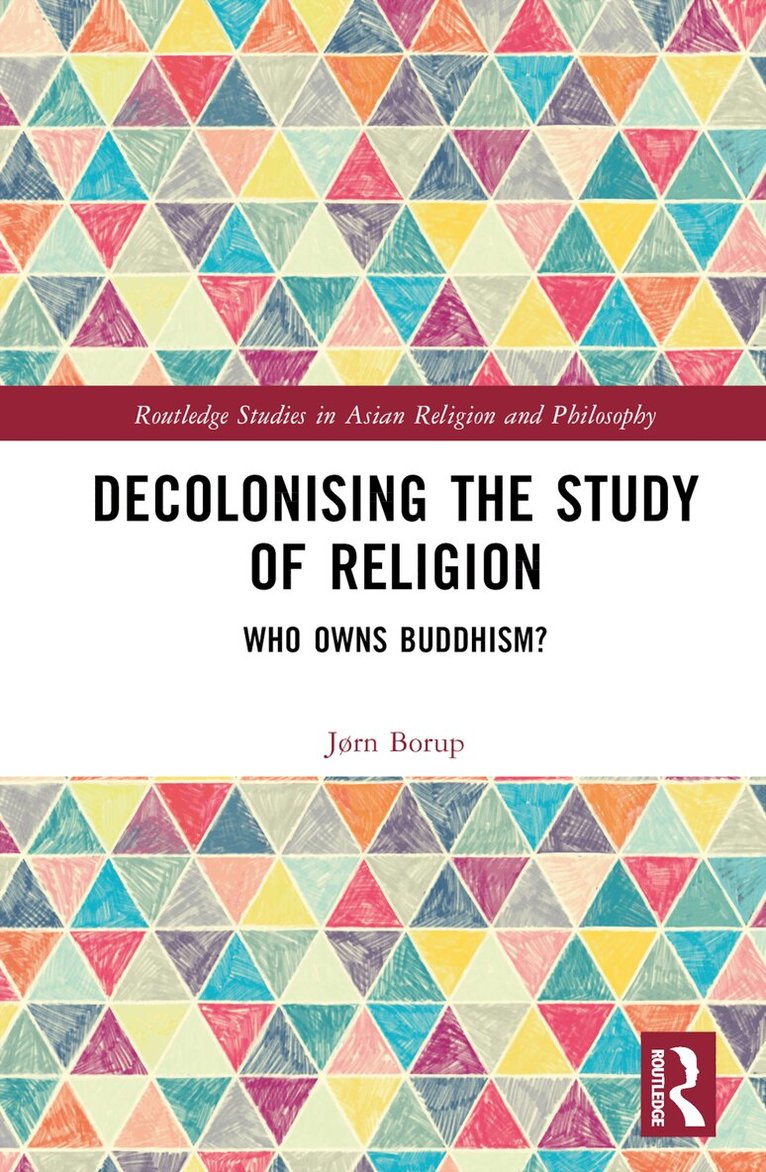
    Decolonising the Study of Religion

    Who Owns Buddhism?

    AvJørn Borup

    Inbunden, Engelska, 2023

    Del i serien Routledge Studies in Asian Religion and Philosophy

    2 423 kr

    Beställningsvara. Skickas inom 10-15 vardagar. Fri frakt över 249 kr.

    Fler format och utgåvor

    E-bok

    829 kr

    E-bok

    829 kr

    Häftad

    681 kr

    Beskrivning

    Decolonising the Study of Religion analyses historical and contemporary discussions in the study of religion and Buddhism and critically investigates representations, possibilities, and challenges of a decolonial approach, addressing the important question: who owns Buddhism?The monograph offers a case-based perspective with which to examine the general study of religion, where new challenges require reflection and prospects for new directions. It focuses on Buddhism, one religion which has been studied in the West for centuries. Building on postcolonial theories and supplemented with a critical analysis of identity and postsecular engagement, the book offers new possibilities and challenges to the study of religion. It critically investigates decolonisation in the study of religion, subscribing to a third way between ‘objectivist’ and ‘subjectivist’ positions.Analysing the postcolonial and decolonial critique of the study of religion, with a particular focus on Buddhist studies in the West and in Japan, this book will be of interest to researchers in the field of Religious Studies, Buddhism, Japanese religions, anthropology, Asian Studies and those interested in religion and decolonisation.

    Produktinformation

    • Utgivningsdatum:2023-12-28
    • Mått:156 x 234 x 19 mm
    • Vikt:500 g
    • Format:Inbunden
    • Språk:Engelska
    • Serie:Routledge Studies in Asian Religion and Philosophy
    • Antal sidor:240
    • Förlag:Taylor & Francis Ltd
    • ISBN:9781032593395

    Utforska kategorier

    • Östasiatiska religioner inom Filosofi och religion
    • Religion: allmänt inom Filosofi och religion
    • Buddhism inom Filosofi och religion

    Mer om författaren

    Jørn Borup is Associate Professor in the Department of the Study of Religion at Aarhus University, Denmark.

    Recensioner i media

    “Borup’s book addresses important and timely issues for the study of Buddhism and Religious Studies as a whole.”– Stephen C. Berkwitz, Missouri State University, USA"Decolonising the Study of Religion helpfully explores the manifestations, goals, and challenges of the decolonisation movement, both generally in Religious Studies and specifically within Buddhist Studies. In following primarily a descriptive rather than prescriptive approach, the author … offers a fairly balanced critique of what the author calls ‘colonialism’, ‘soft decolonisation’, and ‘hard decolonisation’. The difference between the last two orientations is that soft decolonisation wants to reform various systems, both academic and non-academic, whereas hard decolonisation wishes to tear down these systems and start anew (29). In the end Borup favours soft decolonisation as a middle way between extremes, since what is needed most are “critical studies of critical studies” (178) […] the book offers a cogent, capable, and informative exploration of the dynamics of decolonisation both within and without scholarly worlds."– Daniel Capper, Metropolitan State University of Denver, USA, Journal of Contemporary Religion, 09 Aug 2024."This book delves into a timely and somewhat heated topic that will undoubtedly garner increasing attention in the years ahead; the decolonial challenges of studying Buddhism and religion, including their connections to identity politics, postcolonialism, and "critical studies." The book carefully examines and analyzes this prominent theme to untangle the complex field, using specific cases from Western and Japanese traditions in historical and contemporary contexts."– Mitra Härkönen, University of Helsinki, Finland. Nordic Journal of Religion and Society. Vol.37, Iss.2"This is an important book that is relevant not only to specialists in Buddhist Studies but to all those who take Religious Studies seriously in the light of postcolonial and decolonial critique. Borup uses a broad brush, except in his treatment of Japan meaning that nuance is missed in some places. However, his examination of the decolonial critique of Religious Studies and his critical discussion of this critque is balanced and authoritative, recognising not only the importance of decolonising the study of religion but also the right scholars of religion to retain rigorous analysis in their toolkits. I recommend this book." – Elizabeth J. Harris, University of Birmingham, UK, BASR Bulletin 145: November 2024“The book maintains a balanced perspective, advocating for critical decolonial insight in religious studies yet remaining “suspicious that the hermeneutics of suspicion is not sufficiently suspicious of itself. […] Overall, this book is an excellent resource for anyone interested in the shifting discourse on identity, (post)colonialism, critical studies, and the academic study of religion.”– Davide Marino, Religious Studies Review. Volume 50, Issue 4 p. 819."[This book] is an important contribution to ongoing debates about knowledge production, cultural representation, and the legacy of colonialism in academia. It offers a thoughtful and balanced examination of decolonial critiques while also highlighting their limitations. This book is essential reading for scholars of religion, particularly those working in Buddhist studies, especially Kindai Bukkyo Gaku 近代仏教学 as well as anyone interested in the broader implications of the decolonial turn in academia. Borup’s work challenges us to think critically about our own positionality and the frameworks we use to understand and study religion, without losing sight of the value of rigorous, scholarly inquiry."-- DAKE Nobuya, Journal of World Buddhist Cultures vol 8. 2025.3."Decolonization is a highly complex and emotionally laden topic. Borup does a commendable job in averting the pitfalls of the simplistic extremist positions common in public discussion… The book introduces an extremely pertinent discussion that all scholars of religion should consider profoundly."-- Johannes Cairns TEMENOS Vol. 61 No. 1”I can only highly recommend this book to all, I emphasize: all scholars of religion, especially to students. I assume that it will become part of the required reading canon at our institute. It arrives at just the right time and, in its accessible way, offers a valuable contribution to overcoming the polarization that is also becoming noticeable in the cultural sciences.” – Review in Zeitschrift für Religionswissenschaft (2025)”I wholeheartedly recommend this book to anyone interested in theoretical and methodological issues in the study of religion, as well as to those engaged with Buddhism in the context of global modernity […] One of the many strengths of the book lies in the fact that in the more theoretically oriented chapters (one to three), as well as in the subject-specific chapters (four to eight), the author largely refrains from making value judgments or clear positioning. At no point does he become polemical, and he impressively succeeds in providing a nuanced picture of the multi-faceted theoretical debate and its genesis. […] I cannot help but highly recommend this book. It arrives at just the right moment and offers a valuable contribution to overcoming the polarisation that is increasingly evident in the humanities.” – Review in Japanese Religions 46, 1 (2024)-- Christoph Kleine, Professor for the History of Religions & Co-Director of the Centre for Advanced Studies in Humanities and Social Sciences, University of Leipzig, Germany"With his 2023 book, Borup has made a solid contribution in support of the kind of study of religion that the IAHR has long represented. This applies both to his nuanced and critically engaged presentation of complex and complicated developments and positions, and to his well‑balanced and carefully reasoned conclusions. Borup has written a book ‘for its time’. It does not merely intervene in a currently heated debate about the study of religion (including Buddhist studies). It also positions itself within – and constitutes yet another important chapter in – a very long theoretical, methodological, epistemological, and scholarly history of the study of religion, both within and beyond the IAHR. I very much hope that Borup continues the fight […]"-- Tim Jensen, former Secretary General and President of the IAHR (International Association for the History of Religions), Religionsvidenskabeligt Tidsskrift 77 (2026).

    Innehållsförteckning

    • Chapter 1. Introduction; Chapter 2. Decolonisation; Chapter 3. Colonial Religion and Decolonising the Study of Religion; Chapter 4. Colonial and Decolonial Buddhism; Chapter 5. Buddhist Studies in the West: From Science of Religion to Buddhology and Postcolonialism; Chapter 6. Decolonising Buddhist Studies in the West; Chapter 7. Modern and Colonial Buddhism In Japan; Chapter 8. Modern and Postcolonial Buddhist and Religious Studies in Japan; Chapter 9. Critical Discussion of Decolonial Critique; Conclusion: Decolonising Buddhist and Religious Studies, and Beyond; Index