• Fri frakt över 249 kr
  • •
  • Snabba leveranser
  • •
  • Billiga böcker
Kundservice

Du är på sajten för privatpersoner.

Företag, bibliotek eller offentlig verksamhet?

Du handlar på classic.bokus.com, där alla dina funktioner finns intakta.
Till classic.bokus.com
Bokus logotyp. Gå till startsidan.
  • Erbjudanden
  • Nyheter
  • Student
  • Topplistor
  • Barn & ungdom
  • Bokus Play
  • E-böcker
  • Pocketböcker
  • Spel & pussel

10% rabatt på allt med kod NYSTART10 →

Sidfot

Mina sidor

    Hjälp

    • Kundservice
    • Vanliga frågor och svar
    • Frakt och leverans
    • Retur vid ångerrätt
    • Reklamera vara
    • Betalning
    • Köpvillkor
    • Allmänna villkor
    • Information om webbplatsens tillgänglighet

    Om Bokus

    • Om oss
    • Pressrum
    • För studenter
    • För företag
    • För bibliotek och offentlig verksamhet
    • För leverantörer
    • Hållbarhet

    Populärt

    • Aktuella erbjudanden
    • Presentkort
    • Studentlitteratur
    • Nya böcker
    • Topplistor
    • Signerade böcker
    • Engelska böcker

    Inspiration

    • Boktips
    • BookTok
    • Populära bokserier
    • Barnbokskaraktärer
    • Populära författare
    Logotyp för Bokus
    Följ oss på Facebook (extern länk)Följ oss på Instagram (extern länk)Följ oss på YouTube (extern länk)Följ oss på TikTok (extern länk)
    bokus @ CookiesAnpassa cookiesIntegritetspolicyKöpvillkor
    Till Citymail hemsida (extern länk)Till Budbee hemsida (extern länk)Till Postnord hemsida (extern länk)Till Schenker hemsida (extern länk)Till Early Bird hemsida (extern länk)Till Walleys hemsida (extern länk)
    1. Samhälle och politik
    2. Samhälle och kultur
    3. Kultur och medier
    4. Referensverk och tvärvetenskap

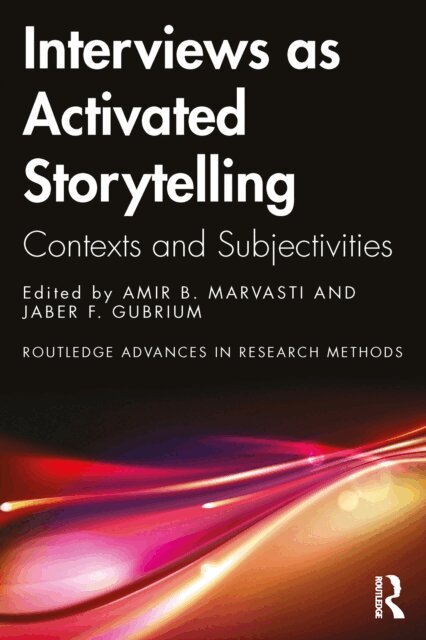
    Interviews as Activated Storytelling

    Contexts and Subjectivities

    AvAmir B. Marvasti,Jaber F. Gubrium

    Inbunden, Engelska, 2025

    Del i serien Routledge Advances in Research Methods

    2 423 kr

    Beställningsvara. Skickas inom 10-15 vardagar. Fri frakt över 249 kr.

    Beskrivning

    Challenging the sanitized view of participants in standardized surveys, Interviews as Activated Storytelling contends that interviewing is a meaning-making process producing useful but context-sensitive knowledge. Through a series of case studies, the book illustrates that participants are not simply there for asking and answering, but inquire and respond in terms of attendant interests and social worlds. Interview interaction and interpretation must take these into account against standardization. In two parts, chapters explore how conditions of the interview process (contexts) and conceptions of interview participants (subjectivities) narratively inform and shape—activate—interviewing and its results. Together with the previously published book Crafting Ethnographic Fieldwork: Sites, Selves, and Social Worlds, insights into the full range of procedural issues in qualitative research are offered.
    Produktinformation

    • Utgivningsdatum:2025-05-30
    • Mått:156 x 234 x 19 mm
    • Vikt:660 g
    • Format:Inbunden
    • Språk:Engelska
    • Serie:Routledge Advances in Research Methods
    • Antal sidor:256
    • Förlag:Taylor & Francis Ltd
    • ISBN:9781032639215

    Utforska kategorier

    • Referensverk och tvärvetenskap inom Samhälle och politik
    • Sociologi inom Samhälle och politik

    Mer om författaren

    Amir B. Marvasti is Professor of Sociology at Penn State Altoona, USA. Amir’s research focuses on identity management in everyday encounters and institutional settings. Using a symbolic interactionist framework, he approaches culture, discourse, and social institutions as interrelated and ongoing practices that collectively shape the self in a social context. His empirical research in this area examines how people (e.g., the homeless) present themselves to others, particularly when required to explain their backgrounds and intentions; and how their self-presentations are related to whether they are helped or accepted by others. Extending his interest in identity management to the subfield of the sociology of emotions, his current research looks at how people narrate their emotions in ways that reinforce gender stereotypes.Jaber F. Gubrium is Emeritus Professor of Sociology at the University of Missouri, USA. The working premise of his research program is that no system of social rules is robust enough to understand its everyday application. Areas of study informed by this are aging and the life course, health and illness, human service organizations, constructions of family, institutional selves, and narrative analysis. Applying a critical constructionism, the goal is to make visible the assemblages of meaning that rationalization erases. Centered on the comparative ethnography of human service settings, he continues to explore and document novelty and pattern in troubles/problems reflexivity within the framework of what Erving Goffman called the “interaction order” and in tandem with a concertedly local brand of Michel Foucault’s concept of “discursive practice.” Jay is also a founding and former editor of the Journal of Aging Studies.

    Innehållsförteckning

    • Introduction Part I: Contexts 1. Interviews as Activated Storytelling Occasions 2. Immigrant Belonging: Meaning-Making in Three Interview Modalities 3. Life as A River: A Metaphor to Activate Marriage Migrants’ Life Stories 4. Navigating Small-Town Complexities: Unraveling Attitudes Through Ethnographic Research 5. Creating Meaning Together: Researcher as Participant, Collaborator, and Interpreter 6. Contextual Dynamics in Interviewing in Institutional and “Free” Settings 7. Activism as an Interpretive Context for Interviewing Part II: Subjectivities 8. Activating Subjectivities in Research Interviews 9. Researching, Interviewing, and Co-Writing the Experiences of a World War II Pilot 10. Activating Prospective Hindsight Through Rehearsal Studios 11. The Active Respondent 12. Minding Whens, Whats, and Hows in Social Movement Oral History Interviews 13. Multi-Active Research Interviews 14. (Re)activated by Objects: Interviewing with and Beyond Unimodal Dialogue Afterword