• Fri frakt över 249 kr
  • •
  • Snabba leveranser
  • •
  • Billiga böcker
Kundservice

Du är på sajten för privatpersoner.

Företag, bibliotek eller offentlig verksamhet?

Du handlar på classic.bokus.com, där alla dina funktioner finns intakta.
Till classic.bokus.com
Bokus logotyp. Gå till startsidan.
  • Erbjudanden
  • Nyheter
  • Student
  • Topplistor
  • Barn & ungdom
  • Bokus Play
  • E-böcker
  • Pocketböcker
  • Spel & pussel

10% rabatt på allt med kod NYSTART10 →

Sidfot

Mina sidor

    Hjälp

    • Kundservice
    • Vanliga frågor och svar
    • Frakt och leverans
    • Retur vid ångerrätt
    • Reklamera vara
    • Betalning
    • Köpvillkor
    • Allmänna villkor
    • Information om webbplatsens tillgänglighet

    Om Bokus

    • Om oss
    • Pressrum
    • För studenter
    • För företag
    • För bibliotek och offentlig verksamhet
    • För leverantörer
    • Hållbarhet

    Populärt

    • Aktuella erbjudanden
    • Presentkort
    • Studentlitteratur
    • Nya böcker
    • Topplistor
    • Signerade böcker
    • Engelska böcker

    Inspiration

    • Boktips
    • BookTok
    • Populära bokserier
    • Barnbokskaraktärer
    • Populära författare
    Logotyp för Bokus
    Följ oss på Facebook (extern länk)Följ oss på Instagram (extern länk)Följ oss på YouTube (extern länk)Följ oss på TikTok (extern länk)
    bokus @ CookiesAnpassa cookiesIntegritetspolicyKöpvillkor
    Till Citymail hemsida (extern länk)Till Budbee hemsida (extern länk)Till Postnord hemsida (extern länk)Till Schenker hemsida (extern länk)Till Early Bird hemsida (extern länk)Till Walleys hemsida (extern länk)
    1. Medicin
    2. Omvårdnad och medicinska stödfunktioner
    3. Biomedicinsk teknik
    • Nyhet

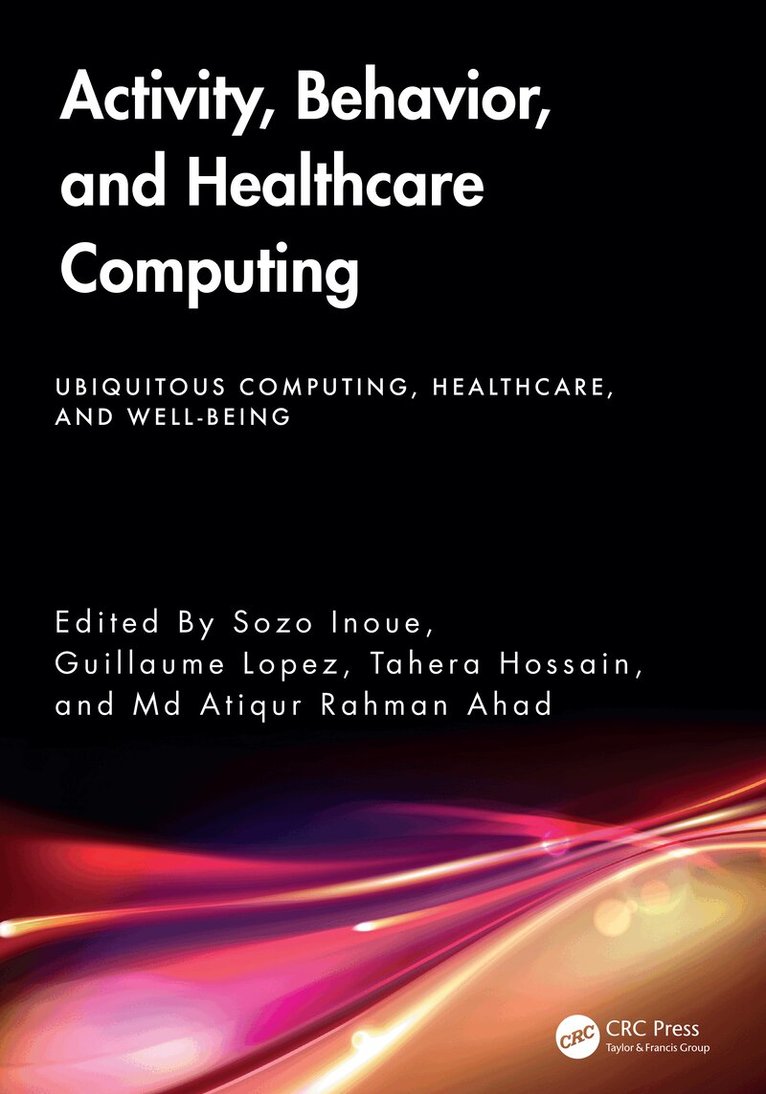
    Activity, Behavior, and Healthcare Computing

    AvSozo Inoue,Guillaume Lopez

    Häftad, Engelska, 2026

    Del i serien Ubiquitous Computing, Healthcare and Well-being

    1 019 kr

    Beställningsvara. Skickas inom 10-15 vardagar. Fri frakt över 249 kr.

    Beskrivning

    Activity, Behavior, and Healthcare Computing relates to the fields of vision and sensor-based human action or activity and behavior analysis and recognition. As well as a series of methodologies, the book includes original methods, exploration of new applications, excellent survey papers, presentations on relevant datasets, challenging applications, ideas and future scopes with guidelines. Featuring contributions from top experts and top research groups globally related to this domain, the book covers action recognition, action understanding, gait analysis, gesture recognition, behavior analysis, emotion and affective computing, healthcare, dementia, nursing, Parkinson’s disease, and related areas. It addresses various challenges and aspects of human activity recognition – both in sensor-based and vision-based domains. This is a unique edited book covering both domains in the field of activity and behavior.

    Produktinformation

    • Utgivningsdatum:2026-07-19
    • Mått:178 x 254 x 19 mm
    • Vikt:680 g
    • Format:Häftad
    • Språk:Engelska
    • Serie:Ubiquitous Computing, Healthcare and Well-being
    • Antal sidor:350
    • Förlag:Taylor & Francis Ltd
    • ISBN:9781032648415

    Utforska kategorier

    • Biomedicinsk teknik inom Medicin
    • Teknik: allmänt inom Naturvetenskap och teknik
    • Artificiell intelligens inom Data och IT

    Mer om författaren

    Sozo Inoue, PhD, is a Professor in the Kyushu Institute of Technology, Japan. His research interests include human activity recognition with smart phones, and healthcare application of web/pervasive/ubiquitous systems. Currently he is working on verification studies in real field applications, and collecting and providing a large-scale open dataset for activity recognition, such as a mobile accelerator dataset with about 35,000 activity data from more than 200 subjects, nurses' sensor data combined with 100 patients' sensor data and medical records, and 34 households' light sensor data set for 4 months combined with smart meter data. Inoue has a Ph.D of Engineering from Kyushu University in 2003. After completion of his degree, he was appointed as an assistant professor in the Faculty of Information Science and Electrical Engineering at the Kyushu University, Japan. He then moved to the Research Department at the Kyushu University Library in 2006. Since 2009, he is appointed as an associate professor in the Faculty of Engineering at Kyushu Institute of Technology, Japan, and moved to Graduate School of Life Science and Systems Engineering at Kyushu Institute of Technology in 2018. Meanwhile, he was a guest professor in Kyushu University, a visiting professor at Karlsruhe Institute of Technology, Germany, in 2014, a special researcher at Institute of Systems, Information Technologies and Nanotechnologies (ISIT) during 2015-2016, and a guest professor at University of Los Andes in Colombia in 2019. He is a technical advisor of Team AIBOD Co. Ltd since 2017, and a guest researcher at RIKEN Center for Advanced Intelligence Project (AIP) since 2017. He is a member of the IEEE Computer Society, the ACM, the Information Processing Society of Japan (IPSJ), the Institute of Electronics, Information and Communication Engineers (IEICE), the Japan Society for Fuzzy Theory and Intelligent Informatics, the Japan Association for Medical Informatics (JAMI), and the Database Society of Japan (DBSJ).Guillaume Lopez, PhD, received an M.E. in Computer Engineering from INSA Lyon, a M.Sc. and a Ph.D. in Environmental Studies from the University of Tokyo in 2000, 2002, and 2005 respectively. He worked as a research engineer at Nissan Motor Corp. from September 2005, and as a project dedicated Assistant Professor at the University of Tokyo from March 2009. In April 2013, he joined Aoyama Gakuin University as an Associate Professor of the Department of Integrated Information Technology. Full Professor since April 2020, his research interests include lifestyle enhancement, skill science, and healthcare support based on intelligent information systems using wearable sensing technology. His professional memberships include the AAAC, ACM, AHI, IEEE, IPSJ, SICE.Tahera Hossain, PhD, is a Postdoctoral Researcher at the Kyushu Institute of Technology, Japan.Md Atiqur Rahman Ahad, PhD, SMIEEE, SMOPTICA, is an Associate Professor of AI and Machine Learning at University of East London, UK; Visiting Professor of Kyushu Institute of Technology, Japan. He worked as a Professor, University of Dhaka (DU); and a Specially Appointed Associate Professor, Osaka University. He studied at the University of Dhaka, University of New South Wales, and Kyushu Institute of Technology. His authored books are: “IoT-sensor based Activity Recognition”; “Motion History Images for Action Recognition and Understanding”; “Computer Vision and Action Recognition”, in Springer along with several edited books. He published ~200 peer-reviewed papers, ~150 keynote/invited talks, ~40 Awards/Recognitions. He is an Editorial Board Member of Scientific Reports, Nature; Assoc. Editor of Frontiers in Computer Science; Editor of Int. Journal of Affective Engineering; Editor-in-Chief: Int. Journal of Computer Vision & Signal Processing http://cennser.org/IJCVSP; General Chair: 10th ICIEV http://cennser.org/ICIEV; 5th IVPR http://cennser.org/IVPR; 4th ABC https://abc-research.github.io, Guest-Editor: Pattern Recognition Letters, Elsevier; JMUI, Springer; JHE, Hindawi; IJICIC; Member: ACM, IAPR. More: http://AhadVisionLab.com

    Innehållsförteckning

    • ForewordPrefaceAcknowledgmentsAbout the EditorsPart 1: Activity and BehaviorChapter 1: PressureTransferNet: Human Attribute Guided Dynamic Ground Pressure Profile Transfer using 3D Simulated Pressure MapsChapter 2: SIMUAug: Variability-aware Data Augmentation for Wearable IMU using Physics SimulationChapter 3: Estimation of Muscle Activation during Complex Movement using Unsupervised Motion Primitives Decomposition of Limb KinematicsChapter 4: Pitcher Identification Method using an Accelerometer and Gyroscope Embedded in a BaseballChapter 5: Design and Implementation of a Long-Casting Support System for Lure Fishing using an AccelerometerChapter 6: Contrastive Left-Right Wearable Sensors (IMUs) Consistency Matching for HARChapter 7: Estimation Method of Doneness for Boiled Eggs and Diced Steaks using Active Acoustic SensingPart 2: HealthcareChapter 8: Older Adults Daily Mobility and Its Connection to DEMMIChapter 9: Subjective Stress and Heart Rate Variability Patterns: A Study on Harassment DetectionChapter 10: Analysis of Physiological Variances in Thermal Comfort among IndividualsChapter 11: Personal Thermal Assessment using Feature Reduction and Machine Learning TechniquesChapter 12: Analysis of Personal Thermal State using Machine Learning Algorithms to Prevent HeatstrokeChapter 13: Ensemble Learning Models-Based Prediction of Personal Thermal Assessment Aimed at Heatstroke PreventionChapter 14: Predicting Heatstroke Risk and Preventing Health Complications: An Innovative Approach Using Machine Learning and Physiological DataChapter 15: Predictive Modeling for Heatstroke Risk Forecasting Integrating Physiological Features Using Ensemble ClassifierChapter 16: Clustering-Based Feature Selection and Stacked Generalization Method to Offset Imbalanced Data for Thermal Stress AssessmentChapter 17: Enhancing Personalized Heatstroke Prevention: Forecasting Thermal Comfort Sensations through Data-Driven ModelsChapter 18: Advancing Heatstroke Prevention: Integrating Physiological Data for Enhanced Thermal Comfort ForecastingChapter 19: Intrapatient Forecasting of Parkinson’s Wearing-Off by Analyzing Data from Wrist-Worn Fitness Tracker and SmartphoneChapter 20: Foreseeing Wearing-Off State in Parkinson’s Disease Patients: A Multimodal Approach with the Usage of Machine Learning and WearablesChapter 21: Wearable Technology-Enabled Prediction of Wearing-Off Phenomenon in Parkinson's Disease: A Personalized Approach Using LSTM-Based Time-Series AnalysisChapter 22: Forecasting Parkinson’s Patient’s Wearing-Off Periods by Employing Stacked Super LearnerChapter 23: Forecasting Wearing-Off in Parkinson’s Disease: An Ensemble Learning Approach Using Wearable DataChapter 24: Forecasting the Wearing-Off Phenomenon in Parkinson’s Disease: Summarized Approaches and Insights