• Fri frakt över 249 kr
  • •
  • Snabba leveranser
  • •
  • Billiga böcker
Kundservice

Du är på sajten för privatpersoner.

Företag, bibliotek eller offentlig verksamhet?

Du handlar på classic.bokus.com, där alla dina funktioner finns intakta.
Till classic.bokus.com
Bokus logotyp. Gå till startsidan.
  • Erbjudanden
  • Nyheter
  • Student
  • Topplistor
  • Barn & ungdom
  • Bokus Play
  • E-böcker
  • Pocketböcker
  • Spel & pussel

10% rabatt på allt med kod: NYSTART10 →

Sidfot

Mina sidor

    Hjälp

    • Kundservice
    • Vanliga frågor och svar
    • Frakt och leverans
    • Retur vid ångerrätt
    • Reklamera vara
    • Betalning
    • Köpvillkor
    • Allmänna villkor
    • Information om webbplatsens tillgänglighet

    Om Bokus

    • Om oss
    • Pressrum
    • För studenter
    • För företag
    • För bibliotek och offentlig verksamhet
    • För leverantörer
    • Hållbarhet

    Populärt

    • Aktuella erbjudanden
    • Presentkort
    • Studentlitteratur
    • Nya böcker
    • Topplistor
    • Signerade böcker
    • Engelska böcker

    Inspiration

    • Boktips
    • BookTok
    • Populära bokserier
    • Barnbokskaraktärer
    • Populära författare
    Logotyp för Bokus
    Följ oss på Facebook (extern länk)Följ oss på Instagram (extern länk)Följ oss på YouTube (extern länk)Följ oss på TikTok (extern länk)
    bokus @ CookiesAnpassa cookiesIntegritetspolicyKöpvillkor
    Till Citymail hemsida (extern länk)Till Budbee hemsida (extern länk)Till Postnord hemsida (extern länk)Till Schenker hemsida (extern länk)Till Early Bird hemsida (extern länk)Till Walleys hemsida (extern länk)
    1. Samhälle och politik
    2. Social välfärd och brottslighet
    3. Socialt arbete och välfärd

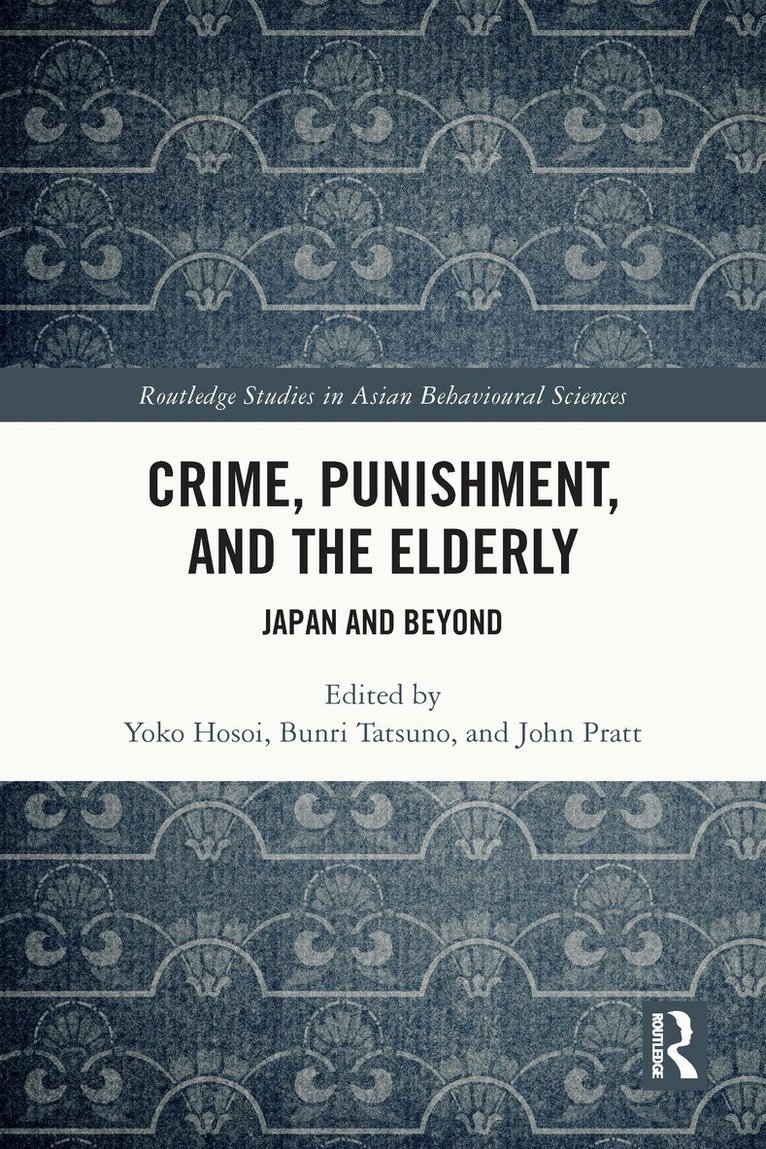
    Crime, Punishment, and the Elderly

    Japan and Beyond

    AvYoko Hosoi,Bunri Tatsuno

    Häftad, Engelska, 2025

    Del i serien Routledge Studies in Asian Behavioural Sciences

    681 kr

    Beställningsvara. Skickas inom 10-15 vardagar. Fri frakt över 249 kr.

    Beskrivning

    Hosoi, Tatsuno and Pratt examine the realities, problems and backgrounds of crimes committed by elderly people in both Japan and international perspectives.Japan’s aging population is a commonly known issue globally, and the world looks to Japan to understand the issues that other nations may experience in the future. One such aspect is an increase in crimes committed by the elderly. According to the National Police Agency in Japan, the proportion of elders arrested for committing theft has doubled over the past 10 years. The chapters in this volume look to answer questions around the reason for elder crime, the types of crime and punishment that exists in this cohort of society and how this increasingly large problem in society can be managed.This book offers important insights into the societal issues and potential solutions for aging societies around the world. It will be a valuable research reference for scholars of mental health, criminology, population studies and Asian studies.

    Produktinformation

    • Utgivningsdatum:2025-06-27
    • Mått:156 x 234 x 19 mm
    • Vikt:451 g
    • Format:Häftad
    • Språk:Engelska
    • Serie:Routledge Studies in Asian Behavioural Sciences
    • Antal sidor:262
    • Förlag:Taylor & Francis Ltd
    • ISBN:9781032669472

    Utforska kategorier

    • Socialt arbete och välfärd inom Samhälle och politik
    • Kriminalvård och straff inom Samhälle och politik

    Mer om författaren

    Yoko Hosoi is Emeritus Professor of Sociology at Toyo University, Tokyo, Japan.Bunri Tatsuno is an adjunct researcher in Criminal Justice Policy at Kokushikan University, Japan.John Pratt is Emeritus Professor of Criminology at the Institute of Criminology, Victoria University of Wellington, New Zealand.

    Innehållsförteckning

    • ContentsPrefaceIntroduction1. What is the current issue: Indications by Western researchers2. Theoretical framework of the research: Focusing on the concept of “Lifeworld”3. Composition of the book4. Goal of the bookSection 1: Considering the Society and Elderly CriminalsChapter 1. Social Circumstances Surrounding the Elderly: Twenty-year Trends1. Changes in population composition2. Changes in social security schemes3. The arrival of a society of disparities4. Two miscalculations pertaining to a Japanese-type welfare societyChapter 2. Study of Social Exclusion and Inclusion in a Post-Welfare State Society: From C. Gilligan's Perspective of "Care"The problem of aging and social reintegration1. From the dilemma of moral norms to the relationship of support2. From the second modern age to the third3. Vulnerability and inclusion4. Social Inclusion of deviant individualsChapter 3. The Actual Situation of Crimes by the Elderly in Japan: Based on Crime Statistics, the Ministry of Justice's Research Report, and Special Investigation1. Overview of crime statistics2. Picture of elderly criminals: according to a special investigation conducted by the Ministry of Justice (2013–2015)3. Recidivism on the part of elderly criminalsChapter 4. Reintegrating Elderly Criminals into the Society: From the Standpoint of Judicial Welfare1. Introduction2. Rehabilitation process of elderly ex-criminals observed in the interview-based survey3. How to see elderly criminals4. Policy on the reintegration of elderly criminals and perpetrators into society5. ConclusionChapter 5. Rehabilitation Process of Elderly Ex-criminals: Analysis of Interview Sessions with Elderly Ex-criminals Who Received Support at Relief and Rehabilitation Facilities1. Interviewee2. Interview methods3. Interviews analysis4. Life of elderly ex-criminalsChapter 6. Duplication of Social Poverty: Elderly Criminals and Homeless People1. Post-modernity and selective relationship that becomes the mainstream in society2. Social poverty: Homeless people and elderly crimes3. Two types of support for elderly criminals: Judicial and welfare system collaboration4. Life history and social rehabilitation of elderly criminals: A case study5. ConclusionsSection II Characteristics of Elderly Criminals Based on Surveys on Elderly Inmates in Japan (survey conducted in 2012, 2016, and 2017)Chapter 1. Survey of Elderly Inmates: Outline and Results of Research on Elderly Male and Female Prisoners (2012 Survey, 2016 Survey, and 2017 Survey)1. Summary of the elderly inmate surveys (2012 Survey, 2016 Survey, and 2017 Survey)2. Results of and discussion concerning the 2016 survey3. Results of and discussion concerning the 2017 survey4. Summary of the “Survey of Elderly Inmates”Chapter 2: Typology of Elderly Male & Female Prisoners on Their Awareness: From Results of 2012 survey and Free-Answer Survey1. Four types of elderly convicts – “the 2012 survey”2. Through a “free-answer survey” of previous term’s elderly convicts (40 years and older)3. DiscussionChapter 3: The Needs of Restorative Justice for Senior Criminal Women in JapanSevere punishment, medicalization, or restorative justice?Chapter 4: Social Position and “Self Perception” of Elder Female Inmates1. Awareness of the problem2. Women of the "underclass," a new class in Japanese society, as seen in the SSM survey of sociology3. Female prisoners and the underclass4. "Female prisoners" and "general female workers"5. ConclusionsSection III Trends and Issues in Elderly Crime From Around the WorldChapter 1: Trends in Crimes Committed by the Elderly and Laws regarding “Sexual Crimes” in New Zealand1. Introduction2. The current situation of elderly convicts in New Zealand3. Sexual crimes and laws in New Zealand4. Recent legislation related to sexual crimes in New Zealand5. ConclusionsChapter 2: ‘No Country for Old Men.’ The Experiences of Elderly Inmates in New Zealand1. The pains of imprisonment as experienced by elderly inmates2. ConclusionChapter 3. The State of Elderly Criminals in Australia1. Purpose of this chapter2. Aging and social security situation in Australia3. Situation of elderly criminals4. ConclusionChapter 4. Older Prisoners in New South Wales, Australia1. Background2. Method3. Results4. Preliminary survey analysis5. DiscussionChapter 5. Rehabilitation Services for Elderly Prisoners in Hong Kong1. Introduction2. The correctional services in Hong Kong3. Tailor-made services for elderly prisoners –The Evergreen Garden4. Hong Kong elderly prisoners survey5. ConclusionChapter 6. Trends in the Aging Prison Population of England and Wales1. Introduction/rationale2. Background of crimes by older people and incarceration3. Re-entry/resettlement of elderly prisoners4. Reasons for re-offending5. ConclusionSection IV A Comparative Cultural Study on Elderly Crime: Results of a Joint Questionnaire Survey in Four Countries (New Zealand, Hong Kong, Australia, and Japan)Chapter 1. Comparison between New Zealand and Japan1. A comparison between characteristics of elderly convicts from Japan and New Zealand2. The Image of Elderly Convicts: Comparison between New Zealand and Japan seen from Interview Surveys3. DiscussionsChapter 2. Comparison of prisoners in New Zealand, Hong Kong, Australia, and Japan1. Survey methodology2. Living conditions3. Life after release4. SummarySummary and Conclusions: What We Learn and Pass on from Research on Elderly Crimes1. Social background for the increase of theft and its repetition in Japan2. The background of the high rate of sexual crimes among the elderly in English-speaking countries: Situations in New Zealand, Australia, and the United Kingdom3. The lifeworld of elderly criminals: A joint survey of Japan and New Zealand4. Crimes by elderly women: Women’s unique life course and awakening of the “self”5. Cooperation and distance between justice and welfare for elderly criminals: Focusing on entrance and exit supports6. Rehabilitation process of elderly criminals: How to expand “self-reliance”ReferencesQuestionnaire (2016 Survey)