• Fri frakt över 249 kr
  • •
  • Snabba leveranser
  • •
  • Billiga böcker
Kundservice

Du är på sajten för privatpersoner.

Företag, bibliotek eller offentlig verksamhet?

Du handlar på classic.bokus.com, där alla dina funktioner finns intakta.
Till classic.bokus.com
Bokus logotyp. Gå till startsidan.
  • Erbjudanden
  • Nyheter
  • Student
  • Topplistor
  • Barn & ungdom
  • Bokus Play
  • E-böcker
  • Pocketböcker
  • Spel & pussel

10% rabatt på allt med kod: NYSTART10 →

Sidfot

Mina sidor

    Hjälp

    • Kundservice
    • Vanliga frågor och svar
    • Frakt och leverans
    • Retur vid ångerrätt
    • Reklamera vara
    • Betalning
    • Köpvillkor
    • Allmänna villkor
    • Information om webbplatsens tillgänglighet

    Om Bokus

    • Om oss
    • Pressrum
    • För studenter
    • För företag
    • För bibliotek och offentlig verksamhet
    • För leverantörer
    • Hållbarhet

    Populärt

    • Aktuella erbjudanden
    • Presentkort
    • Studentlitteratur
    • Nya böcker
    • Topplistor
    • Signerade böcker
    • Engelska böcker

    Inspiration

    • Boktips
    • BookTok
    • Populära bokserier
    • Barnbokskaraktärer
    • Populära författare
    Logotyp för Bokus
    Följ oss på Facebook (extern länk)Följ oss på Instagram (extern länk)Följ oss på YouTube (extern länk)Följ oss på TikTok (extern länk)
    bokus @ CookiesAnpassa cookiesIntegritetspolicyKöpvillkor
    Till Citymail hemsida (extern länk)Till Budbee hemsida (extern länk)Till Postnord hemsida (extern länk)Till Schenker hemsida (extern länk)Till Early Bird hemsida (extern länk)Till Walleys hemsida (extern länk)
    1. Djur och Natur
    2. Naturböcker
    3. Växtböcker

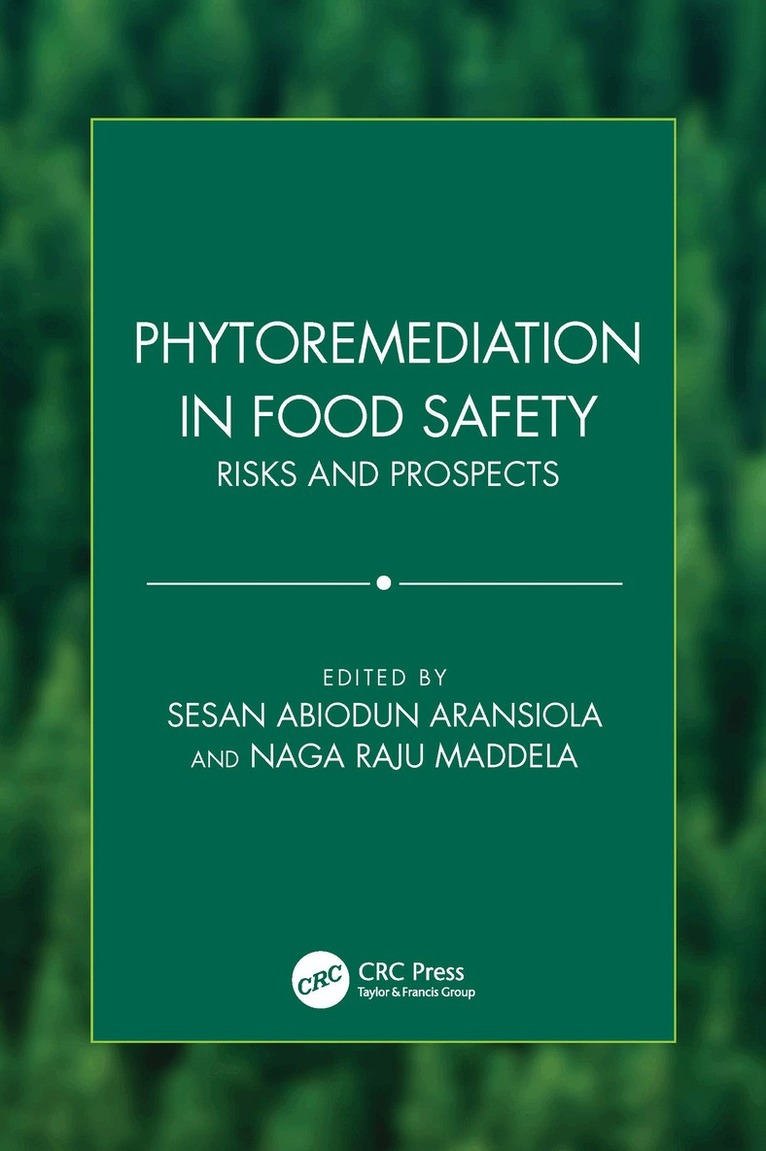
    Phytoremediation in Food Safety

    Risks and Prospects

    AvSesan Abiodun Aransiola,Naga Raju Maddela

    Inbunden, Engelska, 2024

    2 056 kr

    Beställningsvara. Skickas inom 10-15 vardagar. Fri frakt över 249 kr.

    Beskrivning

    Phytoremediation is the process that uses plants to remove pollutants from soils. These pollutants are stored in the edible parts of plants and, if they are consumed above a certain level, they become a health risk for humans and animals. This book is a critical review of phytoremediation, its direct or indirect effects on food products, and the risks posed by this cost-effective technology in food safety. It shows how different plants are suited for phytoremediation, explains the role of toxicants in the environment, and analyses their effects and risks in the food chain at a global level. It also reviews the extraction methods of toxicants from plants after they are exposed to phytoremediation.Features:Summarizes the phytoremediation technology for effective remediationDescribes different types of pollutants in soils that render food products uselessIdentifies the role of phytoremediation in the environment and its advantages and disadvantagesExplains the role of phytoexclusion and phytostabilization in foods and food safetyIncludes many case studies to describe the extraction protocols in postharvest for food safetyThis book is intended for practitioners in public and private companies involved in soil remediation and food production, as well as graduate students and academics, in both developed and developing countries, who are involved in soil and environmental sciences, the food industry, agriculture, and biotechnology.

    Produktinformation

    • Utgivningsdatum:2024-09-13
    • Mått:178 x 254 x 21 mm
    • Vikt:453 g
    • Format:Inbunden
    • Språk:Engelska
    • Antal sidor:280
    • Förlag:Taylor & Francis Ltd
    • ISBN:9781032683744

    Utforska kategorier

    • Växtböcker inom Djur och Natur
    • Geovetenskap inom Naturvetenskap och teknik
    • Botanik inom Naturvetenskap och teknik

    Mer om författaren

    Dr. Sesan Abiodun Aransiola is a Ph.D holder in Environmental Microbiology in the Department of Microbiology, Federal University of Technology, Minna, Nigeria. He obtained his first degree (B.Tech) and Master's Degree (M.Tech) from the same department in 2009 and 2014 respectively. Currently, he is a Lecturer at the Department of Microbiology, University of Abuja, Nigeria. His area of interest is Environmental Microbiology with a research area in phytoremediation, vermicomposting, biosorption, and bioremediation of soil-contaminated environments. He is an award-winning researcher and has over 70 publications including book chapters, research, and review articles of good international repute with high impact factor. He has worked to the rank of an assistant chief scientific officer at the Bioresources Development Centre, National Biotechnology Development Agency, NigeriaDr. Naga Raju Maddela is a Professor at the Facultad de Ciencias de la Salud, Universidad Técnica de Manabí, Portoviejo, Ecuador. He received his M.Sc. in 1998 and his Ph.D. in 2012 in Microbiology from Sri Krishnadevaraya University, Anantapuramu, India. He worked as Prometeo Investigator at Universidad Estatal Amazónica, Ecuador from 2013 to 2015, and was on Postdoctoral Fellowship at Sun Yat-sen University, China from 2016 to 2018. He has participated in national and international conferences and has presented research data in China, Cuba, Ecuador, India, and Singapore. He has been actively publishing scientific articles, books, and chapters, both authored and edited, since 2007. He has published 80 articles, 10 books, and 40 book chapters.

    Innehållsförteckning

    • Section 1: Prospects of Phytoremediation for a Safe Environment and Safe Food. 1. Phytoremediation Overviews and Roles in Food Safety. 2. Phytoremediation and Role in Climate Change for a Safe Environment. 3. Organic and Inorganic Pollutant Uptake Mechanisms by Plants. 4. Soil Regeneration through Phytoremediation for Safe Foods. 5. Environmental Pollution: Causes, Types, Fate, Effects and Control Strategies. 6. Mechanism of Phytoremediation and Plant Uptake of Heavy Metals. Section 2: The Risks of Phytoremediation in Food Safety. 7. Danger of Contaminants in Foods through Phytoremediation. 8. Micro and Nano-plastics in Soil: Plant Uptake and Impact on Food Insecurity. 9. Environmental Pollution and How Toxic Elements Enter the Food Chain. 10. Acute and Chronic Effects of Contaminants from Food Crops. 11. Plant Uptake of Emerging Contaminants in Foods: The Extent of its Effects. 12. Impact of Contamination of Agricultural Soil on Man and the Environment. Section 3: Bringing Safe Foods Home through Phytoremediation. 13. Phytoexclusion and Phytostabilization: Protective Strategy of the Food Chain from Contamination before Phytoremediation. 14. Phytoremediation: Strategies for Protecting the Food Chain from Contamination. 15. Phytoremediation and Food Safety Case Studies. 16. Phytoremediation: A Comprehensive Review on the Prospective Benefits and Biosafety of Vegetables. 17. Soil Assessment Policies and the Permissible Level of Contaminants in Plant Food Products. 18. Plant Uptake of Emerging Contaminants in Foods: Regulatory Considerations and Future Directions. 19. Toxic Metals and Emerging Contaminants in Food: A Global Perspective.