• Fri frakt över 249 kr
  • •
  • Snabba leveranser
  • •
  • Billiga böcker
Kundservice

Du är på sajten för privatpersoner.

Företag, bibliotek eller offentlig verksamhet?

Du handlar på classic.bokus.com, där alla dina funktioner finns intakta.
Till classic.bokus.com
Bokus logotyp. Gå till startsidan.
  • Erbjudanden
  • Nyheter
  • Student
  • Topplistor
  • Barn & ungdom
  • Bokus Play
  • E-böcker
  • Pocketböcker
  • Spel & pussel

Må bättre, för mindre! Upp till 50% rabatt på hälsoböcker

Sidfot

Mina sidor

    Hjälp

    • Kundservice
    • Vanliga frågor och svar
    • Frakt och leverans
    • Retur vid ångerrätt
    • Reklamera vara
    • Betalning
    • Köpvillkor
    • Allmänna villkor
    • Information om webbplatsens tillgänglighet

    Om Bokus

    • Om oss
    • Pressrum
    • För studenter
    • För företag
    • För bibliotek och offentlig verksamhet
    • För leverantörer
    • Hållbarhet

    Populärt

    • Aktuella erbjudanden
    • Presentkort
    • Studentlitteratur
    • Nya böcker
    • Topplistor
    • Signerade böcker
    • Engelska böcker

    Inspiration

    • Boktips
    • BookTok
    • Populära bokserier
    • Barnbokskaraktärer
    • Populära författare
    Logotyp för Bokus
    Följ oss på Facebook (extern länk)Följ oss på Instagram (extern länk)Följ oss på YouTube (extern länk)Följ oss på TikTok (extern länk)
    bokus @ CookiesAnpassa cookiesIntegritetspolicyKöpvillkor
    Till Citymail hemsida (extern länk)Till Budbee hemsida (extern länk)Till Postnord hemsida (extern länk)Till Schenker hemsida (extern länk)Till Early Bird hemsida (extern länk)Till Walleys hemsida (extern länk)
    1. Samhälle och politik
    2. Samhälle och kultur
    3. Kultur och medier
    4. Kulturvetenskap

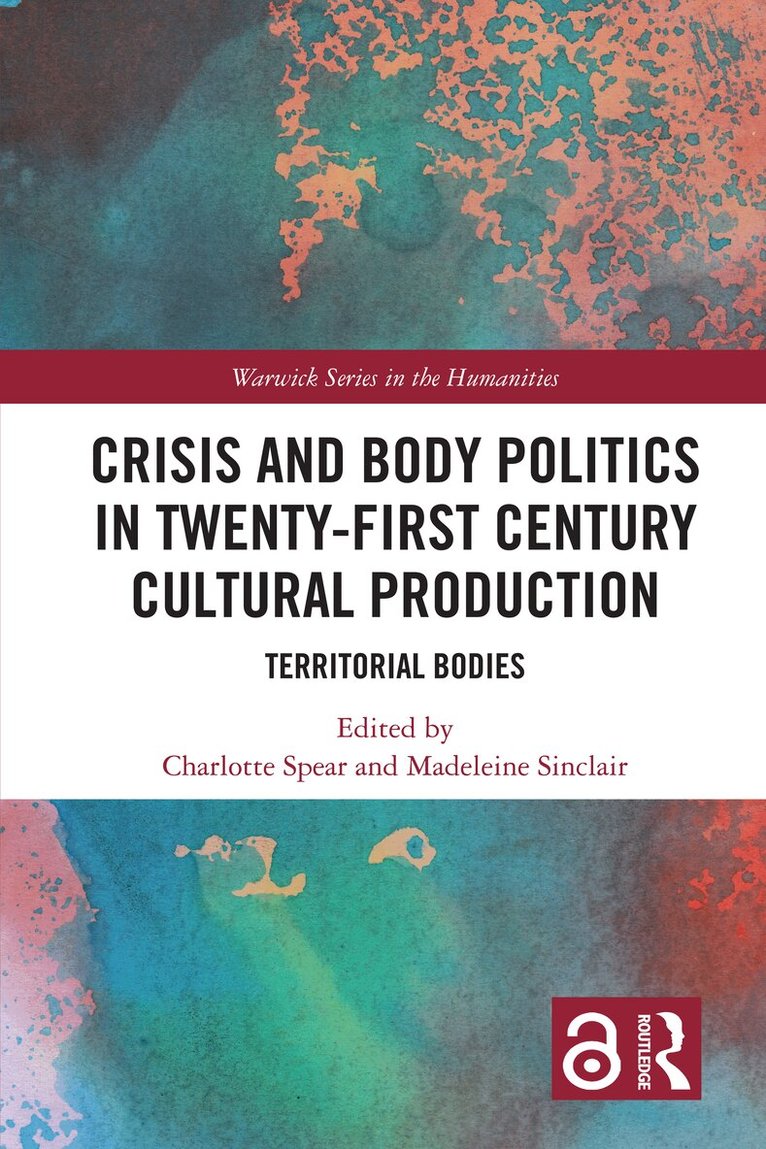
    Crisis and Body Politics in Twenty-First Century Cultural Production

    Territorial Bodies

    AvCharlotte Spear,Madeleine Sinclair

    Inbunden, Engelska, 2025

    Del i serien Warwick Series in the Humanities

    2 434 kr

    Beställningsvara. Skickas inom 10-15 vardagar. Fri frakt över 249 kr.

    Beskrivning

    The twenty-first century has been deemed the “Age of Crisis”. We are witnessing the catastrophic unfolding of environmental crisis, financial crisis, pandemic and conflict. But are we to understand these crises as new phenomena? Is their seemingly simultaneous existence purely coincidental? Or rather do they instead form part of a singular, historically produced, unfolding crisis, which only today has reached a generalised consciousness? And perhaps most urgently, how far can we separate the crises of human experience from those exacted upon the land?The chapters collected in Crisis and Body Politics in Twenty-First Century Cultural Production: Territorial Bodies deploy the framework of “Territorial Bodies” to address urgent social, ecological and political challenges. Examining themes such as (inter)national bodily governance, racialised bodies, eco-feminist movements, spatial justice and bodily displacement, this collection provides a deeper analysis of the interconnected forms of violence perpetrated against marginalised human and non-human bodies, taking this combined violence as the defining feature of contemporary crisis.The Open Access version of this book, available at http://www.taylorfrancis.com, has been made available under a Creative Commons [Attribution-Non Commercial-No Derivatives (CC BY-NC-ND)] 4.0 license.

    Produktinformation

    • Utgivningsdatum:2025-01-31
    • Mått:152 x 229 x 16 mm
    • Vikt:557 g
    • Format:Inbunden
    • Språk:Engelska
    • Serie:Warwick Series in the Humanities
    • Antal sidor:202
    • Förlag:Taylor & Francis Ltd
    • ISBN:9781032689036

    Utforska kategorier

    • Kulturvetenskap inom Samhälle och politik
    • Genusvetenskap inom Samhälle och politik
    • Miljövetenskap och miljöpolitik inom Naturvetenskap och teknik

    Mer om författaren

    Charlotte Spear is a PhD candidate in English and Comparative Literary Studies at the University of Warwick. Her thesis is titled “Locating the Human: World Literature and the Concept of Rights” and explores the role of literature in rethinking dominant human rights frameworks. She has published on the notion of the “state of emergency” in Modern Language Review, on refugee–migrant fiction in Journal of Postcolonial Writing, on postcolonial humanitarian intervention with De Gruyter and on sex workers’ rights in debt economies in The Journal of World-Systems Research.Madeleine Sinclair is a Comparative Literature PhD candidate and Early Career Teaching Fellow in the Institute for Advanced Teaching and Learning at University of Warwick, UK. Entitled “World-Literature, Neoliberalism and the Politics of the Twenty-First Century Short Story-Cycle”, her Wolfson Foundation-funded PhD thesis foregrounded the short story as a distinctive genre in world-literature by examining the interconnections between aesthetics and politics in contemporary short fictional forms. Her work is published, or forthcoming, in Literature Compass, Journal of World-Systems Research and Journal of Short Fiction in Theory and Practice. She is guest editor of a special issue on “Short Fiction: Landscape and Temporality”, forthcoming with the Journal of Short Fiction in Theory and Practice.

    Recensioner i media

    This vibrant collection is timely and forceful in its address of the manifold crisis of capital and ecology unfolding in the late neoliberal era. Mobilizing and extending Verónica Gago’s concept of body-territory in salutary new ways, the essays in the volume are exciting in their interdisciplinary range, bringing together important strands of feminist and environmental thought to offer powerful critiques of the intertwined forces of capitalist accumulation, extractivism, racism, and heteropatriarchal and colonial violence in different global geographies. Crucially, they focus on bodies as not only sites of oppression, but also foreground the ‘protesting body’ as figure and material agent in territories of resistance and insubordination, both in the form of organized politics and collectivities and in the realms of culture, philosophy, and aesthetics.Sharae Deckard, Lecturer in World Literature at the School of English, Drama, and Film University College Dublin, IrelandThis book is essential reading for our politically uncertain times. With its ambitious scope and masterful execution, Spear and Sinclair have curated a vital collection of chapters that explore the body as a central terrain of resistance and refusal. The authors delve deep into our contemporary perma-crisis, compelling us to rethink the concept of ‘crisis’ and the complex webs of socio-ecological violence spanning the past, present, and future. From ecological breakdown to oceanic geographies, and from extractive violence to postcolonial spaces, this book provides an eye-opening and timely perspective. By intersecting gender, race, and coloniality, the authors reveal the profound entanglements between bodies and territories, human and extra-human natures, posing critical questions about embodied ways of knowing and resisting structural violence. Spear and Sinclair guide readers through an incisive critique of this political moment and the uneven histories that shape it. I highly recommend Crisis and Body Politics in Twenty-first Century Cultural Landscapes: Territorial Bodies for anyone seeking to understand the complex dynamics of our era.Thom Davies, Associate Professor in Geography, University of Nottingham and co-editor of Toxic TruthsDrawing inspiration from the Latin American feminist thinking of body-territory, Crisis and Body Politics brings together an exciting variety of different analyses of spatialised embodiment. This extraordinary book more than delivers on its promise to reconstruct our ways of seeing the multivalent crises that mark our times. Illan Wall, Lecturer, School of Law, University of Galway, IrelandTerritorial Bodies offers exciting new perspectives on the interrelations of territory, embodiment, culture, and the environment. Globally diverse in its geographical foci and innovative in its theoretical approaches, the book persuasively locates the body as the site where our age’s multiple crises intersect. Scholars in a variety of fields – from literature and visual culture to geography, postcolonial theory, and gender studies – will find important insights into bodies as and in spaces of crisis in this wide-ranging yet meticulously organized volume.Paul Crosthwaite, Professor of Modern and Contemporary Literature, University of Edinburgh, ScotlandTerritorial Bodies features a provocative chorus of voices that offers a much-needed insight into embodied experiences of gender and racial violence, dispossession, and colonial displacement across the globe. At its core is the Latin American feminist concept of ‘body-territory’, the idea that lands and bodies are entangled and mutually constituted. The cultural narratives explored here compellingly contest the neoliberal notion of the body as individual property and celebrate the vibrant alliances formed by human and more-than-human bodies. That makes this carefully edited book an essential contribution to debates about the current ecological and political crisis.Jordana Blejmar, Senior Lecturer in Visual Media and Cultural Studies, University of Liverpool, UK

    Innehållsförteckning

    • AcknowledgementsList of ContributorsIntroduction: Territorial Bodies in CrisisI: Aquatic Bodies Inhuman Futures: Unmooring Extractivism through Drexciyan Afrofuturism Feminist Aquapelagic Relational Bodies in Mussiro Women of Ibo Island: Diving in Submerged/Emergent Praxes Of Existence, Resistance and Peace in/with the Oceans Troubled Waters: Thin Places, the Troubles, and Nature WritingII: Bodily IntegrityTranscorporeal Alliances: Mapping the Territorial Bodies in Middle Eastern Women’s Video Art The Breaking of the Body: Blackness, Nature, and Animality in David Dabydeen’s Slave Song III: De-Territorial Bodies Tracking the Politics of (De)Territorial Language in Postcolonial AlgeriaTerritories of Transition: Navigating Trans Embodiment, Identity, and Activism in Neoliberal Landscapes IV: Bodily Futures Inscribed Capital, Human Bodies: Interpellating Contemporary World Bank Expressions The Ghosts We See From the Mountains: Scenario Planning and the Territorial Body in Time Peasant Futurisms rooted in Body-as-Territory: how Peasant Practices of Subsistence Farming and Food Sovereignty Challenge the Hegemony of Late Capitalism Index