• Fri frakt över 249 kr
  • •
  • Snabba leveranser
  • •
  • Billiga böcker
Kundservice

Du är på sajten för privatpersoner.

Företag, bibliotek eller offentlig verksamhet?

Du handlar på classic.bokus.com, där alla dina funktioner finns intakta.
Till classic.bokus.com
Bokus logotyp. Gå till startsidan.
  • Erbjudanden
  • Student
  • Topplistor
  • Barn & ungdom
  • Bokus Play
  • E-böcker
  • Ljudböcker
  • Pocketböcker
  • Spel och pussel

Pocketfynda! Hundratals böcker för 49 kr/st →

Sidfot

Mina sidor

    Hjälp

    • Kundservice
    • Vanliga frågor och svar
    • Frakt och leverans
    • Retur vid ångerrätt
    • Reklamera vara
    • Betalning
    • Köpvillkor
    • Allmänna villkor
    • Information om webbplatsens tillgänglighet

    Om Bokus

    • Om oss
    • Pressrum
    • För studenter
    • För företag
    • För bibliotek och offentlig verksamhet
    • För leverantörer
    • Hållbarhet

    Populärt

    • Aktuella erbjudanden
    • Presentkort
    • Studentlitteratur
    • Nya böcker
    • Topplistor
    • Signerade böcker
    • Engelska böcker

    Inspiration

    • Boktips
    • BookTok
    • Barnbokskaraktärer
    • Populära författare
    Logotyp för Bokus
    Följ oss på Facebook (extern länk)Följ oss på Instagram (extern länk)Följ oss på YouTube (extern länk)Följ oss på TikTok (extern länk)
    bokus @ CookiesAnpassa cookiesIntegritetspolicyKöpvillkor
    Till Citymail hemsida (extern länk)Till Budbee hemsida (extern länk)Till Postnord hemsida (extern länk)Till Schenker hemsida (extern länk)Till Early Bird hemsida (extern länk)Till Walleys hemsida (extern länk)
    1. Samhälle och politik
    2. Sociologi och antropologi
    3. Antropologi

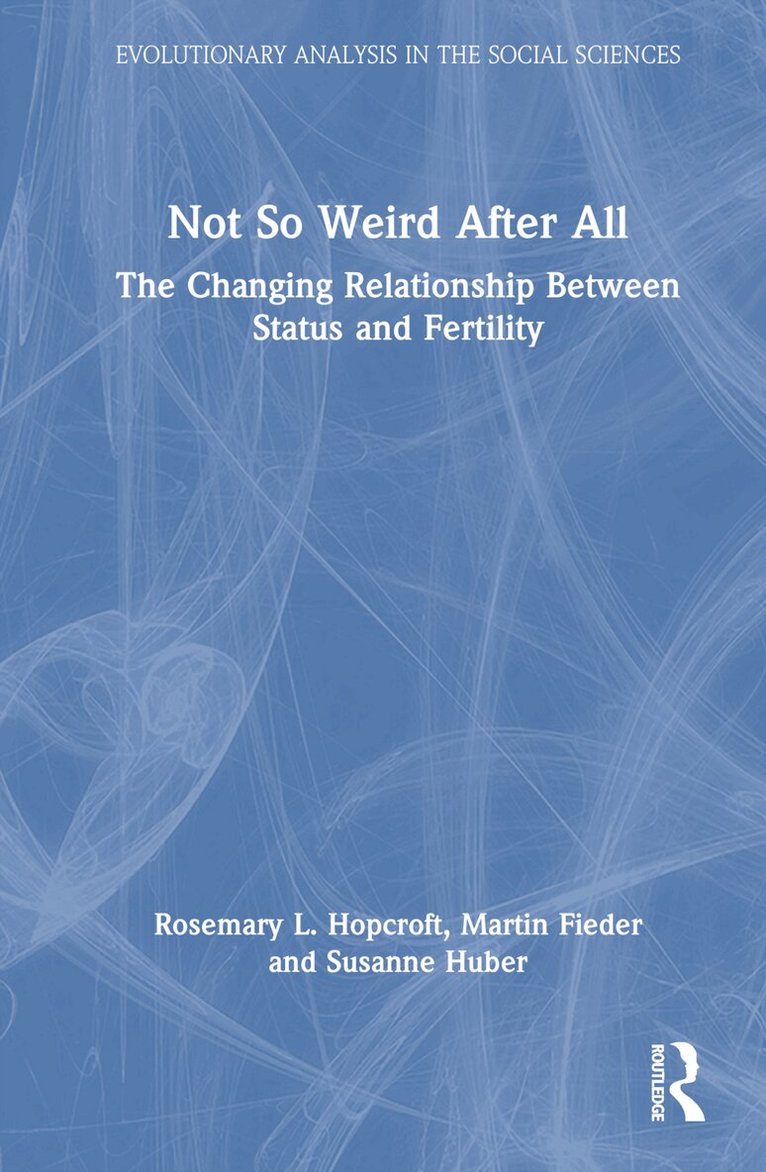
    Not So Weird After All

    The Changing Relationship Between Status and Fertility

    AvRosemary L. Hopcroft,Martin Fieder

    Inbunden, Engelska, 2024

    Del i serien Evolutionary Analysis in the Social Sciences

    2 410 kr

    Beställningsvara. Skickas inom 10-15 vardagar. Fri frakt över 249 kr.

    Fler format och utgåvor

    Häftad

    580 kr

    Beskrivning

    This is the first book to fully examine, from an evolutionary point of view, the association of social status and fertility in human societies before, during, and after the demographic transition. In most nonhuman social species, social status or relative rank in a social group is positively associated with the number of offspring, with high-status individuals typically having more offspring than low-status individuals. However, humans appear to be different. As societies have gotten richer, fertility has dipped to unprecedented lows, with some developed societies now at or below replacement fertility. Within rich societies, women in higher-income families often have fewer children than women in lower-income families. Evolutionary theory suggests that the relationship between social status and fertility is likely to be somewhat different for men and women, so it is important to examine this relationship for men and women separately. When this is done, the positive association between individual social status and fertility is often clear in less-developed, pre-transitional societies, particularly for men. Once the demographic transition begins, it is elite families, particularly the women of elite families, who lead the way in fertility decline. Post-transition, the evidence from a variety of developed societies in Europe, North America and East Asia is that high-status men (particularly men with high personal income) do have more children on average than lower-status men. The reverse is often true of women, although there is evidence that this is changing in Nordic countries. The implications of these observations for evolutionary theory are also discussed. This book will be of interest to students and researchers in the social sciences with an interest in evolutionary sociology, evolutionary anthropology, evolutionary psychology, demography, and fertility.

    Produktinformation

    • Utgivningsdatum:2024-03-26
    • Mått:156 x 234 x 12 mm
    • Vikt:453 g
    • Format:Inbunden
    • Språk:Engelska
    • Serie:Evolutionary Analysis in the Social Sciences
    • Antal sidor:116
    • Förlag:Taylor & Francis Ltd
    • ISBN:9781032732572

    Utforska kategorier

    • Antropologi inom Samhälle och politik
    • Genusvetenskap inom Samhälle och politik
    • Sociologi inom Samhälle och politik

    Mer om författaren

    Rosemary L. Hopcroft is Professor Emerita of Sociology at the University of North Carolina at Charlotte, U.S. She has published widely in the areas of evolutionary sociology and comparative and historical sociology in journals including the American Sociological Review, American Journal of Sociology, Social Forces, Evolution and Human Behavior, and Human Nature. She is the author of Evolution and Gender: Why it Matters for Contemporary Life (Routledge 2016), editor of The Oxford Handbook of Evolution, Biology, and Society (2018) and co-author of The Handbook of Sex Differences (2023).Martin Fieder is Associate Professor of Evolutionary Demography at the University of Vienna, Austria. He works in the field of evolution, fertility, social status, religion, and behavioral genetics. He has published in the field of evolutionary anthropology, evolutionary demographics and behavior genetics in a wide range of international journals such as Evolution and Human Behavior, Proceedings of the Royal Society B, BMC Evolutionary Biology, American Journal of Human Biology, Biosocial Sciences as well as in The Oxford Handbook of Evolution, Biology, and Society (2018).Susanne Huber is Senior Research Fellow at the Department of Evolutionary Anthropology of the University of Vienna, Austria. She works on evolutionary explanations of human behavior, homogamy, and early life factor effects and has published in journals such as Proceedings of the Royal Society B, Evolution and Human Behavior, and Human Nature and in The Oxford Handbook of Evolution, Biology, and Society (2018).

    Recensioner i media

    "Researchers have been finding more and more evidence that, among and within countries that have already passed through what’s generally called demographic transition, the old, positive relationship between status and affluence on the one hand and number of children on the other is beginning to reestablish itself…In Not So Weird After All: The Changing Relationship Between Status and Fertility, sociologist Rosemary L. Hopcroft of the University of North Carolina at Charlotte and anthropologists Martin Fieder and Susanne Huber of the University of Vienna look at the evolutionary background and implications of the change."Justin Fox, Bloomberg Opinion columnist, former editorial director of the Harvard Business Review, and author of The Myth of the Rational Market (2010).

    Innehållsförteckning

    • 1. The changing relationship between status and fertility 2. Evolutionary theory and the fertility behavior of humans 3. Sources of social status across human societies 4. Status and fertility in pre-industrial societies 5. Status and fertility in Europe and America during the demographic transition 6. Status and Fertility in East Asia during the demographic transition 7. Status and fertility in contemporary transitioning societies 8. The relationship between status and fertility in post-transition Europe and America 9. Additional factors influencing status and fertility 10. Not so weird after all