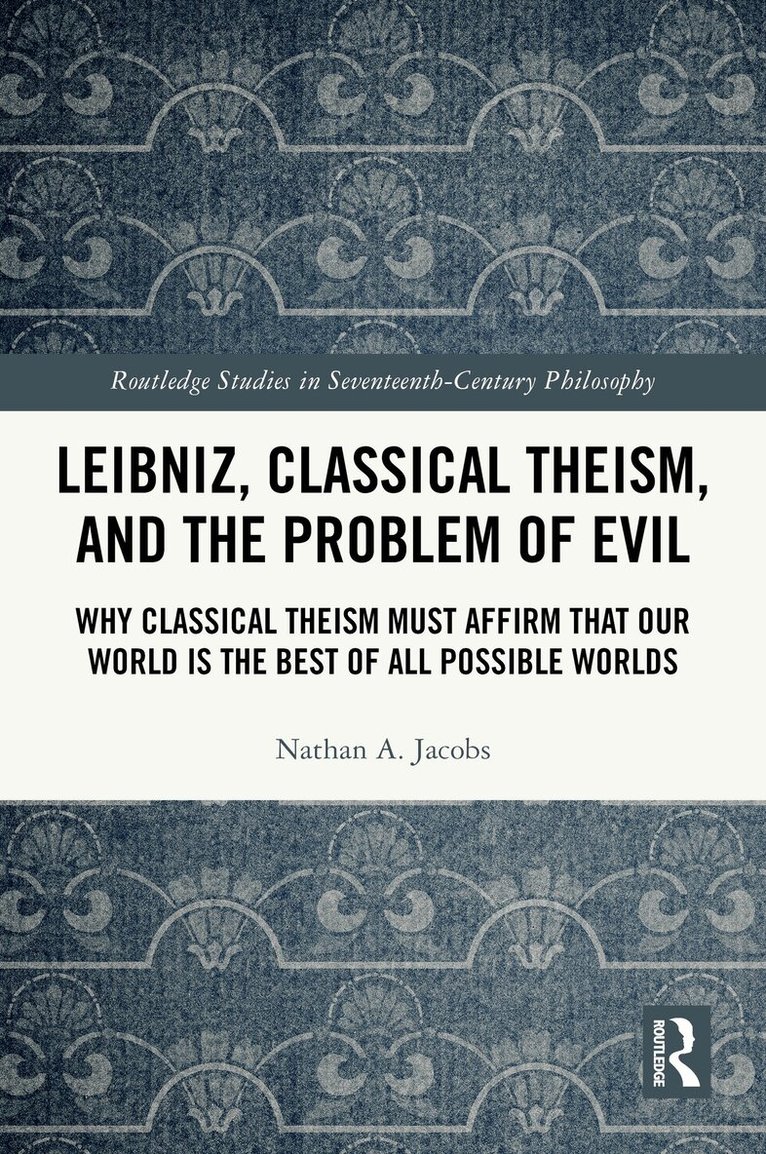
Häftad, Engelska, 2026
Leibniz, Classical Theism, and the Problem of Evil
Why Classical Theism Must Affirm That Our World is the Best of All Possible Worlds
Del i serien Routledge Studies in Seventeenth-Century Philosophy
700 kr
Beställningsvara. Skickas inom 10-15 vardagar. Fri frakt över 249 kr.
Beskrivning
Produktinformation
- Utgivningsdatum: 2026-10-15
- Mått: 152 x 229 x 22 mm
- Vikt: 750 g
- Format: Häftad
- Språk: Engelska
- Serie: Routledge Studies in Seventeenth-Century Philosophy
- Antal sidor: 392
- Upplaga: 26001
- Förlag: Taylor & Francis Ltd
- ISBN: 9781032739205
Utforska kategorier
Mer om författaren
Nathan A. Jacobs, PhD, is Scholar in Residence of Philosophy and Religion at Vanderbilt Divinity School, Co-editor of Kant and the Question of Theology (CUP) and The Persistence of the Sacred in Modern Thought (UNDP) and co-author of In Defense of Kant’s “Religion” (IUP). Jacobs specializes in Modern philosophy and Eastern patristic thought.
Recensioner i media
“This book is an important contribution to philosophical theology, the problem of evil, and the history of dogmatics. There are few works available that explore Leibniz on the problem of evil, but even fewer that integrate the study with classical theism that is also consistent with common themes in the wider Christian tradition. The present study will be of interest not only to philosophers and historians, but to dogmatic theologians.”Joshua Farris, Missional University, USA“After more than 200 years, it is rare for a book to capture something vital and new in one of the established philosophical subcultures of Modern thought. Jacobs’s book on Leibniz and theodicy does exactly that. While marshaling an impressive array of resources fore and aft Leibniz, Jacobs presents a compelling case for maintaining a robust understanding of Leibniz on human freedom in harmony with divine foreknowledge and predetermination. This book provides a much-needed corrective to the field, and is sure to provide healthy new fodder for contemporary discussions on the problem of evil.”Chris L. Firestone, Trinity International University, USA“This work is poised to overturn modern philosophy with its distinctive portrayal of the thought of Gottfried Leibniz. Gone is the portrait of the determinist-compatibilist who advances a novel theological optimism, where ours is the best of all possible worlds. What emerges is a Leibniz who advances a defensible libertarian account of freedom, where the traditional theist cannot posit that any world could surpass our own. Capably leading the reader through dense conceptual territory from medieval scholastics, accounts of human agency and action, possible worlds, the freedom-determinism divide, etc. Jacobs provides a wealth of insight reaching deeply into ancient, medieval, and modern philosophy.”James H. Joiner, Northern Arizona University, USA
Betyg & recensioner
0 recensioner
Inga recensioner tillgängliga.