• Fri frakt över 249 kr
  • •
  • Snabba leveranser
  • •
  • Billiga böcker
Kundservice

Du är på sajten för privatpersoner.

Företag, bibliotek eller offentlig verksamhet?

Du handlar på classic.bokus.com, där alla dina funktioner finns intakta.
Till classic.bokus.com
Bokus logotyp. Gå till startsidan.
  • Erbjudanden
  • Nyheter
  • Student
  • Topplistor
  • Barn & ungdom
  • Bokus Play
  • E-böcker
  • Pocketböcker
  • Spel & pussel

10% rabatt på allt med kod: NYSTART10 →

Sidfot

Mina sidor

    Hjälp

    • Kundservice
    • Vanliga frågor och svar
    • Frakt och leverans
    • Retur vid ångerrätt
    • Reklamera vara
    • Betalning
    • Köpvillkor
    • Allmänna villkor
    • Information om webbplatsens tillgänglighet

    Om Bokus

    • Om oss
    • Pressrum
    • För studenter
    • För företag
    • För bibliotek och offentlig verksamhet
    • För leverantörer
    • Hållbarhet

    Populärt

    • Aktuella erbjudanden
    • Presentkort
    • Studentlitteratur
    • Nya böcker
    • Topplistor
    • Signerade böcker
    • Engelska böcker

    Inspiration

    • Boktips
    • BookTok
    • Populära bokserier
    • Barnbokskaraktärer
    • Populära författare
    Logotyp för Bokus
    Följ oss på Facebook (extern länk)Följ oss på Instagram (extern länk)Följ oss på YouTube (extern länk)Följ oss på TikTok (extern länk)
    bokus @ CookiesAnpassa cookiesIntegritetspolicyKöpvillkor
    Till Citymail hemsida (extern länk)Till Budbee hemsida (extern länk)Till Postnord hemsida (extern länk)Till Schenker hemsida (extern länk)Till Early Bird hemsida (extern länk)Till Walleys hemsida (extern länk)
    1. Naturvetenskap och teknik
    2. Geovetenskap
    3. Miljövetenskap och miljöpolitik

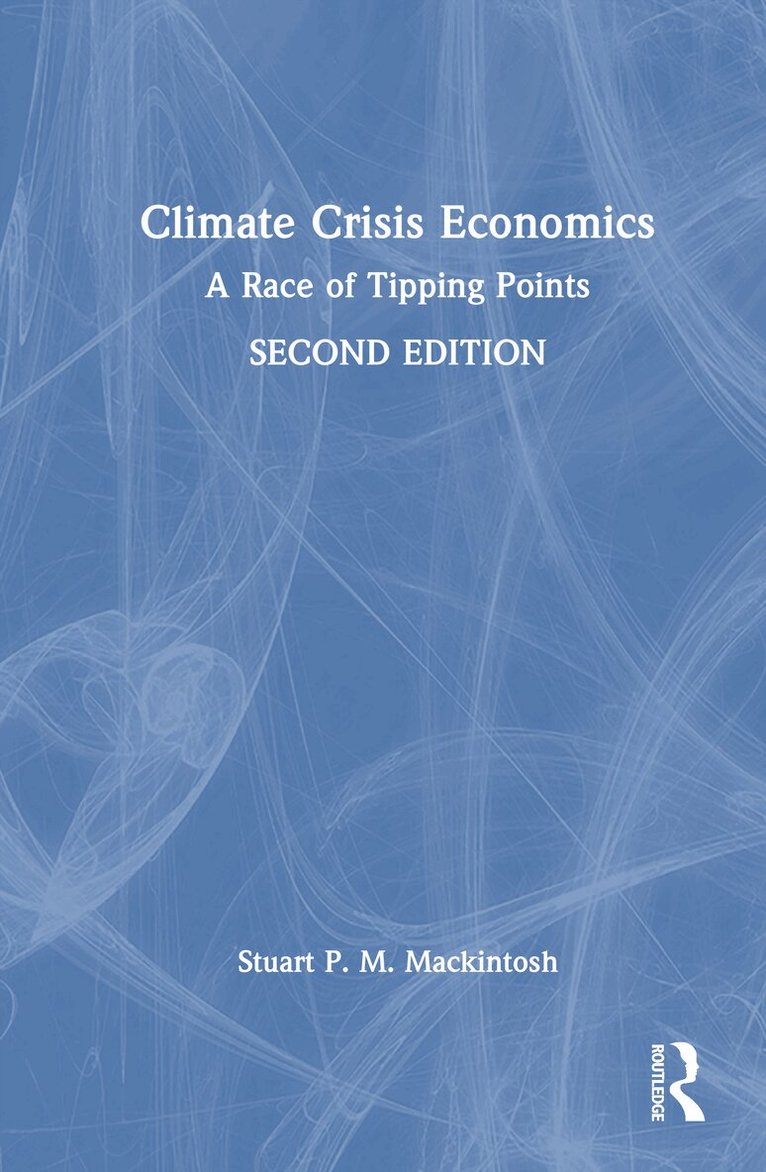
    Climate Crisis Economics

    A Race of Tipping Points

    AvStuart P. M. Mackintosh

    Inbunden, Engelska, 2025

    2 423 kr

    Beställningsvara. Skickas inom 10-15 vardagar. Fri frakt över 249 kr.

    Fler format och utgåvor

    Häftad

    625 kr

    E-bok

    738 kr

    E-bok

    740 kr

    Häftad

    Tillf. slut

    Beskrivning

    Climate Crisis Economics: A Race of Tipping Points draws on economics, political economy, scientific literature, and data to gauge the extent to which our various communities – political, economic, and business – are making the essential leap to a new narrative and policy approach that will accelerate us towards the necessary transition to a decarbonised economy and sustainable future. Time is fast running out to avoid tipping points of no return, warns Mackintosh.The book draws out policies and practices with both national and local examples, which demonstrate various complementary approaches that are empowering states and people as they seek to pursue the carbon-neutral goal. The author delineates a climate crisis economics approach that is fit for purpose and which can help achieve necessary climate change goals in the decades ahead. This new 2nd edition has been thoroughly updated throughout, including new material on the Biden administration and countries outside the United States and Europe; new chapters on tipping point dangers, and the need for a just transition. It includes key questions for students and supplemental reading for each chapter.Written in an accessible voice, Climate Crisis Economics: A Race of Tipping Points makes the case for a new model of climate crisis economics, and new narratives to address the climate change dangers ahead. It will appeal to academics, students, investors, and professionals from varying disciplines including politics, international political economy, and international economics.

    Produktinformation

    • Utgivningsdatum:2025-04-25
    • Mått:156 x 234 x 25 mm
    • Vikt:850 g
    • Format:Inbunden
    • Språk:Engelska
    • Antal sidor:354
    • Upplaga:2
    • Förlag:Taylor & Francis Ltd
    • ISBN:9781032782003

    Utforska kategorier

    • Miljövetenskap och miljöpolitik inom Naturvetenskap och teknik
    • Ekonomisk politik inom Ekonomi och Ledarskap
    • Miljöekonomi inom Ekonomi och Ledarskap

    Mer om författaren

    Stuart P. M. Mackintosh is an economist and financial author, and the Executive Director of the Group of Thirty, an influential international economic and financial think tank comprised of the most senior figures in central banking, finance, and academia. In 2016 he was elected by his peers as President of the National Association of Business Economics, the leading US organisation of professional economists. He is also a Visiting Fellow at Newcastle University, UK. He is the author of four other books on the global financial system, systemic risks, central banking, and climate change. He is a prolific newspaper columnist. www.stuartmackintoshauthor.info

    Recensioner i media

    Praise for the First Edition:‘Timed to influence the 2021 UN climate change conference in Glasgow, Stuart Mackintosh presents a compelling case for urgent, comprehensive action to meet the challenge of our era. Dispensing acute analysis and pungent judgement this highly readable manifesto for engagement shows the path forward to a green globalization 2.0. This book is an indispensable guide for business, educators, journalists, government officials and every citizen. It is a major achievement made possible by Mackintosh’s decades-long global experience in the European Union, with Mitsubishi, and as executive director of the Group of Thirty and as president of the National Association of Business Economists.’Dr. Carl Lankowski, retired director of European Area Studies, US Department of State‘Dr. Mackintosh has written a long overdue book. Climate Crises Economics covers this vital subject fully in a candid and unusually complete manner. His book can be read by the expert or educated layman. One of his skills is weaving together a number of recommended solutions rather than one draconian one. An important read for those who care, a must-read for those who want to put a solution in place.’Michael O. Clark, Senior Advisor at 1919 Investment Counsel, LLC, USA‘Few areas of study combine the efforts of science, economics and public policy as does climate change analysis. Stuart Mackintosh, with his background in economics and public policy, is excellently positioned to combine the threads of these three efforts into a manuscript that describes an approach to achieve the goals of public and private agents in the field of climate change. I endorse this book as a must-read for those who wish to actively pursue the goals of addressing climate change in a systematic way.’John Silvia, CEO and Founder of Dynamic Economic Strategy, USA"Sunak [Chancellor of the Exchequer, UK] is also concerned about the cost of warding off the worst of global heating. He should read Climate Crisis Economics by Stuart PM Mackintosh, executive director of the Group of 30, the esteemed international economic thinktank. In an echo of Ernest Hemingway’s famous exchange in The Sun Also Rises – "How did you go bankrupt?" "Two ways. Gradually, then suddenly" – Mackintosh concludes, in respect of global heating, that "change happens slowly and then fast". The evidence is all around us."William Keegan, writing in The Guardian‘This book explores the challenge of global climate change, with a focus on understanding the situation we are in and how to get out of it. This book is highly textual and has a strong emphasis on real-world examples […] It provides an up-to-date, broad overview of the climate challenge and explores what is needed to address it. Along the way it covers topics from green finance to green industrial policy, and the importance of leadership and climate-focused institutions. […] This book will remain useful for informing future courses of action.’Paul J. Burke, Australian National University, Australia (Review in Economic Record, The Economic Society of Australia)

    Innehållsförteckning

    • Prologue 1. Crises as crucibles for change 2. Obscured horizons and middling models 3. Warning: Tipping points may be closer than they appear 4. Setting targets, bending the GHG curve toward zero 5. Pricing carbon: How to achieve that and how high to go 6. Demographics, the changing investment narrative landscape, and market incentives 7. Building a decarbonised world: Institutional innovations that reinforce market outcomes 8. A sector-by-sector shift and place-based industrial policies: Speeding diffusion and the achievement of net zero 9. A just transition: possible but difficult and unlikely 10. A race of tipping points