• Fri frakt över 249 kr
  • •
  • Snabba leveranser
  • •
  • Billiga böcker
Kundservice

Du är på sajten för privatpersoner.

Företag, bibliotek eller offentlig verksamhet?

Du handlar på classic.bokus.com, där alla dina funktioner finns intakta.
Till classic.bokus.com
Bokus logotyp. Gå till startsidan.
  • Erbjudanden
  • Nyheter
  • Student
  • Topplistor
  • Barn & ungdom
  • Bokus Play
  • E-böcker
  • Pocketböcker
  • Spel & pussel

10% rabatt på allt med kod: NYSTART10 →

Sidfot

Mina sidor

    Hjälp

    • Kundservice
    • Vanliga frågor och svar
    • Frakt och leverans
    • Retur vid ångerrätt
    • Reklamera vara
    • Betalning
    • Köpvillkor
    • Allmänna villkor
    • Information om webbplatsens tillgänglighet

    Om Bokus

    • Om oss
    • Pressrum
    • För studenter
    • För företag
    • För bibliotek och offentlig verksamhet
    • För leverantörer
    • Hållbarhet

    Populärt

    • Aktuella erbjudanden
    • Presentkort
    • Studentlitteratur
    • Nya böcker
    • Topplistor
    • Signerade böcker
    • Engelska böcker

    Inspiration

    • Boktips
    • BookTok
    • Populära bokserier
    • Barnbokskaraktärer
    • Populära författare
    Logotyp för Bokus
    Följ oss på Facebook (extern länk)Följ oss på Instagram (extern länk)Följ oss på YouTube (extern länk)Följ oss på TikTok (extern länk)
    bokus @ CookiesAnpassa cookiesIntegritetspolicyKöpvillkor
    Till Citymail hemsida (extern länk)Till Budbee hemsida (extern länk)Till Postnord hemsida (extern länk)Till Schenker hemsida (extern länk)Till Early Bird hemsida (extern länk)Till Walleys hemsida (extern länk)
    1. Samhälle och politik
    2. Politik och statsskick
    3. Politiskt förtryck

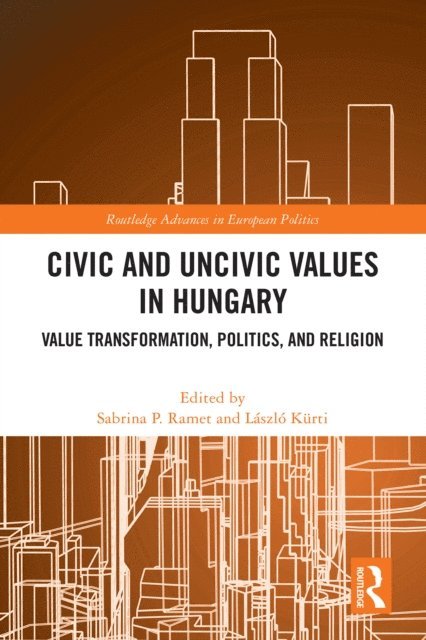
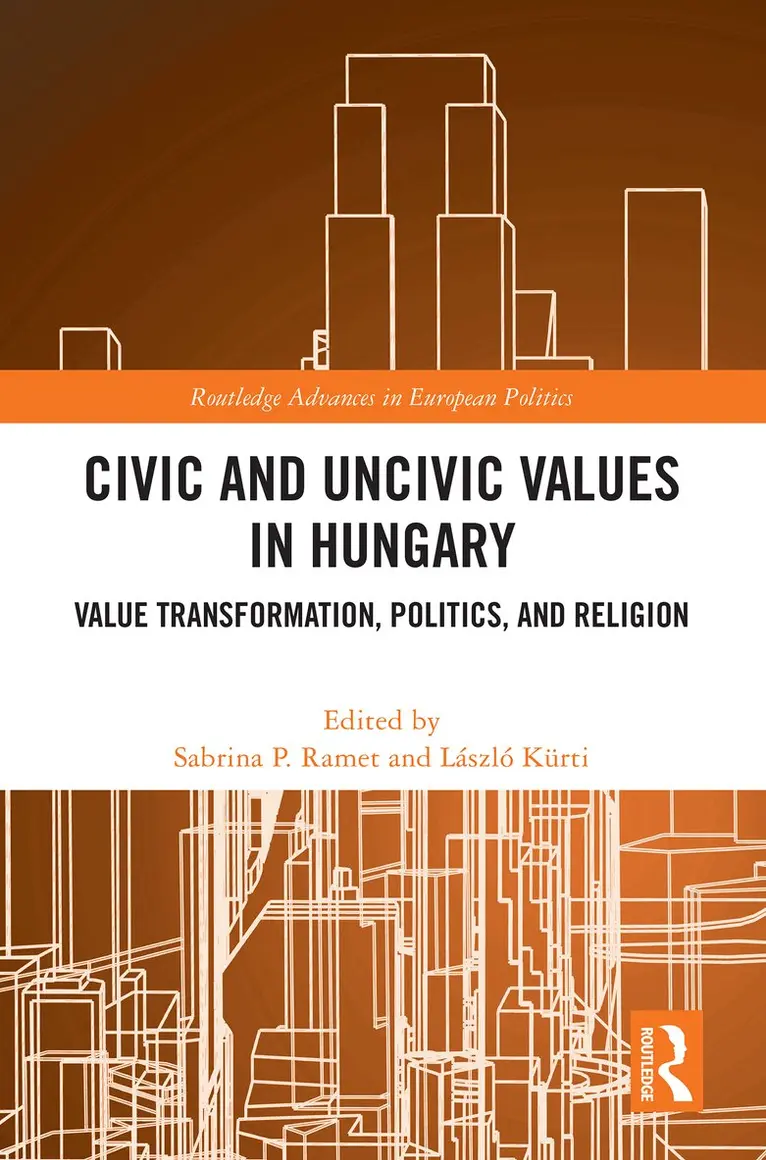
    Civic and Uncivic Values in Hungary

    Value Transformation, Politics, and Religion

    AvSabrina P. Ramet,László Kürti

    Häftad, Engelska, 2026

    Del i serien Routledge Advances in European Politics

    587 kr

    Beställningsvara. Skickas inom 10-15 vardagar. Fri frakt över 249 kr.

    Beskrivning

    This book offers an analysis of values in Hungary.Following the proposition that civic values are crucial to liberal democracy and conducive to international peace, this book examines the extent to which these values are respected and practised in a number of policy spheres, with chapters devoted to the political system, the media, religion, relations with the European Union, history textbooks, cinema, Roma, and the attitudes of Hungarian women voters. The book also charts how, under Prime Minister Orbán, Hungary has gravitated away from the civic values spelled out in the Universal Declaration of Human Rights and the Charter of the European Union.This book will prove to be of great use to scholars and students of democracy, East Central Europe, minorities, Hungarian contemporary history and politics, civic culture, gender studies, nationalism, human rights, and more broadly the social sciences.

    Produktinformation

    • Utgivningsdatum:2026-01-30
    • Mått:156 x 234 x 14 mm
    • Vikt:470 g
    • Format:Häftad
    • Språk:Engelska
    • Serie:Routledge Advances in European Politics
    • Antal sidor:240
    • Förlag:Taylor & Francis Ltd
    • ISBN:9781032786520

    Utforska kategorier

    • Politiskt förtryck inom Samhälle och politik
    • Statsskick och politiska processer inom Samhälle och politik
    • Folkrätt inom Juridik

    Mer om författaren

    Sabrina P. Ramet is Professor Emerita at the Norwegian University of Science & Technology (NTNU), Norway.László Kürti is Professor at the Institute of Applied Social Sciences, University of Miskolc, Hungary.

    Recensioner i media

    “Once a leading light of anti-communist liberalism in the late 1980s, Hungary’s Viktor Orbán has since become known, even admired in some quarters, for systematically undoing domestic checks and balances, and for dissension in the EU and NATO, and over Western support for Ukraine. This erudite, readable collection gives insights on contemporary Hungary, and with immediate relevance for understanding political phenomena worldwide. Those who know Hungary and those who do not will both gain a great deal.”Rick Fawn, Professor of International Studies, University of St Andrews, UK, and author of Castle on a Hill: The Visegrad Group, Regionalism, and the Remaking of Europe (2024)."Sabrina Ramet and László Kürti invited scholars to this book from very different fields of social science to deep-drill into the apparently homogeneous texture of the Hungarian society under Orbán's rule. Their choices proved successful. Human rights and their increasingly deplorable situation are revealed in different dimensions, as Orbán's authoritarian system gradually develops and infiltrates into all segments of society. Systemic controversies are analyzed in high-quality studies, be they from a philosophical, legal, institutional, or political science approach on political developments, gender, religion, minority groups, or even individual history."Maria Csanádi, Professor Emerita, Hungarian Academy of Sciences, Hungary, and principal author of Dynamics of an Authoritarian System: Hungary, 2010-2021 (2022).

    Innehållsförteckning

    • 1. Civic values and the vulnerability of an illiberal political order: The case of Hungary Part 1: The System 2. Politics in Hungary: Two critical junctures 3. The Hungarian media system: Unequal worlds Part 2: Values 4. Hungarian civic values in a European context 5. EU rule-of-law-conditionality and uncivic Hungary: Can you buy the rule of law? 6. Illiberalism and popular religion in Hungary: State Christianity 7. Anti-minority prejudice in Hungary: Gypsy business - Roma politics 8. Orbán and Vučić: From disparate beginnings to shared values 9. Reconstructionist religions in Hungary: In the shadow of threats Part 3: Culture, Gender and History Textbooks 10. Representations of post-Communist illiberalism in Coyote: Civic values in an illiberal state? 11. Polarized society in an illiberal polypore state: Values and attitudes among Hungarian women voters 12. Changing interpretations in history teaching and history textbooks Part 4: Conclusion 13. The wild wild East (A Conclusion)