• Fri frakt över 249 kr
  • •
  • Snabba leveranser
  • •
  • Billiga böcker
Kundservice

Du är på sajten för privatpersoner.

Företag, bibliotek eller offentlig verksamhet?

Du handlar på classic.bokus.com, där alla dina funktioner finns intakta.
Till classic.bokus.com
Bokus logotyp. Gå till startsidan.
  • Erbjudanden
  • Nyheter
  • Student
  • Topplistor
  • Barn & ungdom
  • Bokus Play
  • E-böcker
  • Pocketböcker
  • Spel & pussel

10% rabatt på allt med kod: NYSTART10 →

Sidfot

Mina sidor

    Hjälp

    • Kundservice
    • Vanliga frågor och svar
    • Frakt och leverans
    • Retur vid ångerrätt
    • Reklamera vara
    • Betalning
    • Köpvillkor
    • Allmänna villkor
    • Information om webbplatsens tillgänglighet

    Om Bokus

    • Om oss
    • Pressrum
    • För studenter
    • För företag
    • För bibliotek och offentlig verksamhet
    • För leverantörer
    • Hållbarhet

    Populärt

    • Aktuella erbjudanden
    • Presentkort
    • Studentlitteratur
    • Nya böcker
    • Topplistor
    • Signerade böcker
    • Engelska böcker

    Inspiration

    • Boktips
    • BookTok
    • Populära bokserier
    • Barnbokskaraktärer
    • Populära författare
    Logotyp för Bokus
    Följ oss på Facebook (extern länk)Följ oss på Instagram (extern länk)Följ oss på YouTube (extern länk)Följ oss på TikTok (extern länk)
    bokus @ CookiesAnpassa cookiesIntegritetspolicyKöpvillkor
    Till Citymail hemsida (extern länk)Till Budbee hemsida (extern länk)Till Postnord hemsida (extern länk)Till Schenker hemsida (extern länk)Till Early Bird hemsida (extern länk)Till Walleys hemsida (extern länk)
    1. Språk och ordböcker
    2. Språk: referensverk och allmänt

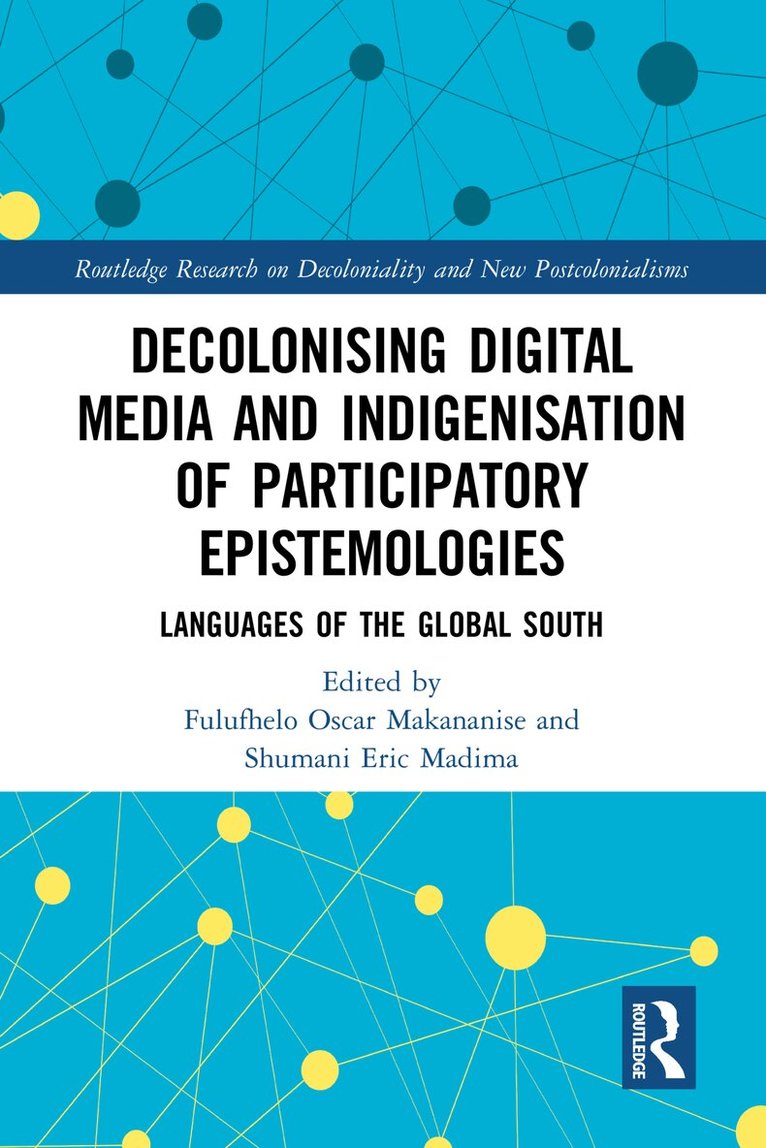
    Decolonising Digital Media and Indigenisation of Participatory Epistemologies

    Languages of the Global South

    AvFulufhelo Oscar Makananise,Shumani Eric Madima

    Häftad, Engelska, 2025

    Del i serien Routledge Research on Decoloniality and New Postcolonialisms

    681 kr

    Beställningsvara. Skickas inom 10-15 vardagar. Fri frakt över 249 kr.
    Beskrivning

    The book provides valuable insights on decolonising the digital media landscape and the indigenisation of participatory epistemologies to continue the legacies of indigenous languages in the global South.It is one of its kind as it climaxes that the construction phase of self-determining and redefining among the global South societies is an essential step towards decolonising the digital landscape and ensuring that indigenous voices and worldviews are equally infused, represented, and privileged in the process of higher-level communication, exchanging epistemic philosophies, and knowledge expressions. The book employs an interdisciplinary approach to engage in the use of digital media as a sphere for resistance and knowledge transformation against the persistent colonialism of power through dominant non-indigenous languages and scientific epistemic systems. It further advocates that decolonising digital media spaces through appreciating participatory epistemologies and their languages can help promote the inclusion and empowerment of indigenous communities. It indicates that the decolonial process can also help to redress the historical and ongoing injustices that have disadvantaged many indigenous communities in the global South and contributed to their marginalisation.This book will appeal to undergraduate and graduate students, scholars, and academics in communication, media studies, languages, linguistics, cultural studies, and indigenous knowledge systems in higher education institutions. It will be a valuable resource for those interested in epistemologies of the South, decoloniality, postcoloniality, indigenisation, participatory knowledge, indigenous language legacies, indigenous artificial intelligence, and digital media in the Fourth Industrial Revolution.

    Produktinformation

    • Utgivningsdatum:2025-12-26
    • Mått:156 x 234 x 12 mm
    • Vikt:420 g
    • Format:Häftad
    • Språk:Engelska
    • Serie:Routledge Research on Decoloniality and New Postcolonialisms
    • Antal sidor:210
    • Förlag:Taylor & Francis Ltd
    • ISBN:9781032804699

    Utforska kategorier

    • Språk: referensverk och allmänt inom Språk och ordböcker
    • Referensverk och tvärvetenskap inom Samhälle och politik
    • Medievetenskap inom Samhälle och politik

    Mer om författaren

    Fulufhelo Oscar Makananise is an Associate Professor in the Department of Communication Science at the University of South Africa (UNISA). He holds a doctoral degree in Media Studies from the University of Limpopo. Prof. Makananise obtained a PG (dip)HE from Rhodes University. He also serves as an external examiner in other South African universities and as a reviewer in international and national scholarly journals. Prof. Makananise has authored and published academic articles in peer-reviewed and DHET-accredited journals. In addition, Prof. Makananise has presented papers at both national and international conferences. His research interests include new media technology, digital media, indigenous language media and social media, political communication, digital diplomacy, and news media consumption.Shumani Eric Madima is a Linguistics Senior Lecturer at the University of Venda (UNIVEN) in the Department of English, Media Studies and Linguistics, Faculty of Humanities, Social Sciences and Education. He teaches Linguistics to undergraduate and postgraduate students. He completed his BA degree at the University of South Africa (Unisa), BA (Hons) in Applied Linguistics at the University of Pretoria, MA (Cum Laude) in Linguistics, and PhD in Linguistics at the University of Venda. He has been a teacher and a lecturer at South African Teacher Education (SACTE). His fields of specialisation are Sociolinguistics, Language Planning, Psycholinguistics, Language and gender, Linguistics in Educational Context and Media Studies. He has written several articles on various themes, such as Linguistics and Media Studies, which have been published in different international journals.

    Innehållsförteckning

    • Introduction: A Decolonial Study of Digital Media and the Epistemic Indigenisation of the Indigenous FutureFulufhelo Oscar Makananise and Shumani Eric Madima PART I: DECOLONISING DIGITAL SPACE, AND INDIGENOUS LANGUAGE PRESERVATION Chapter 1: Decolonial Thinking of Digital Media Inequalities and Indigenous Language Marginalisation of the Global South from the South African ContextFulufhelo Oscar Makananise Chapter 2: Preservation of Indigenous Languages, Changes in Digital Media, Social Development, and Family CommunicationEmmanuel Ezimako Nzeaka and Beryl A. EhondorChapter 3: Decoloniality of the Internet: Linguistic Revolution of the Marginalised Minority South African Indigenous LanguagesShumani Eric Madima and Fulufhelo Oscar Makananise Chapter 4: Incorporating Indigenous Language in TikTok Content Creation: Influence of IsiZulu in Content CreationKhatija BiBi KhanPART II: EPISTEMIC DECOLONIAL NARRATIVES, DIGITAL HUMOUR, AND POSTCOLONIAL PARTICIPATORY EPISTEMOLOGIES Chapter 5: Convergence between Educommunication and Good Living: Decolonial Narratives of Other Possible FuturesThais BrianeziChapter 6: ‘Tlen quihtoa moyollo?’ – ‘What does your heart tell you?’: Language Revitalisation and Postcolonial Cultural Education Among the #Nahuatl Language Teaching Community on TikTokAmanda R RuschakChapter 7: Chasu: A Favoured Medium in Endearment and Amusement in Online Chats by Chasu Native Speaker multilinguals in TanzaniaErasmus Akiley MsuyaPART III: EPISTEMOLOGIES OF MARGINALISED GROUPS AND DIGITAL PRESENCE OF NATIVE LANGUAGESChapter 8: The Revalorisation of the Native Languages in the New Bolivia: Strategies for Changing Minds towards the Democratic and Cultural RevolutionEduardo Lopez Rosse Chapter 9: Revitalising Endangered Languages through Social Media: A Case Study of Olunyore Language Preservation through Facebook in KenyaJackline U. Lidubwi and John O. NdavulaChapter 10: Visibility of Indigenous Groups through Creativity and Social Networks in MexicoEva Citlali Martínez EstrellaChapter 11: Promoting the Use of the Nama Language on YouTube in Democratic South AfricaEdgar Julius Malatji, Nhlayisi Cedrick Baloyi, Mawethu Glemar Mapulane, Amukelani Collen Mangaka and Rudzanimbilu Muthambi