Häftad, Engelska, 2027
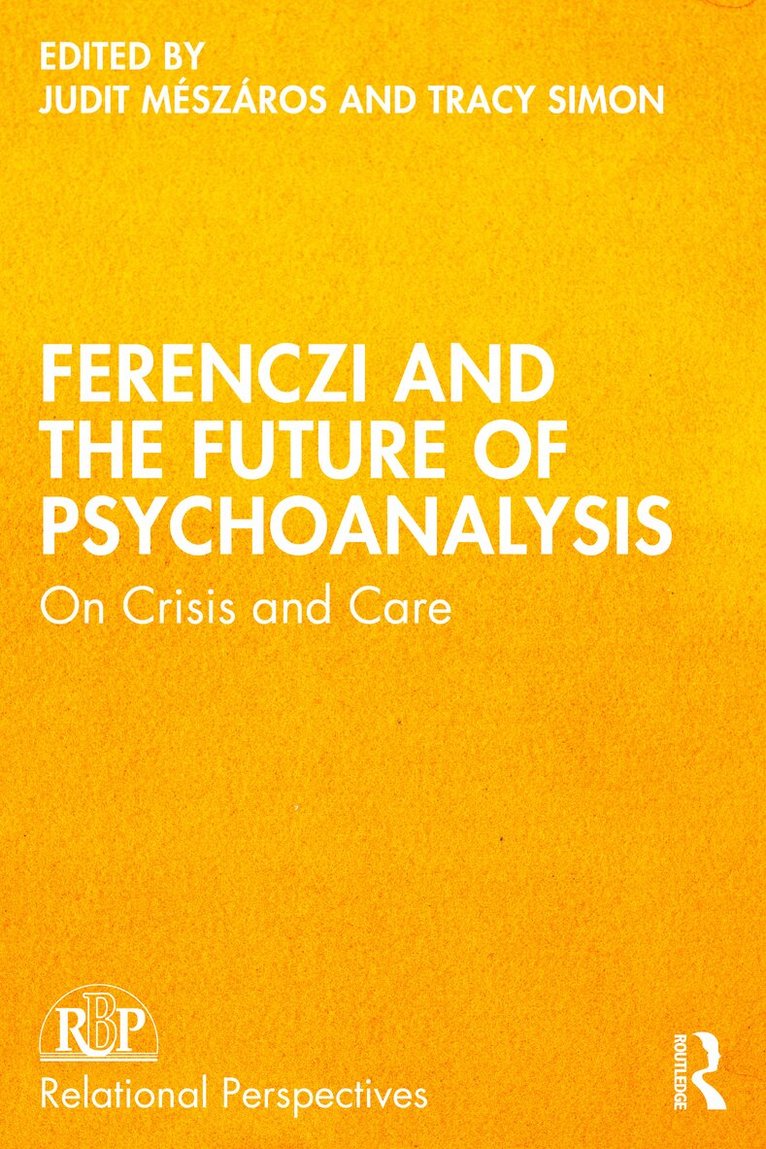
Ferenczi and the Future of Psychoanalysis
On Crisis and Care
Av Judit Mészáros, Tracy Simon
Del i serien Relational Perspectives Book Series
522 kr
Kommande
Beskrivning
Produktinformation
- Utgivningsdatum: 2027-03-18
- Mått: 156 x 234 x undefined mm
- Format: Häftad
- Språk: Engelska
- Serie: Relational Perspectives Book Series
- Antal sidor: 338
- Förlag: Taylor & Francis Ltd
- ISBN: 9781032812946
Utforska kategorier
Mer om författaren
Judit Mészáros, PhD, is president of the Sándor Ferenczi Society and a training and supervising psychoanalyst of the Hungarian Psychoanalytical Society. An internationally recognized scholar of Sándor Ferenczi and the Budapest School, she has authored and edited several books and has played an important role in the Ferenczi Renaissance, including the establishment of the Ferenczi Center and Archives in Budapest.Tracy Simon, Psy.D., is director of the Community Psychoanalysis Track at the Foundation for Community psychoanalysis, faculty and supervisor at Pulsion International Institute for Psychoanalysis and training psychoanalyst at NYU Postdoctoral Program in Psychoanalysis and Psychotherapy. She is an editor for Studies in Gender & Sexuality and worked for many years with the Human Rights Clinic of HealthRight International. Her practice is based in New York.
Recensioner i media
'An important book of our times.Ferenczi informs thinking today with understandings of the traumatic etched hidden inside the unconscious as history, metaphor and cruelties.In parallel the rising fragmentations on our world , previously formed a century ago with the rise in totalitarian controls returns now as a haunting and hate rebounds within our human condition.Ferenczian understanding of hidden controls in families and Societies can set us free with knowledge no longer suppressed but known.'Dr Jonathan Sklar FRCPsych Independent Training Psychoanalyst BPAS'This rich volume brings together an international collection of scholars who build impressively on Ferenczi’s foundational clinical observations and ideas. Some contributors explore trauma, both in individuals and on a mass scale, including social factors like gender, immigration, and being forced to flee one’s country; its neurological substrates; and clinical impacts like dissociation, splitting and fragmentation, the registration of trauma in the body, the difficulty relinquishing a sense of omnipotence, traumatic repetition, and the exceptional receptivity that can follow trauma, but also resilience in the face of trauma. Following Ferenczi’s revolutionary observations about the fate of “unwelcome” children, there’s a special section about the role of mothers and maternal subjectivity, and the trauma for a child when her mother doesn’t embrace her as the person she is. Other contributors study treatment, going further down paths first blazed by Ferenczi, such as analytic love and “being with” the patient, witnessing, mutuality, conviction, identification, introjection, regression, transference, the impact of countertransference, the role of language, and work with people in the grip of primitive mental states. There’s a historical chapter that sheds new light on the details of Ferenczi’s experiment with mutual analysis, and another that explores the posthumous deprecation of Ferenczi’s work, which prevented a fair assessment of his contributions for decades afterwards. This book is an indispensable resource for every student of Ferenczi’s work or any of the fields his work pioneered.'Jay Frankel, Ph.D., psychologist, psychoanalyst, Faculty, New York University Postdoctoral Program in Psychotherapy and Psychoanalysis'In this global anthology of new research on Sándor Ferenczi, what emerges is a sweeping intellectual portrait of his psychoanalytic creativity and his compassion. The ground-breaking scope of his theory, Freud acknowledged, was unmatched. Early in the 20th Century, Ferenczi pioneered a reading of the psychoanalytic encounter that meshed psychology, biology, and sociology while probing heady realms: primitive mind states, non-human environments, abandonment, and subjective truth. By arguing against a determinist view of the universe and instead upholding human agency, he widened the psychoanalytic treatment model and made it a cultural force. Judit Mészáros and Tracy Simon, the two award-winning editors who convened the book’s large international group of contributors, are to be applauded for elevating Sándor Ferenczi’s modernist impact on psychoanalysis – and beyond.'Elizabeth Ann Danto, Author, Freud's Free Clinics — Psychoanalysis & Social Justice, 1918-1938
Betyg & recensioner
0 recensioner
Inga recensioner tillgängliga.