• Fri frakt över 249 kr
  • •
  • Snabba leveranser
  • •
  • Billiga böcker
Kundservice

Du är på sajten för privatpersoner.

Företag, bibliotek eller offentlig verksamhet?

Du handlar på classic.bokus.com, där alla dina funktioner finns intakta.
Till classic.bokus.com
Bokus logotyp. Gå till startsidan.
  • Erbjudanden
  • Nyheter
  • Student
  • Topplistor
  • Barn & ungdom
  • Bokus Play
  • E-böcker
  • Pocketböcker
  • Spel & pussel

10% rabatt på allt med kod: NYSTART10 →

Sidfot

Mina sidor

    Hjälp

    • Kundservice
    • Vanliga frågor och svar
    • Frakt och leverans
    • Retur vid ångerrätt
    • Reklamera vara
    • Betalning
    • Köpvillkor
    • Allmänna villkor
    • Information om webbplatsens tillgänglighet

    Om Bokus

    • Om oss
    • Pressrum
    • För studenter
    • För företag
    • För bibliotek och offentlig verksamhet
    • För leverantörer
    • Hållbarhet

    Populärt

    • Aktuella erbjudanden
    • Presentkort
    • Studentlitteratur
    • Nya böcker
    • Topplistor
    • Signerade böcker
    • Engelska böcker

    Inspiration

    • Boktips
    • BookTok
    • Populära bokserier
    • Barnbokskaraktärer
    • Populära författare
    Logotyp för Bokus
    Följ oss på Facebook (extern länk)Följ oss på Instagram (extern länk)Följ oss på YouTube (extern länk)Följ oss på TikTok (extern länk)
    bokus @ CookiesAnpassa cookiesIntegritetspolicyKöpvillkor
    Till Citymail hemsida (extern länk)Till Budbee hemsida (extern länk)Till Postnord hemsida (extern länk)Till Schenker hemsida (extern länk)Till Early Bird hemsida (extern länk)Till Walleys hemsida (extern länk)
    1. Naturvetenskap och teknik
    2. Matematik och naturvetenskap
    3. Kemi
    4. Analytisk kemi

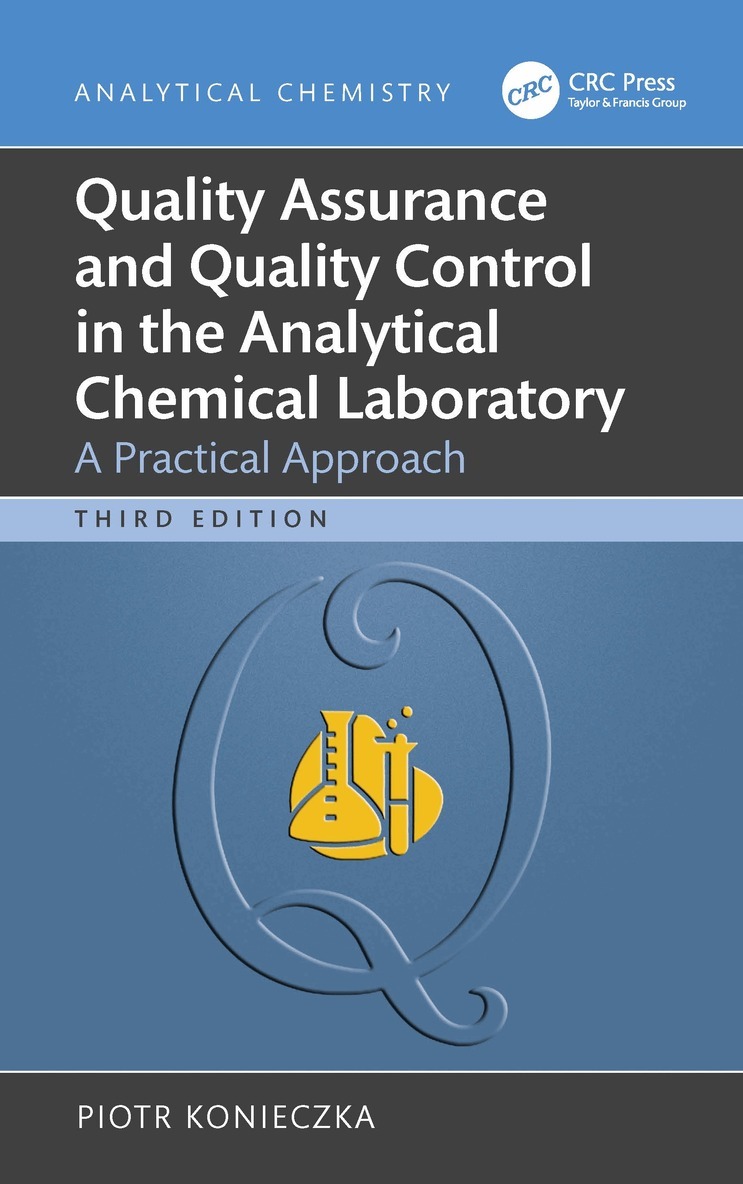
    Quality Assurance and Quality Control in the Analytical Chemical Laboratory

    A Practical Approach

    AvPiotr Konieczka

    Inbunden, Engelska, 2025

    Del i serien Analytical Chemistry

    2 954 kr

    Beställningsvara. Skickas inom 10-15 vardagar. Fri frakt över 249 kr.

    Fler format och utgåvor

    Häftad

    779 kr

    E-bok

    3 530 kr

    E-bok

    3 521 kr

    Inbunden

    2 954 kr

    E-bok

    738 kr

    E-bok

    738 kr

    Beskrivning

    The third edition of Quality Assurance and Quality Control in the Analytical Chemical Laboratory: A Practical Approach defines the tools used in QA/QC, especially the application of statistical tools during analytical data treatment. Clearly written and logically organized, this well-loved volume takes a generic approach applicable to any field of analysis. The authors begin with the theory behind quality control systems, then detail validation parameter measurements, the use of statistical tests, counting the margin of error, uncertainty estimation, traceability, reference materials, proficiency tests, and method validation. The new edition contains fully updated references throughout and includes new information on CRMs and PTs. A new chapter covers calibration and contains numerous new examples, and the subject of accreditation is expanded.Fully updated and revised referencesNew computational examples and solution problemsNew chapter on Calibration and expanded coverage of AccreditationA practical approach applicable to any field of analysis

    Produktinformation

    • Utgivningsdatum:2025-09-16
    • Mått:156 x 234 x 23 mm
    • Vikt:780 g
    • Format:Inbunden
    • Språk:Engelska
    • Serie:Analytical Chemistry
    • Antal sidor:316
    • Upplaga:3
    • Förlag:Taylor & Francis Ltd
    • ISBN:9781032824659

    Utforska kategorier

    • Analytisk kemi inom Naturvetenskap och teknik
    • Naturvetenskap:allmänt inom Naturvetenskap och teknik
    • Tillverkningsteknik inom Naturvetenskap och teknik

    Mer om författaren

    Piotr Konieczka is Professor at Gdańsk University of Technology, where he is Head of the Department of Analytical Chemistry. He has co-authored 113 publications, 8 books and holds 1 patent. His research interests are environmental pollution analysis, trace analysis, in particular analysis of heavy metal content using spectroscopic techniques, as well as chemical statistics and metrology, as well as control and quality assurance of analytical measurement results, including aspects related to the production and use of certified reference materials (CRM) and the organization and development of proficiency test results (PT).

    Innehållsförteckning

    • LIST OF ABBREVIATIONS1. BASIC NOTIONS OF STATISTICS1.1. Introduction1.2. Distributions of random variables1.2.1. Characterization of distributions1.3. Measures of location1.4. Measures of dispersion1.5. Measures of asymmetry1.6. Measures of concentration1.7. Statistical hypothesis testing1.8. Statistical tests1.8.1 Confidence interval method1.8.2. Critical range method1.8.3. Dixon’s Q test1.8.4. Chi-Square test1.8.5. Snedecor’s F test1.8.6. Hartley’s Fmax test1.8.7. Bartlett’s test1.8.8. Morgan’s test1.8.9. Student’s t test1.8.10. Cochran-Cox test1.8.11. Aspin-Welch test1.8.12. Cochran’s test1.8.13. Grubbs’ test1.8.14. Hampel’s test1.8.15. Z-Score1.8.16. En –Score1.8.17. Mandel’s test1.8.18. Kolmogorov-Smirnov test1.9. Linear regression1.10. Significant Digits. Rules of Rounding.1.11. References2. QUALITY OF ANALYTICAL RESULTS2.1. Definitions2.2. Introduction2.3. Quality assurance system2.4. Conclusions2.5. References3. INTERNAL QUALITY CONTROL3.1. Definitions3.2. Introduction3.3. Quality control in the laboratory3.4. Control charts 3.4.1. Shewhart charts3.4.2. Shewhart chart preparation3.4.3. Shewhart chart analysis3.4.4. Types of control charts3.4.5.Control samples3.5. Conclusion3.6. References4. TRACEABILITY4.1. Definitions4.2. Introduction4.3. The role of traceability in QA/QC system4.4. Conclusion4.5. References5. UNCERTAINTY5.1. Definitions5.2. Introduction5.3. Methods of estimating of measurement uncertainty5.3.1. Procedure for estimating the measurement uncertainty according to GUM5.4. Tools used for uncertainty estimation5.5. Uncertainty and confidence interval5.6. Calibration uncertainty5.7. Conclusion5.8. References6. REFERENCE MATERIALS6.1. Definitions6.2. Introduction6.3. Parameters which characterize RMs6.3.1. General information6.3.2. Representativeness 6.3.3. Homogeneity 6.3.4. Stability 6.3.5. Certified value6.4. Production of CRMs – requirements (ISO 17034)6.5. Practical application of CRM6.6. Conclusion6.7. References7. INTERLABORATORY COMPARISIONS7.1. Definitions7.2. Introduction7.3. Classification of interlaboratory studies7.4. Characteristics and organization of interlaboratory comparisons7.5. The presentation of interlaboratory comparison results. Statistical analysis in interlaboratory comparisons7.5.1. Comparisons of results obtained using various procedures7.5.2. Comparison of the measurement results obtained in a two-level study (for two samples with various analyte concentrations)7.6. Organisation of PTs – requirements (ISO 17043)7.7. Conclusions7.8. References8. CALIBRATION8.1. Introduction8.2. Types of calibration8.3. Calibration techniques8.3.1. Single standard technique8.3.2. Bracketing solutions technique8.3.3. Calibration curve technique8.3.4. Standard addition technique8.3.5. Multiple standard addition technique8.3.6. Internal standard technique8.3.6.1. Isotope Dilution Mass Spectrometry (IDMS) technique8.4. Conclusions8.5. References9. METHOD VALIDATION9.1. Introduction9.2. Characterization of validation parameters9.2.1. Selectivity9.2.2. Linearity9.2.3. Limit of Detection and Limit of Quantitation9.2.4. Range9.2.5. Sensitivity9.2.6. Precision9.2.6.1. Manners of estimating the standard deviation9.2.7. Accuracy and Trueness9.2.7.1. Measurement Errors9.2.8. Robustness and ruggedness9.2.9. Uncertainty9.3. Conclusions9.4. References10. METHOD EQUIVALENCE10.1. Introduction10.2. Ways of equivalence demonstration10.2.1. Difference testing10.2.2. Equivalence testing10.2.3. Regression analysis testing10.3. Conclusions10.4. ReferencesAPPENDIX