• Fri frakt över 249 kr
  • •
  • Snabba leveranser
  • •
  • Billiga böcker
Kundservice

Du är på sajten för privatpersoner.

Företag, bibliotek eller offentlig verksamhet?

Du handlar på classic.bokus.com, där alla dina funktioner finns intakta.
Till classic.bokus.com
Bokus logotyp. Gå till startsidan.
  • Erbjudanden
  • Nyheter
  • Student
  • Topplistor
  • Barn & ungdom
  • Bokus Play
  • E-böcker
  • Pocketböcker
  • Spel & pussel

10% rabatt på allt med kod: NYSTART10 →

Sidfot

Mina sidor

    Hjälp

    • Kundservice
    • Vanliga frågor och svar
    • Frakt och leverans
    • Retur vid ångerrätt
    • Reklamera vara
    • Betalning
    • Köpvillkor
    • Allmänna villkor
    • Information om webbplatsens tillgänglighet

    Om Bokus

    • Om oss
    • Pressrum
    • För studenter
    • För företag
    • För bibliotek och offentlig verksamhet
    • För leverantörer
    • Hållbarhet

    Populärt

    • Aktuella erbjudanden
    • Presentkort
    • Studentlitteratur
    • Nya böcker
    • Topplistor
    • Signerade böcker
    • Engelska böcker

    Inspiration

    • Boktips
    • BookTok
    • Populära bokserier
    • Barnbokskaraktärer
    • Populära författare
    Logotyp för Bokus
    Följ oss på Facebook (extern länk)Följ oss på Instagram (extern länk)Följ oss på YouTube (extern länk)Följ oss på TikTok (extern länk)
    bokus @ CookiesAnpassa cookiesIntegritetspolicyKöpvillkor
    Till Citymail hemsida (extern länk)Till Budbee hemsida (extern länk)Till Postnord hemsida (extern länk)Till Schenker hemsida (extern länk)Till Early Bird hemsida (extern länk)Till Walleys hemsida (extern länk)
    1. Samhälle och politik
    2. Samhälle och kultur
    3. Kultur och medier
    4. Referensverk och tvärvetenskap

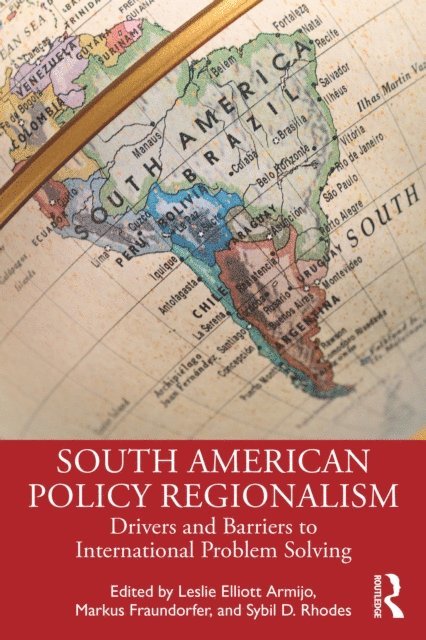
    South American Policy Regionalism

    Drivers and Barriers to International Problem Solving

    AvLeslie Elliott Armijo,Markus Fraundorfer

    Inbunden, Engelska, 2024

    2 421 kr

    Beställningsvara. Skickas inom 10-15 vardagar. Fri frakt över 249 kr.

    Beskrivning

    “Regional cooperation exists, but looks different in the global South than in the European Union,” claim the contributors to South American Policy Regionalism, which offers novel theory, methods, and Latin American case studies of joint governance efforts in nine international policy arenas, ranging from illegal drugs to artificial intelligence.Contrasting three major schools of thought in international relations (highlighting power, institutions, and ideas), this book introduces the idea of international policy regionalism as a framework for informed debate about international policy-sector interactions in a regional space. Beginning with a conceptual approach applicable to any world region, it includes a brief history of Western Hemisphere regionalism to aid in future cross-regional comparisons. An international group of contributors constructs rich narratives of the politics of Latin American policy sector evolution since the Cold War. Besides the aforementioned, included sectors span regional development banking, infrastructure planning, electricity distribution, migration governance, climate action, neglected tropical diseases, and food policies.This volume equips readers from various academic disciplines and the policy world to understand the relevance of core international relations theory for the analysis of policy sectors that cross national borders, both within Latin America and elsewhere, and especially throughout the global South.

    Produktinformation

    • Utgivningsdatum:2024-09-30
    • Mått:152 x 229 x 23 mm
    • Vikt:453 g
    • Format:Inbunden
    • Språk:Engelska
    • Antal sidor:318
    • Förlag:Taylor & Francis Ltd
    • ISBN:9781032857244

    Utforska kategorier

    • Referensverk och tvärvetenskap inom Samhälle och politik
    • Etnicitet inom Samhälle och politik
    • Internationella relationer inom Samhälle och politik

    Mer om författaren

    Leslie Elliott Armijo holds research affiliations with Simon Fraser University (SIS) and Boston University (GDP Center) and has been a Visiting Scholar in Rio de Janeiro (PUC), New Delhi (CPR), Berlin (FUB), and São Paulo (USP). She is (co)author or editor of The BRICS and Collective Financial Statecraft (2018), Unexpected Outcomes: How Emerging Economies Survived the Global Financial Crisis (2015), The Financial Statecraft of Emerging Powers (2014), Debating the Global Financial Architecture (2002), Financial Globalization and Democracy in Emerging Markets (1999), and fifty odd articles or chapters on ethics, democracy, growth, and international politics in Latin America and India.Markus Fraundorfer is Associate Professor of Global Governance at the University of Leeds and the program director of the MA Global Governance & Diplomacy. He examines current transformation processes in global governance and previously researched Brazil’s role in regional and global governance. He worked at the Universidade de São Paulo and was a visiting fellow at the Pontifíia Universidade Católica do Rio de Janeiro (PUC-Rio) and the Universidade de Brasíia. His previous books include Brazil’s Emerging Role in Global Governance: Health, Food Security and Bioenergy (2015), Rethinking Global Democracy in Brazil (2018), and Global Governance in the Age of the Anthropocene (2022).Sybil D. Rhodes directs the Department of Political and Juridical Sciences and the Foreign Policy Observatory at the Universidad del CEMA in Buenos Aires, Argentina. Her areas of expertise include the politics of international public policy and multilateral cooperation, particularly in the policy arenas of migration, citizenship and human rights, as well as infrastructure and consumer protection. She is the author of Social Movements and Free-Market Capitalism in Latin America (2006).

    Recensioner i media

    “Policy rather than politics: this is the right way to make sense of Latin American regionalism. Focusing on international problem solving rather than institution-building, the authors highlight function over form and look into effective cooperation rather than rhetorical integration. This book is theoretically informed, yet no-nonsensical, and its empirically based chapters put analysis before prescription. It’s about time!”Andrés Malamud, Instituto de Ciências Sociais, Universidade de Lisboa“…a renewed theoretical corpus and updated empirical analysis of regionalism applied to multiple public policy arenas in recent South America. It is an essential work…”Elsa Llenderrozas, Ciencia Política, Universidad de Buenos Aires "… a very timely, thought-provoking contribution to the debate on bridging the gap between academia and policy making.”Oliver Della Costa Stuenkel, International Relations, Fundação Getulio Vargas (FGV), São Paulo “This invaluable volume expands consideration of regionalism in Latin America beyond the usual narrowly institutional focus, with profound consequences for how we conceptualize governance in this part of the global South.”Eric Hershberg, Department of Government and CLALS, American University“…the essential guide to South American regionalism in comparative perspective.”Kevin P. Gallagher, Director, Boston University Global Development Policy Center

    Innehållsförteckning

    • ForewordJorge HeineEditor's PrefacePart 1. International Policy Regionalism: Why, How, and the Theoretical Significance of Latin America1. How Latin America Cooperates: A Brief Look at the Historical RecordLeslie Elliott Armijo, Markus Fraundorfer, and Sybil D. Rhodes2. Theory: The International Relations of Regional Policy CooperationLeslie Elliott Armijo, Markus Fraundorfer, and Sybil D. Rhodes3. Methods: Investigating International Policy Regionalism in the Global South and BeyondLeslie Elliott Armijo, Markus Fraundorfer, and Sybil D. RhodesPart 2. International Power Structures and Policy Sector Results4. Illegal Drugs: How the Support of Prohibition Undermines Effective Regional Solutions Nicolas Alexander Beckmann5. Infrastructure: Explaining the Divergent Experiences of Central and South AmericaGiovanni Agostinis and Stefano Palestini6. Long-Term Finance: The Challenging International Politics of Regional Development BanksLeslie Elliott Armijo and Verónica Rubio Vega SepehrPart 3. The Strength of Issue Arena Incentives7. Energy: Interconnection without IntegrationKlaus Guimarães Dalgaard and Felipe Mendes Cardoso8. Immigration and Asylum: The Political Economy of Migration Governance in South America since the Cold WarSybil D. Rhodes9. Climate Action: Splintered Multilateralism and Networked TransnationalismAmy BelowPart 4. When Norm Entrepreneurs Lead10. Neglected Tropical Diseases: Health Governance at the Global–Regional NexusMarkus Fraundorfer11. Food Policy: Examining the Influence of Brazilian CoalitionsCarolina Milhorance and Paulo Niederle12. Artificial Intelligence: Latin America’s Contested NormsGlauco Arbix, João Paulo C. Veiga, Scott B. MartinPart 5. Conclusions: Findings and Further Questions, Empirical and Theoretical13. Lessons from South American Policy RegionalismLeslie Armijo, Markus Fraundorfer, and Sybil D. Rhodes