• Fri frakt över 249 kr
  • •
  • Snabba leveranser
  • •
  • Billiga böcker
Kundservice

Du är på sajten för privatpersoner.

Företag, bibliotek eller offentlig verksamhet?

Du handlar på classic.bokus.com, där alla dina funktioner finns intakta.
Till classic.bokus.com
Bokus logotyp. Gå till startsidan.
  • Erbjudanden
  • Nyheter
  • Student
  • Topplistor
  • Barn & ungdom
  • Bokus Play
  • E-böcker
  • Pocketböcker
  • Spel & pussel

10% studentrabatt med kod TERM26

Sidfot

Mina sidor

    Hjälp

    • Kundservice
    • Vanliga frågor och svar
    • Frakt och leverans
    • Retur vid ångerrätt
    • Reklamera vara
    • Betalning
    • Köpvillkor
    • Allmänna villkor
    • Information om webbplatsens tillgänglighet

    Om Bokus

    • Om oss
    • Pressrum
    • För studenter
    • För företag
    • För bibliotek och offentlig verksamhet
    • För leverantörer
    • Hållbarhet

    Populärt

    • Aktuella erbjudanden
    • Presentkort
    • Studentlitteratur
    • Nya böcker
    • Topplistor
    • Signerade böcker
    • Engelska böcker

    Inspiration

    • Boktips
    • BookTok
    • Populära bokserier
    • Barnbokskaraktärer
    • Populära författare
    Logotyp för Bokus
    Följ oss på Facebook (extern länk)Följ oss på Instagram (extern länk)Följ oss på YouTube (extern länk)Följ oss på TikTok (extern länk)
    bokus @ CookiesAnpassa cookiesIntegritetspolicyKöpvillkor
    Till Citymail hemsida (extern länk)Till Budbee hemsida (extern länk)Till Postnord hemsida (extern länk)Till Schenker hemsida (extern länk)Till Early Bird hemsida (extern länk)Till Walleys hemsida (extern länk)
    1. Samhälle och politik
    2. Samhälle och kultur
    3. Kultur och medier
    4. Referensverk och tvärvetenskap

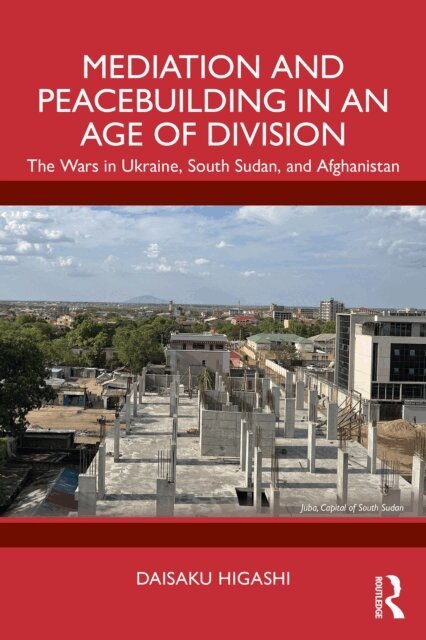
    Mediation and Peacebuilding in an Age of Division

    The Wars in Ukraine, South Sudan, and Afghanistan

    AvDaisaku Higashi

    Häftad, Engelska, 2026

    628 kr

    Beställningsvara. Skickas inom 10-15 vardagar. Fri frakt över 249 kr.

    Fler format och utgåvor

    Inbunden

    2 434 kr

    E-bok

    727 kr

    E-bok

    727 kr

    Beskrivning

    This book explores the major challenges of mediation during armed conflicts and post-conflict peacebuilding in an age of division, when the permanent members of the UN Security Council are fundamentally divided. The author argues that it is critical to mediate armed conflicts and implement peacebuilding by maintaining the fundamental rules of the international system, such as respecting “national sovereignty, borders of states, and self-determination of peoples,” even in the age of division. At the same time, he calls for “adaptive peacebuilding,” reflecting local contexts, histories, and political dynamics, avoiding text-tailored approaches.Dialogues and interviews with the leadership of conflicted states provide unique perspectives on both inter-state and intra-state wars, presenting major findings regarding the wars in Ukraine, South Sudan, and Afghanistan.This volume targets scholars and students of international relations and international organizations, especially those interested in mediation and peacebuilding; it is also valuable for practitioners working for UN, NGOs, think-tanks, diplomats, policymakers, and member states.
    Produktinformation

    • Utgivningsdatum:2026-05-18
    • Mått:156 x 234 x 13 mm
    • Vikt:300 g
    • Format:Häftad
    • Språk:Engelska
    • Antal sidor:152
    • Förlag:Taylor & Francis Ltd
    • ISBN:9781032872582

    Utforska kategorier

    • Referensverk och tvärvetenskap inom Samhälle och politik
    • Etnicitet inom Samhälle och politik
    • Internationella relationer inom Samhälle och politik

    Mer om författaren

    Daisaku Higashi is a professor at Sophia University in Tokyo. He specializes in mediation on armed conflicts, post-conflict peacebuilding, and international relations. He started his career as a program director at NHK, Japan Public TV Stations and produced many documentaries, including “Rebuilding Iraq: Challenges of UN” by which he received the silver medal from UN Correspondents Association in New York in 2004. Then, he took MA and Ph.D. in Political Science at the University of British Columbia in Canada. He also worked for United Nations Assistance Mission in Afghanistan (UNAMA) as a team leader for reconciliation in Kabul (2009–2010), as well as Minister-Counsellor in the Permanent Mission of Japan to the UN in New York (2012-2014). His English publications include Inclusivity in Mediation and Peacebuilding: UN, Neighboring States, and Global Power (Edward Elgar 2022) and Challenges of Constructing Legitimacy in Peacebuilding: Afghanistan, Iraq, Sierra Leone and East Timor (Routledge 2015).

    Recensioner i media

    ""This book could not be more timely or important. Professor Higashi courageously takes on the tough challenges of how to try to resolve key conflicts in a starkly divided world and build sustainable post-conflict peace. While he advocates for the primacy of respecting the core principles of sovereignty and self-determination, he does so in pragmatic way. This means adapting those principles flexibly and grounded in deep situational knowledge, which is what Dr. Higashi has accumulated with his impressive research of the conflicts and nation and peace building efforts in Ukraine, South Sudan and Afghanistan. His nuanced conclusions seek to sidestep some of the current roadblocks in each of these cases and bear close hearing. What package of elements regarding territorial disputes, war crimes, and a post-conflict security framework are the most promising to end the war in Ukraine? What are the advantages and disadvantages of seeking to resolve conflict by establishing a democratic regime and engage in peacebuilding with a non-democratic government? Read Higashi’s deeply informed book to find out.”- Richard Price, Director of Graduate & Postdoctoral Studies, Faculty of Arts, Professor, Department of Political Science, Certified Coach for UBC Coaching Services, The University of British Columbia“This important book weaves together international relations theory and diplomatic perspectives from the trenches of the worst war-torn settings to offer practical guidance for achieving peace. In a compelling narrative, the book advances the need for pragmatic and adaptive peacebuilding. Higashi argues that national sovereignty and stability must sometimes take precedence, even when this requires deferring goals such as democratization or accountability for war crimes. His analysis of the conflicts in Ukraine, South Sudan, and Afghanistan highlights critical turning points in negotiations where alternative choices could have produced better outcomes. A must-read for scholars and practitioners alike, the book offers a clear-eyed path toward more effective peacebuilding.”- Christina L. Davis, Edwin O. Reischauer Professor, Harvard University; author of Discriminatory Clubs: The Geopolitics of Membership in International Organizations“In Mediation and Peacebuilding in an Age of Division, Professor Higashi provides careful, critical analysis and constructive suggestions that draw on his extensive experience and interactions with leaders of various stripes engaged in some of the most intractable conflicts of the time. His reflections will be of real value to practitioners and to scholars alike who seek to understand such conflicts and look for pathways towards peace."- Alistair Edgar, Associate Professor of Political Science and Associate Dean of the School of International Policy & Governance at the Balsillie School of International Affairs(BSIA), Wilfrid Laurier University

    Innehållsförteckning

    • 1. Introduction: The War in Ukraine, the Conflict in Gaza, and the Division of the World 2. Theoretical Arguments of Mediation and Peacebuilding 3. Three Challenges of Ending the War in Ukraine: Territory, War Crimes, and Post-Conflict Framework 4. The Challenges of Mediation by the Trump Administration in the War in Ukraine 5. Challenges of Mediation and Peacebuilding When Creating a Democratic State: The Case of South Sudan 6. Challenges of Peacebuilding under a Non-Democratic System: The Case of Afghanistan 7. Conclusion