• Fri frakt över 249 kr
  • •
  • Snabba leveranser
  • •
  • Billiga böcker
Kundservice

Du är på sajten för privatpersoner.

Företag, bibliotek eller offentlig verksamhet?

Du handlar på classic.bokus.com, där alla dina funktioner finns intakta.
Till classic.bokus.com
Bokus logotyp. Gå till startsidan.
  • Erbjudanden
  • Nyheter
  • Student
  • Topplistor
  • Barn & ungdom
  • Bokus Play
  • E-böcker
  • Pocketböcker
  • Spel & pussel

10% studentrabatt med kod TERM26

Sidfot

Mina sidor

    Hjälp

    • Kundservice
    • Vanliga frågor och svar
    • Frakt och leverans
    • Retur vid ångerrätt
    • Reklamera vara
    • Betalning
    • Köpvillkor
    • Allmänna villkor
    • Information om webbplatsens tillgänglighet

    Om Bokus

    • Om oss
    • Pressrum
    • För studenter
    • För företag
    • För bibliotek och offentlig verksamhet
    • För leverantörer
    • Hållbarhet

    Populärt

    • Aktuella erbjudanden
    • Presentkort
    • Studentlitteratur
    • Nya böcker
    • Topplistor
    • Signerade böcker
    • Engelska böcker

    Inspiration

    • Boktips
    • BookTok
    • Populära bokserier
    • Barnbokskaraktärer
    • Populära författare
    Logotyp för Bokus
    Följ oss på Facebook (extern länk)Följ oss på Instagram (extern länk)Följ oss på YouTube (extern länk)Följ oss på TikTok (extern länk)
    bokus @ CookiesAnpassa cookiesIntegritetspolicyKöpvillkor
    Till Citymail hemsida (extern länk)Till Budbee hemsida (extern länk)Till Postnord hemsida (extern länk)Till Schenker hemsida (extern länk)Till Early Bird hemsida (extern länk)Till Walleys hemsida (extern länk)
    1. Samhälle och politik
    2. Samhälle och kultur
    3. Kultur och medier
    4. Referensverk och tvärvetenskap

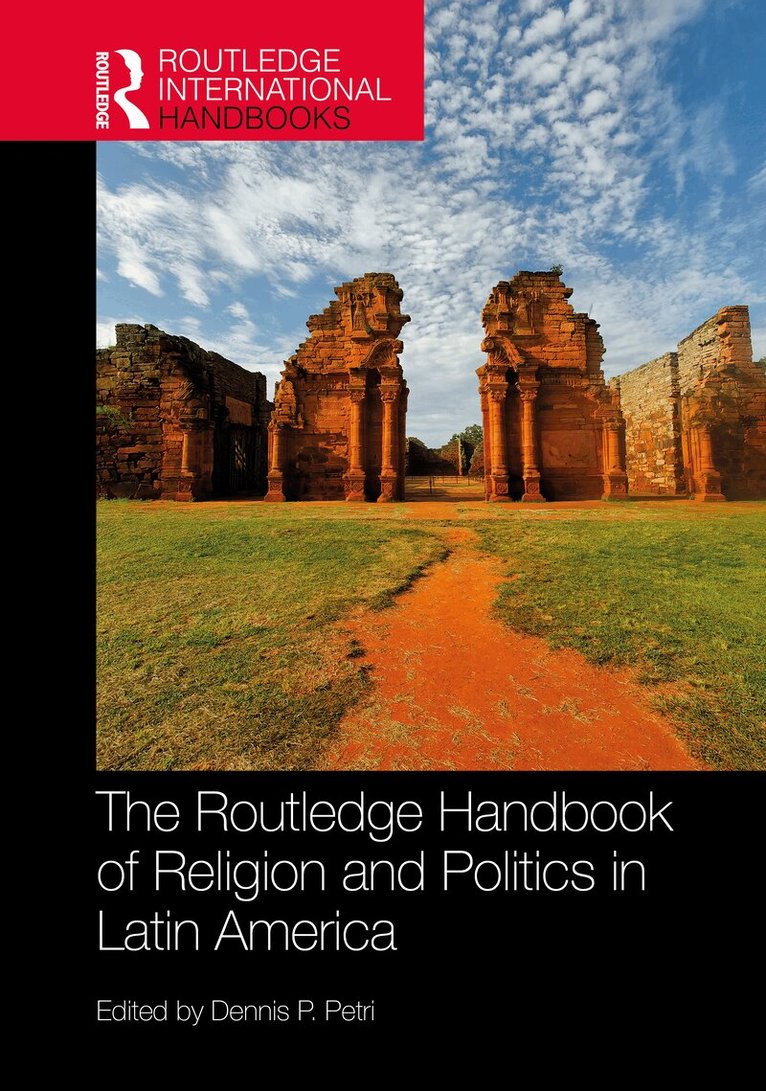
    Routledge Handbook of Religion and Politics in Latin America

    AvDennis P. Petri

    Inbunden, Engelska, 2026

    Del i serien Routledge International Handbooks

    3 658 kr

    Slutsåld

    Beskrivning

    The Routledge Handbook of Religion and Politics in Latin America offers a state of the art of the academic and multidisciplinary reflection on the main aspects of the relationships between religion, politics, and society in Latin America.The book provides insights from leading scholars in the fields of religious studies and political science, from the historical roots of religious pluralism to contemporary debates on religious freedom, democratization, and civic engagement, each chapter delves into a different aspect of this multifaceted topic. Special emphasis is given to the need to overcome the dominant reductionist approaches to the study of religion and politics in Latin America which focus too narrowly on church-state relations and ignore the sometimes contentious political and societal implications of the growing religious pluralism in the region. The handbook also aims to build bridges between the often isolated disciplines of religious studies and political science, as well as between Latin American and Western scholars. The first section provides an overview of the political perspectives of Latin American worldviews. The second section looks at the interface of religion and the public sphere. The third section delves into the multiple dimensions of religious freedom. Section four examines the complex relationship between religion and democratization. Section five explores religious civic engagement and its impact on development. Finally, section six offers several country case studies to illustrate points made in earlier sections and go more in-depth into particularities of each country.The Routledge Handbook of Religion and Politics in Latin America will appeal to students and scholars of politics, religious studies, and Latin America, providing a valuable resource for understanding the forces shaping Latin American societies..

    Produktinformation

    • Utgivningsdatum:2026-11-20
    • Mått:174 x 246 x undefined mm
    • Format:Inbunden
    • Språk:Engelska
    • Serie:Routledge International Handbooks
    • Antal sidor:664
    • Förlag:Taylor & Francis Ltd
    • ISBN:9781032964676

    Utforska kategorier

    • Referensverk och tvärvetenskap inom Samhälle och politik
    • Etnicitet inom Samhälle och politik
    • Sociologi inom Samhälle och politik

    Mer om författaren

    Dennis P. Petri is a political scientist, researcher, and international consultant, with extensive experience in Latin America, Europe, Africa, and the Middle East. He has worked in academic and policy roles for various universities, international NGOs, and multilateral organizations. Currently, Petri is the Head of the Chair of Humanities and Professor in International Relations at the Latin American University of Science and Technology of Costa Rica. He lectures regularly at the Latin American Faculty of Social Sciences (FLACSO-UNESCO) and The Hague University of Applied Sciences. Petri also holds the position of International Director at the International Institute for Religious Freedom and is the Executive Director of the Foundation Platform for Social Transformation and the founder and scholar-at-large of the Observatory of Religious Freedom in Latin America. He earned his PhD in Political Philosophy from Vrije Universiteit Amsterdam. As a Mexican-Dutch-Costa Rican author, Petri has published extensively on freedom of religion, religion and politics, social dialogue, parliamentary reform, and democracy assistance.

    Innehållsförteckning

    • Chapter 1. Introduction: Framework for the analysis of religion and politics in Latin America Part I. Political perspectives of Latin American worldviews Chapter 2. The survival and reinvention of pre-Columbian forms of spirituality Chapter 3. The geopolitics of the Catholic Church in Latin America Chapter 4. Evangelicals and politics Chapter 5. Liberation theology Chapter 6. Jews, Jewish Identity, and Politics in Latin America Chapter 7. Mexican Necro-State: The Political Economy of Santa Chapter 8. The kaleidoscope of reconfigurations between religions and public spaces in Latin America Part II. Religion and the public sphere Chapter 9. Religion(s) and State Formation in Latin America Chapter 10. Colonial influence on Church-State relations Chapter 11. Towards a typology of Latin American secularisms: public tensions and transitions between religion, society and politics. Chapter 12. Christian Democracy Chapter 13. Contemporary Religious Political Parties in Latin America Chapter 14. Power and Evangelicals in Latin America: Between Faith and Politics? Part III. Dimensions of religious freedom Chapter 15. Government Religion Policy and Religious Freedom in Latin America and the Caribbean between 1990 and 2023 Chapter 16. Determinants of Religious Freedom Expansion in Latin America: A Comparative Policy Perspective Chapter 17. Secular Shifts on the Ground:Bureaucracy, Scholarship and Interfaith in the Protestantization of Mexican Secularism Chapter 18. The construction of Indigenous peoples’ freedom of religion or belief in international and Latin American human rights law and policy Chapter 19. The right to FoRB and Afro-Diasporic Religions in Latin America Chapter 20. Beyond the State: Non-State Restrictions on Religious Freedom in Latin America Chapter 21. Religious Communities Amid Violence: Social role and Vulnerability factors Chapter 22. Religious freedom in the Inter-American Human Rights System Chapter 23. Measuring Subnational Variation in Freedom of Religion or Belief Violations: Reflections on a Path Forward Part IV. Religion and quality of democracy Chapter 24. Religion and authoritarianism Chapter 25. The Role of the Catholic Church in Democratic Transitions Chapter 26. North-South ecumenical networks of humanitarian activism in Latin America (1960-1990): from the sacred foundation of human rights to a new form of transnational citizenship Chapter 27. Understanding Places of Worship in Relation to Urban Regulations and Public Policies Chapter 28. Conservative Moral Activism: The Fight Against Gender Ideology Chapter 29. Religion, populism and foreign policy in Latin America Chapter 30. The role of religion in parliaments in Latin America Chapter 31. Legislators’ Religiosity and Same-Sex Marriage in Latin America Chapter 32. Religious Diplomacy in Latin America: Tradition, Emerging Actors, and New Issues Part V. Religious civic engagement and development Chapter 33. Religion and Local Development: Jesuit schools in Latin America Chapter 34. The role of urban planning in protecting religious freedom Chapter 35. Faith-based collective action Chapter 36. Religion and Peacebuilding: The Mexican Case Part VI. Case studies Chapter 37. The good God and the evil Evo: Religious-political performance and polarization in the 2019 crisis in Bolivia Chapter 38. Religious conflicts in Brazil: historical experiences and current challenges Chapter 39. The Role of the Catholic Church in Colombia in Areas of Armed Violence Chapter 40. Costa Rica: From Catholic to Evangelical Influence in Politics? Chapter 41. Between Constitutional Promise and Bureaucratic Repression: Religion and the State in Cuba Chapter 42. Religion and Politics in Mexico. The history of a complex and always difficult relationship Chapter 43. From Somoza to Ortega: The Catholic Church as a democratizing force in Nicaragua Chapter 44. The interaction between the State and the Church in Venezuela