• Fri frakt över 249 kr
  • •
  • Snabba leveranser
  • •
  • Billiga böcker
Kundservice

Du är på sajten för privatpersoner.

Företag, bibliotek eller offentlig verksamhet?

Du handlar på classic.bokus.com, där alla dina funktioner finns intakta.
Till classic.bokus.com
Bokus logotyp. Gå till startsidan.
  • Erbjudanden
  • Nyheter
  • Student
  • Topplistor
  • Barn & ungdom
  • Bokus Play
  • E-böcker
  • Pocketböcker
  • Spel & pussel

10% rabatt på allt med kod NYSTART10 →

Sidfot

Mina sidor

    Hjälp

    • Kundservice
    • Vanliga frågor och svar
    • Frakt och leverans
    • Retur vid ångerrätt
    • Reklamera vara
    • Betalning
    • Köpvillkor
    • Allmänna villkor
    • Information om webbplatsens tillgänglighet

    Om Bokus

    • Om oss
    • Pressrum
    • För studenter
    • För företag
    • För bibliotek och offentlig verksamhet
    • För leverantörer
    • Hållbarhet

    Populärt

    • Aktuella erbjudanden
    • Presentkort
    • Studentlitteratur
    • Nya böcker
    • Topplistor
    • Signerade böcker
    • Engelska böcker

    Inspiration

    • Boktips
    • BookTok
    • Populära bokserier
    • Barnbokskaraktärer
    • Populära författare
    Logotyp för Bokus
    Följ oss på Facebook (extern länk)Följ oss på Instagram (extern länk)Följ oss på YouTube (extern länk)Följ oss på TikTok (extern länk)
    bokus @ CookiesAnpassa cookiesIntegritetspolicyKöpvillkor
    Till Citymail hemsida (extern länk)Till Budbee hemsida (extern länk)Till Postnord hemsida (extern länk)Till Schenker hemsida (extern länk)Till Early Bird hemsida (extern länk)Till Walleys hemsida (extern länk)
    1. Naturvetenskap och teknik
    2. Matematik och naturvetenskap
    3. Matematik
    4. Matematisk statistik

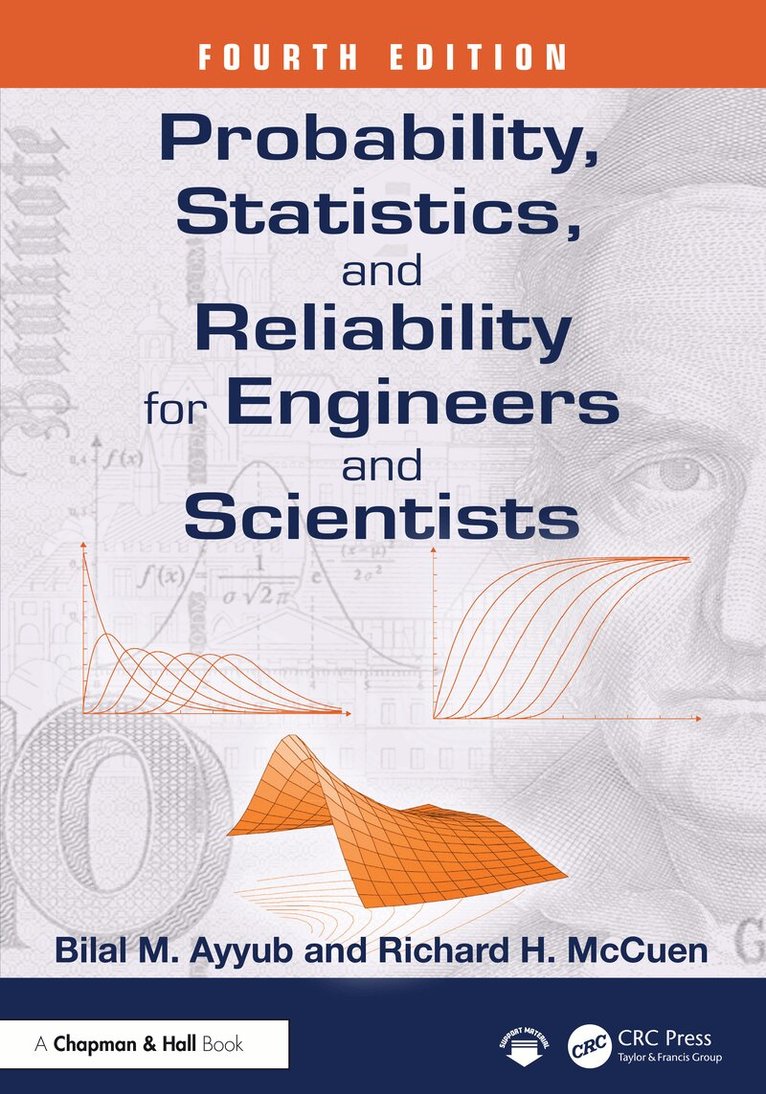
    Probability, Statistics, and Reliability for Engineers and Scientists

    AvBilal M. Ayyub,Richard H. McCuen

    Inbunden, Engelska, 2025

    1 692 kr

    Beställningsvara. Skickas inom 10-15 vardagar. Fri frakt över 249 kr.

    Fler format och utgåvor

    Inbunden

    Tillf. slut

    Beskrivning

    Virtually every engineer and scientist must be able to collect, analyze, interpret, and properly use vast arrays of data. This means acquiring a solid foundation in the methods of data analysis and synthesis. Understanding the theoretical aspects is important, but learning to properly apply the theory to real-world problems is essential.The goal of this popular and proven book is to introduce the fundamentals of probability, statistics, reliability, and risk methods to engineers and scientists for the purpose of data and uncertainty analysis and modeling in support of decision-making.The primary objectives to the author’s approach include: (1) introducing probability, statistics, reliability, and risk methods to students and practicing professionals in engineering and the sciences; (2) emphasizing the practical use of these methods; and (3) establishing the limitations, advantages, and disadvantages of the methods. The book was developed with an emphasis on solving real-world technological problems that engineers and scientists are asked to solve as part of their professional responsibilities.Upon graduation, engineers and scientists must have a solid academic foundation in methods of data analysis and synthesis, as the analysis and synthesis of complex systems are common tasks that confront even entry-level professionals.The underlying theory, especially the assumptions central to the methods, is presented, but then the proper application of the theory is presented through realistic examples, often using actual data. Every attempt is made to show that methods of data analysis are not independent of each other. Instead, we show that real-world problem-solving often involves applying many of the methods presented in different chapters.Probability, Statistics, and Reliability for Engineers and Scientists, here in its fourth edition, is a very popular textbook. Ultimately, readers will find its content of great value in problem-solving and decision-making, particularly in practical applications.

    Produktinformation

    • Utgivningsdatum:2025-05-12
    • Mått:178 x 254 x 35 mm
    • Vikt:1 440 g
    • Format:Inbunden
    • Språk:Engelska
    • Antal sidor:614
    • Upplaga:4
    • Förlag:Taylor & Francis Ltd
    • ISBN:9781032967714

    Utforska kategorier

    • Matematisk statistik inom Naturvetenskap och teknik
    • Teknik: allmänt inom Naturvetenskap och teknik

    Mer om författaren

    Bilal M. Ayyub, PhD, PE, DistMASCE, HonMASME, is an A. James Clark School of Engineering Professor and Director of the Center for Technology and Systems Management at the University of Maryland, College Park and was a visiting fellow at the National Security Analysis Department of the Applied Physics Laboratory from 2015–2016. He was a chair professor at Tongji University, Shanghai, China (2016–2018) and is currently the Co-Director of its International Joint Research Center for Resilient Infrastructure. He completed his PhD and MSCE degrees from the Georgia Institute of Technology in 1983 and 1981, and BSCE from Kuwait University in 1980. Dr. Ayyub’s main research interests and work are in risk, resilience, sustainability, uncertainty, and decision analysis, applied to civil, infrastructure, and energy. Professor Ayyub is also a fellow of the Society of Naval Architects and Marine Engineers (SNAME), the Structural Engineering Institute (SEI), and the Society for Risk Analysis (2017–018 Treasurer), and a senior member of the Institute of Electrical and Electronics Engineers (IEEE). Dr. Ayyub completed research and development projects for governmental and private entities worldwide. He is the recipient of several awards, most recently the 2024 ASCE OPAL Award for Education; the 2018 ASCE Alfredo Ang Award on Risk Analysis and Management of Civil Infrastructure; the 2019 ASCE President Medal for efforts to bring adaptive design to the profession to help address a changing climate; the 2019 ASCE Le Val Lund Award for contributions to resilience enhancement and risk reduction of lifeline-networked systems through measurement science and associated economics of informing policy and decision-making practices; the 2018 ENR Newsmaker Award for passionate efforts in giving engineers their first formal guidance to be more resilient to weather extremes when designing infrastructure; and the 2016 ASNE Solberg Award for significant engineering research and development accomplishments in the field of ship survivability. He is the author and co-author of more than 650 publications in journals, conference proceedings, and reports, and the founding editor-in-chief of the ASCEASME Journal on Risk and Uncertainty in Engineering Systems in its two parts on civil and mechanical engineering. In addition to 15 edited books, his eight textbooks include the following titles: Uncertainty Modeling and Analysis for Engineers and Scientists (Chapman & Hall/CRC 2006 with G. Klir), Risk Analysis in Engineering and Economics (Chapman & Hall/CRC 2003, 2014), Elicitation of Expert Opinions for Uncertainty and Risks (CRC Press 2002), and Numerical Methods for Engineers (Prentice Hall 1996 with McCuen, 2nd ed. Chapman & Hall/CRC 2016). Dr. Ayyub is an academician of the Georgian National Academy of Science, Tbilisi, Georgia, and serves on the National Oceanic and Atmospheric Administration (NOAA) Science Advisory Board, the National Academies Board of Environmental Change and Society, and the Roundtable on Macroeconomics and Climate Related Risks and Opportunities.Richard H. McCuen, PhD, is an emeritus professor of civil and environmental engineering at the University of Maryland. He retired as the Ben Dyer Professor of Civil & Environmental Engineering (1998–2020). Dr. McCuen received a BSCE degree from Carnegie-Mellon University (1967) and MSCE and PhD (1971) degrees from the Georgia Institute of Technology. He was a faculty member at the University of Maryland for 49 years and served as Director of the Engineering Honors Program for more than 35 years. He is the author of 29 textbooks including Hydrologic Analysis and Design (4th ed., 2017), Modeling Hydrologic Change (2002), and Critical Thinking, Idea Innovation, and Creativity (2023). He received the 2015 Ven Te Chow Award for Research, Education, and Service from ASCE, the 1991 James M. Robbins Award for Excellence in Teaching from Chi Epsilon, the 2017 President’s Outstanding Service Award from the AWRA, and the 1988 Icko Iben Award from the AWRA.

    Innehållsförteckning

    • IntroductionIntroductionKnowledge, Information, and OpinionsIgnorance and UncertaintyAleatory and Epistemic Uncertainties in System AbstractionCharacterizing and Modeling UncertaintySimulation for Uncertainty Analysis and PropagationSimulation ProjectsData Description and TreatmentIntroductionClassification of DataGraphical Description of DataHistograms and Frequency DiagramsDescriptive MeasuresApplicationsAnalysis of Simulated DataSimulation ProjectsFundamentals of ProbabilityIntroductionSets, Sample Spaces, and EventsMathematics of ProbabilityRandom Variables and Their Probability DistributionsMomentsApplication: Water Supply and QualitySimulation and Probability DistributionsSimulation ProjectsProbability Distributions for Discrete Random VariablesIntroductionBernoulli DistributionBinomial DistributionGeometric DistributionPoisson DistributionNegative Binomial and Pascal Probability DistributionsHypergeometric Probability DistributionApplicationsSimulation of Discrete Random VariablesA Summary of DistributionsSimulation ProjectsProbability Distributions for Continuous Random VariablesIntroductionUniform DistributionNormal DistributionLognormal DistributionExponential DistributionTriangular DistributionGamma DistributionRayleigh DistributionBeta DistributionStatistical Probability DistributionsExtreme Value DistributionsApplicationsSimulation and Probability DistributionsA Summary of DistributionsSimulation ProjectsMultiple Random VariablesIntroductionJoint Random Variables and Their Probability DistributionsFunctions of Random VariablesModeling Aleatory and Epistemic UncertaintyApplicationsMultivariable SimulationSimulation ProjectsSimulationIntroductionMonte Carlo SimulationRandom NumbersGeneration of Random VariablesGeneration of Selected Discrete Random VariablesGeneration of Selected Continuous Random VariablesApplicationsSimulation ProjectsFundamentals of Statistical AnalysisIntroductionProperties of EstimatorsMethod-of-Moments EstimationMaximum Likelihood EstimationSampling DistributionsUnivariate Frequency AnalysisApplicationsSimulation ProjectsHypothesis TestingIntroductionGeneral ProcedureHypothesis Tests of MeansHypothesis Tests of VariancesTests of DistributionsApplicationsSimulation of Hypothesis Test AssumptionsSimulation ProjectsAnalysis of VarianceIntroductionTest of Population MeansMultiple Comparisons in the ANOVA TestTest of Population VariancesRandomized Block DesignTwo-Way ANOVAExperimental DesignApplicationsSimulation ProjectsConfidence Intervals and Sample-Size DeterminationIntroductionGeneral ProcedureConfidence Intervals on Sample StatisticsSample Size DeterminationRelationship between Decision Parameters and Types I and II ErrorsQuality ControlApplicationsSimulation ProjectsRegression AnalysisIntroductionCorrelation AnalysisIntroduction to RegressionPrinciple of Least SquaresReliability of the Regression EquationReliability of Point Estimates of the Regression CoefficientsConfidence Intervals of the Regression EquationCorrelation versus RegressionApplications of Bivariate Regression AnalysisSimulation and Prediction ModelsSimulation ProjectsMultiple and Nonlinear Regression AnalysisIntroductionCorrelation AnalysisMultiple Regression AnalysisPolynomial Regression AnalysisRegression Analysis of Power ModelsApplicationsSimulation in Curvilinear ModelingSimulation ProjectsReliability Analysis of ComponentsIntroductionTime to FailureReliability of ComponentsFirst-Order Reliability MethodAdvanced Second-Moment MethodSimulation MethodsReliability-Based DesignApplication: Structural reliability of a Pressure VesselSimulation ProjectsReliability and Risk Analysis of SystemsIntroductionReliability of SystemsRisk AnalysisRisk-Based Decision AnalysisApplication: System Reliability of a Post-Tensioned TrussSimulation ProjectsBayesian MethodsIntroductionBayesian ProbabilitiesBayesian Estimation of ParametersBayesian StatisticsApplicationsAppendix A: Probability and Statistics TablesAppendix B: Taylor Series ExpansionAppendix C: Data for Simulation ProjectsAppendix D: Semester Simulation ProjectIndexProblems appear at the end of each chapter.