• Fri frakt över 249 kr
  • •
  • Snabba leveranser
  • •
  • Billiga böcker
Kundservice

Du är på sajten för privatpersoner.

Företag, bibliotek eller offentlig verksamhet?

Du handlar på classic.bokus.com, där alla dina funktioner finns intakta.
Till classic.bokus.com
Bokus logotyp. Gå till startsidan.
  • Erbjudanden
  • Nyheter
  • Student
  • Topplistor
  • Barn & ungdom
  • Bokus Play
  • E-böcker
  • Pocketböcker
  • Spel & pussel

Må bättre, för mindre! Upp till 50% rabatt på hälsoböcker

Sidfot

Mina sidor

    Hjälp

    • Kundservice
    • Vanliga frågor och svar
    • Frakt och leverans
    • Retur vid ångerrätt
    • Reklamera vara
    • Betalning
    • Köpvillkor
    • Allmänna villkor
    • Information om webbplatsens tillgänglighet

    Om Bokus

    • Om oss
    • Pressrum
    • För studenter
    • För företag
    • För bibliotek och offentlig verksamhet
    • För leverantörer
    • Hållbarhet

    Populärt

    • Aktuella erbjudanden
    • Presentkort
    • Studentlitteratur
    • Nya böcker
    • Topplistor
    • Signerade böcker
    • Engelska böcker

    Inspiration

    • Boktips
    • BookTok
    • Populära bokserier
    • Barnbokskaraktärer
    • Populära författare
    Logotyp för Bokus
    Följ oss på Facebook (extern länk)Följ oss på Instagram (extern länk)Följ oss på YouTube (extern länk)Följ oss på TikTok (extern länk)
    bokus @ CookiesAnpassa cookiesIntegritetspolicyKöpvillkor
    Till Citymail hemsida (extern länk)Till Budbee hemsida (extern länk)Till Postnord hemsida (extern länk)Till Schenker hemsida (extern länk)Till Early Bird hemsida (extern länk)Till Walleys hemsida (extern länk)
    1. Ekonomi och Ledarskap
    2. Nationalekonomi
    3. Mikroekonomi

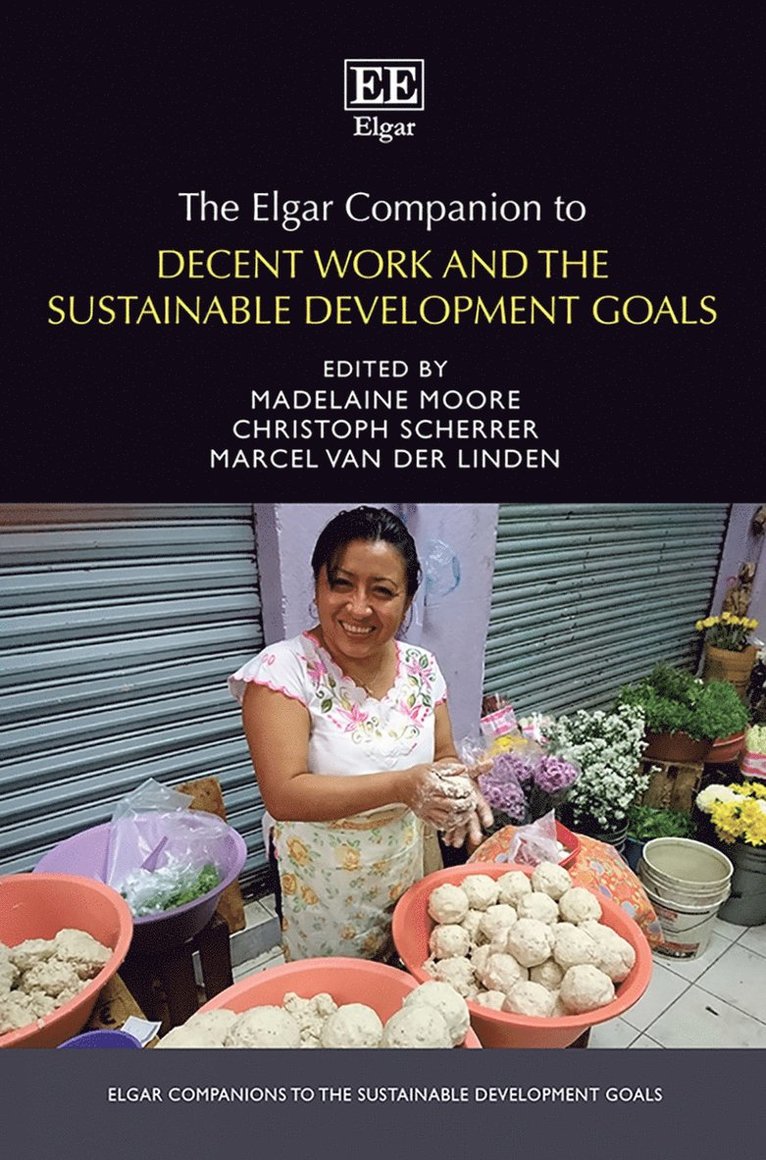
    Elgar Companion to Decent Work and the Sustainable Development Goals

    AvMadelaine Moore,Christoph Scherrer

    Inbunden, Engelska, 2025

    Del i serien Elgar Companions to the Sustainable Development Goals series

    4 472 kr

    Beställningsvara. Skickas inom 5-8 vardagar. Fri frakt över 249 kr.

    Beskrivning

    The Elgar Companion to Decent Work and the Sustainable Development Goals is an essential reference for understanding the role of the International Labour Organization (ILO) and its promotion of fair conditions, rights at work and employment opportunities for all. Bringing together contributions from over 60 leading labour scholars, this Companion critically investigates the ILO’s Decent Work Agenda and how it links to the UN’s Sustainable Development Goals. Chapters look ahead to the future of labour trends and address a range of perspectives, including viewpoints from political science, economics, sociology and law. A comprehensive analysis of the decent work deficit is provided, along with an examination of the global labour market. Ultimately, the Companion discusses pressing issues such as ecological crises and the growing effect of the gig economy and automation on the changing nature of work, addressing the gap between aspirations and the reality of the global labour market. This prescient Companion is vital for students and scholars of labour studies, economics, international relations and law. Offering an important overview of the history of the Decent Work Agenda, it is also beneficial to practitioners and policy advocates.

    Produktinformation

    • Utgivningsdatum:2025-01-21
    • Mått:169 x 244 x undefined mm
    • Format:Inbunden
    • Språk:Engelska
    • Serie:Elgar Companions to the Sustainable Development Goals series
    • Förlag:Edward Elgar Publishing Ltd
    • ISBN:9781035300891

    Utforska kategorier

    • Mikroekonomi inom Ekonomi och Ledarskap
    • Referensverk och tvärvetenskap inom Samhälle och politik
    • Miljövetenskap och miljöpolitik inom Naturvetenskap och teknik

    Mer om författaren

    Edited by Madelaine Moore, Environment and Society Group, The University of New South Wales, Australia, Christoph Scherrer, Professor Emeritus of Globalization and Politics, University of Kassel and Associate Fellow, Global Labour University, Germany and Marcel van der Linden, Senior Research Fellow, International Institute of Social History, Amsterdam, the Netherlands

    Recensioner i media

    ‘The Decent Work Agenda, proposed by the ILO in 1999 and formally adopted in 2008, comprises four pillars: employment creation, social protection, rights at work and social dialogue. In 2015 these were incorporated in the UN Agenda for Sustainable Development. Yet work has become more and more precarious and exploitative. This book critically assesses the ILO's strategic response to globalisation, addressing the setbacks and criticisms surrounding the decent work agenda. It captures the complexity of this agenda, evaluating different criticisms and providing a platform for further scrutiny. As a comprehensive guide, this Companion cuts across disciplines, including labour studies, political economy, political science, sociology and social policy. It serves as an important resource for academics, students and policy practitioners navigating the multifaceted landscape of labour, making it an essential contribution to the debates on sustainable development.’

    Innehållsförteckning

    • Contents 1 Introduction to the challenges of decent work and the Sustainable Development Goals 1 Madelaine Moore, Christoph Scherrer and Marcel van der Linden HISTORICAL AND CONCEPTUAL FOUNDATIONS OF DECENT WORK AND THE SDGS 2 Decent work’s place among the SDGs: contribution by the International Labour Organization 26 Eva Senghaas-Knobloch 3 The genesis of the Decent Work Agenda 39 Tânia Ferraro 4 Unravelling capitalist structuring conditions: limits of the Decent Work Agenda 52 Andreas Bieler 5 Competing conceptualizations of decent work: measurement and policy coherence challenges 63 Erica Di Ruggiero 6 Measuring decent work 76 Léa Renard and Bénédicte Zimmermann DEVELOPMENT OF WORKING CONDITIONS IN/OUTSIDE STANDARD WORK 7 The evolution of standard work 90 Paul Schoukens, Eleni De Becker and Charlotte Bruynseraede 8 The workplace 104 Narayan Prasad and Nausheen Nizami 9 Wages: functions, types, inequalities 116 Maarten van Klaveren 10 Work without protection: informal work 128 Jan Breman and Marcel van der Linden 11 Unemployment – underemployment 139 Gerhard Bosch12 Unfree labour within and beyond the Decent Work Agenda 152 Anne Lisa Carstensen 13 Reproductive work against productivism from the Decent Work Agenda to the SDGs 163 Alessandra Mezzadri 14 Valuing domestic labour: the changing meanings of ‘housework’ under capitalism 175 Indu Agnihotri DEVELOPMENT OF WORKING CONDITIONS OF SPECIFIC SOCIAL GROUPS 15 Women workers 188 Madhumita Dutta and Sirisha C. Naidu 16 Migrant workers 200 Helen Schwenken 17 Child workers 213 Ben White 18 Africa: young people between insecurity and the aspiration for decent jobs 225 Babacar Fall 19 People with disabilities 236 Felix Welti 20 Challenges of decent work for smallholders and agricultural workers: reflections on the Global South 247 Praveen Jha DRIVERS OF DECENT WORK DEFICITS 21 Three windows on decent work: theories of labour relations 260 Chris Tilly 22 Uneven and combined development and decent work 274 Ronaldo Munck 23 International labour migration and decent work 284 Immanuel Ness 24 Labour, social upgrading and indecent work in global value chains 298 Kristoffer Marslev and Cornelia StaritzPUBLIC AND CORPORATE ENFORCEMENT MECHANISMS OF DECENT WORK 25 Navigating globalization: examining the ILO’s efforts to promote decent work 312 Faradj Koliev 26 The ILO and the promotion of social dialogue at the global and national level 324 Yvonne Rueckert 27 The elimination of violence and harassment in the world of work: ILO Convention No. 190 335 Reingard Zimmer 28 Securing compliance with standards of occupational health and safety: labour inspection and its challenges 346 David Walters 29 Trade agreements and decent work 358 Christoph Scherrer 30 Corporate due diligence in global value chains 370 Christian Scheper 31 The efficacy of market-driven voluntary governance mechanisms for decent work 382 Tim Connor, Kate Macdonald and Shelley Marshall 32 Regional integration: a promising tool to advance the international decent work agenda? 396 Roland Erne, Mark Anner, Michele Ford, Tamara Kay and Vincenzo Maccarrone BOTTOM-UP ENFORCEMENT MECHANISMS AND DECENT WORK 33 Trade unions and decent work 413 Greg Patmore 34 Trade unions as organised forms of labour movements: why this matters in liberal democracies 425 Peter Fairbrother and Karen Douglas 35 Strikes and decent work 438 Jörg Nowak 36 Collective representation of precarious workers: what has the Decent Work Agenda got to do with it? 448 Edlira Xhafa and Melisa R. Serrano37 Worker organizing in the Global South: an experimental trend 461 Lynford Dor and Edward Webster 38 Transnational regulation of decent work through Global Framework Agreements: a collective instrument of worker voice 473 Michael Fichter 39 The power of boycotts 487 Allyson P. Brantley NEW CHALLENGES TO THE DECENT WORK AGENDA 40 The role of labour and nature within just transition strategies 500 Nora Räthzel and Dimitris Stevis 41 Work health and safety, adaptation, and climate change 514 Elizabeth Humphrys 42 Degrowth and decent work 526 Birte Strunk 43 Future of work and global trends: reframing the debate in an age of state capitalism and systemic competition 538 Frederick Harry Pitts and Huw Thomas 44 The technopolitics of decent digital work 551 Simon Schaupp 45 Digital labour platforms and their contribution to development outcomes 562 Uma Rani, Rishabh Kumar Dhir and Nora Gobel ALTERNATIVES TO WORKPLACE-RELATED RIGHTS 46 Decent work and welfare states: two sides of the same coin? 577 Martin Seeleib-Kaiser, Leonid Shvyrev and Jakub Sowula 47 Social protection floors as a knowledge object: examining their place within the Decent Work and Sustainable Development Agenda 604 John Berten and Alexandra Kaasch 48 Universal versus employment-based social protection? 615 Gabriele Koehler 49 Size matters: universal basic income as a strategy for decent work 627 Ruth Castel-Branco and Nicolas Pons-Vignon THE FUTURE OF THE DECENT WORK AGENDA 50 No future for decent work without the right to strike 639 Frank Hoffer