• Fri frakt över 249 kr
  • •
  • Snabba leveranser
  • •
  • Billiga böcker
Kundservice

Du är på sajten för privatpersoner.

Företag, bibliotek eller offentlig verksamhet?

Du handlar på classic.bokus.com, där alla dina funktioner finns intakta.
Till classic.bokus.com
Bokus logotyp. Gå till startsidan.
  • Erbjudanden
  • Nyheter
  • Student
  • Topplistor
  • Barn & ungdom
  • Bokus Play
  • E-böcker
  • Pocketböcker
  • Spel & pussel

10% rabatt på allt med kod NYSTART10 →

Sidfot

Mina sidor

    Hjälp

    • Kundservice
    • Vanliga frågor och svar
    • Frakt och leverans
    • Retur vid ångerrätt
    • Reklamera vara
    • Betalning
    • Köpvillkor
    • Allmänna villkor
    • Information om webbplatsens tillgänglighet

    Om Bokus

    • Om oss
    • Pressrum
    • För studenter
    • För företag
    • För bibliotek och offentlig verksamhet
    • För leverantörer
    • Hållbarhet

    Populärt

    • Aktuella erbjudanden
    • Presentkort
    • Studentlitteratur
    • Nya böcker
    • Topplistor
    • Signerade böcker
    • Engelska böcker

    Inspiration

    • Boktips
    • BookTok
    • Populära bokserier
    • Barnbokskaraktärer
    • Populära författare
    Logotyp för Bokus
    Följ oss på Facebook (extern länk)Följ oss på Instagram (extern länk)Följ oss på YouTube (extern länk)Följ oss på TikTok (extern länk)
    bokus @ CookiesAnpassa cookiesIntegritetspolicyKöpvillkor
    Till Citymail hemsida (extern länk)Till Budbee hemsida (extern länk)Till Postnord hemsida (extern länk)Till Schenker hemsida (extern länk)Till Early Bird hemsida (extern länk)Till Walleys hemsida (extern länk)
    1. Naturvetenskap och teknik
    2. Geovetenskap
    3. Miljövetenskap och miljöpolitik

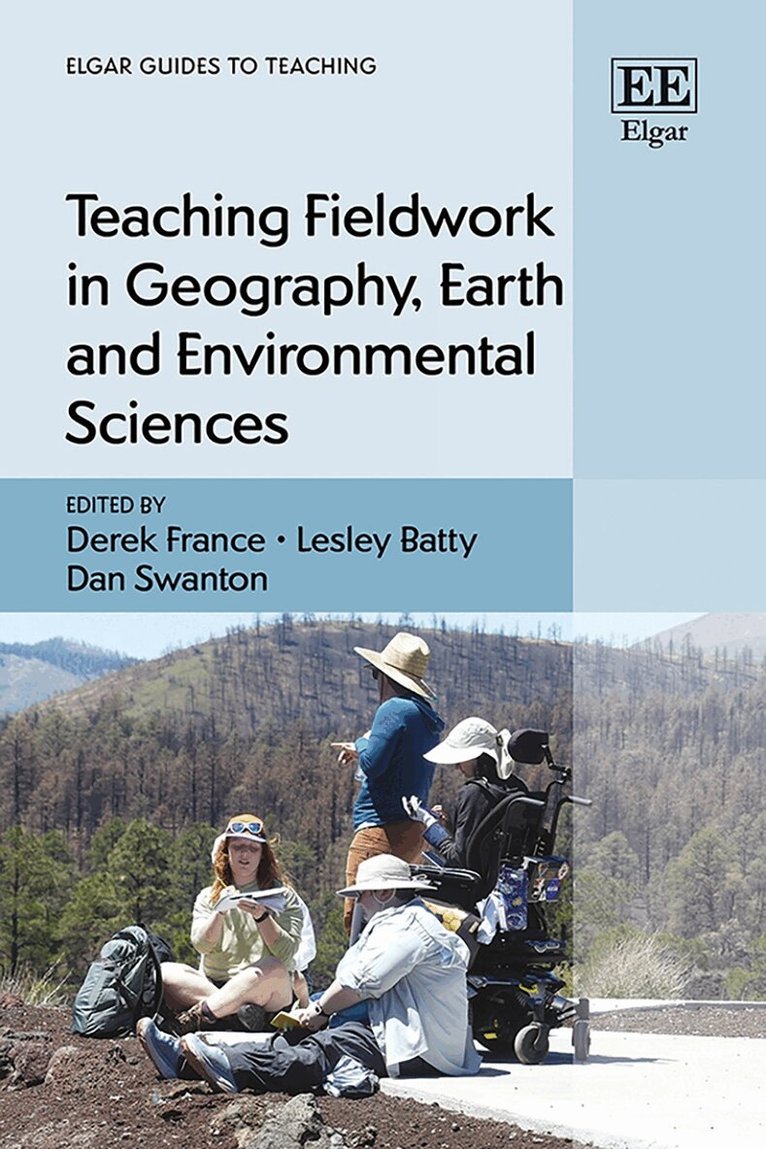
    Teaching Fieldwork in Geography, Earth and Environmental Sciences

    AvDerek France,Lesley Batty

    Inbunden, Engelska, 2025

    Del i serien Elgar Guides to Teaching

    2 367 kr

    Beställningsvara. Skickas inom 5-8 vardagar. Fri frakt över 249 kr.

    Beskrivning

    This book provides invaluable practical guidance for teaching and learning through fieldwork in higher education. Featuring contributions from a diverse range of experienced field educators, it delves into the challenges and opportunities of teaching beyond the classroom across Geography, Earth and Environmental Sciences (GEES).Organised into three thematic parts, the book covers ethical and responsible fieldwork, approaches to defining and redefining the field, and relevant skills and competencies. Chapters discuss strategies for making learning accessible, facing uncertainty and transforming fieldwork using digital tools, supplemented by themed vignettes which provide examples and resources for teaching. The book documents the many innovative ways in which educators are responding to the changing contexts of fieldwork and concludes by presenting an insightful audit tool that readers can use to reflect on, review and enhance their field teaching.Interdisciplinary in scope, this is a vital read for instructors in geography, earth sciences, environmental science and archaeology as well as other courses with a fieldwork component. Its theoretical and practical insights are also beneficial to students and researchers interested in education, teaching methods, outdoor education and future skills development.

    Produktinformation

    • Utgivningsdatum:2025-07-29
    • Mått:156 x 234 x undefined mm
    • Format:Inbunden
    • Språk:Engelska
    • Serie:Elgar Guides to Teaching
    • Förlag:Edward Elgar Publishing Ltd
    • ISBN:9781035322381

    Utforska kategorier

    • Miljövetenskap och miljöpolitik inom Naturvetenskap och teknik
    • Geografi inom Naturvetenskap och teknik
    • Referensverk och tvärvetenskap inom Samhälle och politik

    Mer om författaren

    Edited by Derek France, Division of Humanities, Cultures & Environment, University of Chester, Lesley Batty, School of Geography, Earth and Environmental Sciences, University of Birmingham and Dan Swanton, School of GeoSciences, University of Edinburgh, UK

    Recensioner i media

    ‘This collection of edited chapters provides a timely contribution to the pedagogy of field teaching and learning. At the outset, the signature pedagogy of the Geography, Earth and Environmental Sciences disciplines is conceptualised in its broadest terms, essentially defined as any learning activity that takes place beyond the limits of the classroom. Fundamentally fieldwork engages students with real-world experiences. The intent of this book is to provide both guidance and examples of how to create field courses (from moments to months) that can be delivered within the challenging and continually evolving framework of Higher Education in which we find ourselves at present. Covering three key themes, (1) ethical, responsible, safe and accessible fieldwork, (2) defining and redefining the field, and (3) fieldwork skills and competences, examples and resources to design and deliver field courses are shared throughout each chapter using a series of vignettes. The ‘how to’ emphasis of each chapter is backed up and informed by a robust pedagogy. This approach makes the content of the book, with its emphasis and focus on sharing practice and commitment to enhancing fieldwork, engaging, accessible and appealing, as well as generating and embodying a genuine community of practice in the discipline.

    Innehållsförteckning

    • ContentsPreface xxiAcknowledgements xxix1 Introduction to Teaching Fieldwork in Geography, Earth andEnvironmental Sciences 1Derek France, Lesley Batty and Dan SwantonVignette 1.1: Students’ everyday life as fieldwork – learningemotional geographies in the classroom and beyond 11Matej BlazekVignette 1.2: Through the window – embedding micro-fieldworkactivity into classroom teaching 14Peter G. KnightVignette 1.3: Fieldwork bingo cards 17Kjersti Daae and Mirjam S. Glessmer2 Climate hypocrisy, sustainability and undergraduate fieldtrips 21Elizabeth R. Hurrell, Adrian Gonzalez and Daryl StumpVignette 2.1: Sustainable travel for fieldwork 41Jane Bevan, Tamara Hunt and Lucas TrawickiVignette 2.2: Growing local sustainable food and community 44Eifiona Thomas Lane and Rebecca JonesVignette 2.3: Lower carbon week-long fieldtrips 47Aled Singleton, Keith Halfacree, Angharad Closs and Stephens3 Ethics in fieldwork teaching 50Julia Cooke, Matthew W. Bulbert, Eleanor Drinkwater andZoë M. SimmonsVignette 3.1: Developing a care-full praxis of ‘access is love’ inapproaching and practising fieldwork 70Sam Staddon and Clare BarnesVignette 3.2: Decolonising geography fieldwork – commemorativelandscapes in Western Australia 734 Who really matters? Methods for making fieldwork accessibleand inclusive 77Trevor Collins and Sarah DaviesVignette 4.1: Inclusivity in student fieldtrips 91Christine Barnes, Kevin Lougheed and Daniel SchillereffVignette 4.2: Conquering the mountain – the practicalities ofmaking in-person fieldwork accessible 94Katherine Dobbie and Jennifer PikeVignette 4.3: Enabling remote activity – a responsive system for livelinking students to fieldwork 98Sarah Davies and Trevor CollinsVignette 4.4: An inclusive, accessible investigation based on the useof video resources 101Janet Haresnape, Hannah Gauci and Vicky TaylorVignette 4.5: Hybrid fieldwork approaches – the independent studyof ‘place’ in teaching and learning 104Fiona Williams and Sonja RewhornVignette 4.6: Geoscience in pixels – a creative approach to moreinclusive fieldwork 107Ed Thomas, Anna McGairy, Manlin Zhang, Frankie Butler andRosa FrancescaVignette 4.7: Distance teaching field skills without access to theinternet – a second-year Human Geography module 111Vicky Johnson and Sonja RewhornVignette 4.8: City parks as venues for accessible and inclusive OpenUniversity environment field days 114Jennie Neve Bellamy and Yoseph Araya5 Supporting students in the field 117Julie Peacock, Liam Taylor and C. Scott WatsonVignette 5.1: Foregrounding field-based student welfare andcommunity – a framework for developing collaborative residentialfield courses 129Hannah Mathers6 Research in the field and professional practice 133Brian Whalley, Derek France and Sonja RewhornVignette 6.1: ‘Drifting’ the city – familiarising learners with thefield site through group-led, randomised walking 152Edward WigleyVignette 6.2: Exploring in/accessibility of familiar urbanenvironments using qualitative and immersive methods 155Faith and TuckerVignette 6.3: Undergraduate expedition fieldwork to South CentralNorway 158Jane Bevan and Derek FranceVignette 6.4: Experiential learning during international fieldwork inBarcelona 161Alan Marvell and David SimmVignette 6.5: Using interactive maps and dashboards to developstudents’ sense of place before, during and after Human Geographyfieldwork 164David Morgan and Charlotte FosterVignette 6.6: Participation of undergraduate students as fieldassistants for postgraduate fieldwork 167Edward G. McGowan and Matthew Brown7 Enhancing and transforming fieldwork using digital tools 170Lesley Batty, Kristofer Chan and Derek FranceVignette 7.1: Hyperlocal fieldwork – connecting users to a local orbringing together many locals 190Addy Pope and Derek FranceVignette 7.2: Opportunities offered by drones, 360 degrees scanningand extended reality (virtual and augmented reality) to enhancefieldwork experience 193Servel MillerVignette 7.3: Using Esri’s 360 VR for developing learningopportunities and accessibility on field courses 196Damien MansellVignette 7.4: Digital fieldtrips – crafting environmental historynarratives with StoryMapJS 199Paul MunroVignette 7.5: Student co-creation of virtual fieldtrips 202Simon M. Hutchinson and Amy L. EvansVignette 7.6: Project Millport – creating a virtual fieldtrip inMinecraft 205Richard Fitzpatrick8 Citizen science and community-based fieldwork 208Alice Mauchline and Ian ThornhillVignette 8.1: Volunteering as fieldwork – ‘I felt as though I wasdoing something that actually was beneficial to the environmentrather than just learning how to help theoretically’ 224Dominic Charles HenriVignette 8.2: Participatory action research in Malawi 227Alan DixonVignette 8.3: ArcGIS Survey123 231Kristofer Chan9 Navigating success: groupwork strategies in field environments 234Liz HamiltonVignette 9.1: Students taking ownership in a jigsaw approach tofieldwork 258Kjersti Daae, Hans Christian Steen-Larsen and Mirjam S. GlessmerVignette 9.2: Groupwork in an immersive virtual fieldtrip setting 262Jenny Shepperson and Sarah ZylinskiVignette 9.3: Learning environmental science in the UK usingmobile-device-captured current data by Malawian macadamia nutfarmers 265Yoseph Araya, Jennie Neve Bellamy, Andrew Emmott, Will Rawesand Emmanuel ZuzaVignette 9.4: Site surveying for contaminated land assessment 268Lucy CrockfordVignette 9.5: Using Digital Field Notebooks (DFN) for collaborativefield notes 271Janine Maddison, Richard Bevan and Sara MarshamVignette 9.6: Reconstructing natural and anthropogenicenvironmental change 275Graham Wilson and Derek France10 Project-led fieldwork 279Phil Jones and Rhiannon BlakeVignette 10.1: Challenging fieldwork with problem-based learning 290Adrian Chappell, Pan He and David MacLeodVignette 10.2: Project-based field teaching – blending desktopresearch with first-hand encounters 293Niall Majury and Conor Graham11 Assessment and fieldwork 296Dan SwantonVignette 11.1: Landscape character assessment – working above theecosystem level 315Bethan WoodVignette 11.2: Volcanic hazard and emergency management in theBay of Naples 318Servel Miller, Martin Degg, Namrata Bhattacharya-Mis andKatharine WelshVignette 11.3: Building reflection for research design learning andresearch skill development 322Katie Orchel and Geoff Main12 Field learning and employability in Geography, Earth, andEnvironmental Sciences 327Jacqueline Dohaney and Alison StokesVignette 12.1: Using scaffolding to deliver professional field skills totackle the graduate ecological skills gap 340Sarah L. TaylorVignette 12.2: Fieldwork case studies – a model for the developmentof essential employability skills in a fieldwork setting 343Laura Grange and Martyn KurrVignette 12.3: Live fieldwork broadcast – a student placement 348Janine Maddison, Leah Ada Constantinou, Ellen Fletcher, CallumTurner, Richard Bevan and Sara MarshamVignette 12.4: From the field to a career – building skills foremployability 352Addy Pope, Dave Morgan and Damien MansellVignette 12.5: Working with industry for Grand Challenge studentled fieldwork learning experience 355Rupert Perkins and Sophie Watson13 Conclusions and recommendations for teaching fieldwork inGeography, Earth and Environmental Sciences 359Derek France, Lesley Batty and Dan Swanton