• Fri frakt över 249 kr
  • •
  • Snabba leveranser
  • •
  • Billiga böcker
Kundservice

Du är på sajten för privatpersoner.

Företag, bibliotek eller offentlig verksamhet?

Du handlar på classic.bokus.com, där alla dina funktioner finns intakta.
Till classic.bokus.com
Bokus logotyp. Gå till startsidan.
  • Erbjudanden
  • Nyheter
  • Student
  • Topplistor
  • Barn & ungdom
  • Bokus Play
  • E-böcker
  • Pocketböcker
  • Spel & pussel

10% studentrabatt med kod TERM26

Sidfot

Mina sidor

    Hjälp

    • Kundservice
    • Vanliga frågor och svar
    • Frakt och leverans
    • Retur vid ångerrätt
    • Reklamera vara
    • Betalning
    • Köpvillkor
    • Allmänna villkor
    • Information om webbplatsens tillgänglighet

    Om Bokus

    • Om oss
    • Pressrum
    • För studenter
    • För företag
    • För bibliotek och offentlig verksamhet
    • För leverantörer
    • Hållbarhet

    Populärt

    • Aktuella erbjudanden
    • Presentkort
    • Studentlitteratur
    • Nya böcker
    • Topplistor
    • Signerade böcker
    • Engelska böcker

    Inspiration

    • Boktips
    • BookTok
    • Populära bokserier
    • Barnbokskaraktärer
    • Populära författare
    Logotyp för Bokus
    Följ oss på Facebook (extern länk)Följ oss på Instagram (extern länk)Följ oss på YouTube (extern länk)Följ oss på TikTok (extern länk)
    bokus @ CookiesAnpassa cookiesIntegritetspolicyKöpvillkor
    Till Citymail hemsida (extern länk)Till Budbee hemsida (extern länk)Till Postnord hemsida (extern länk)Till Schenker hemsida (extern länk)Till Early Bird hemsida (extern länk)Till Walleys hemsida (extern länk)
    1. Filosofi och religion
    2. Filosofi
    3. Filosofiska discipliner

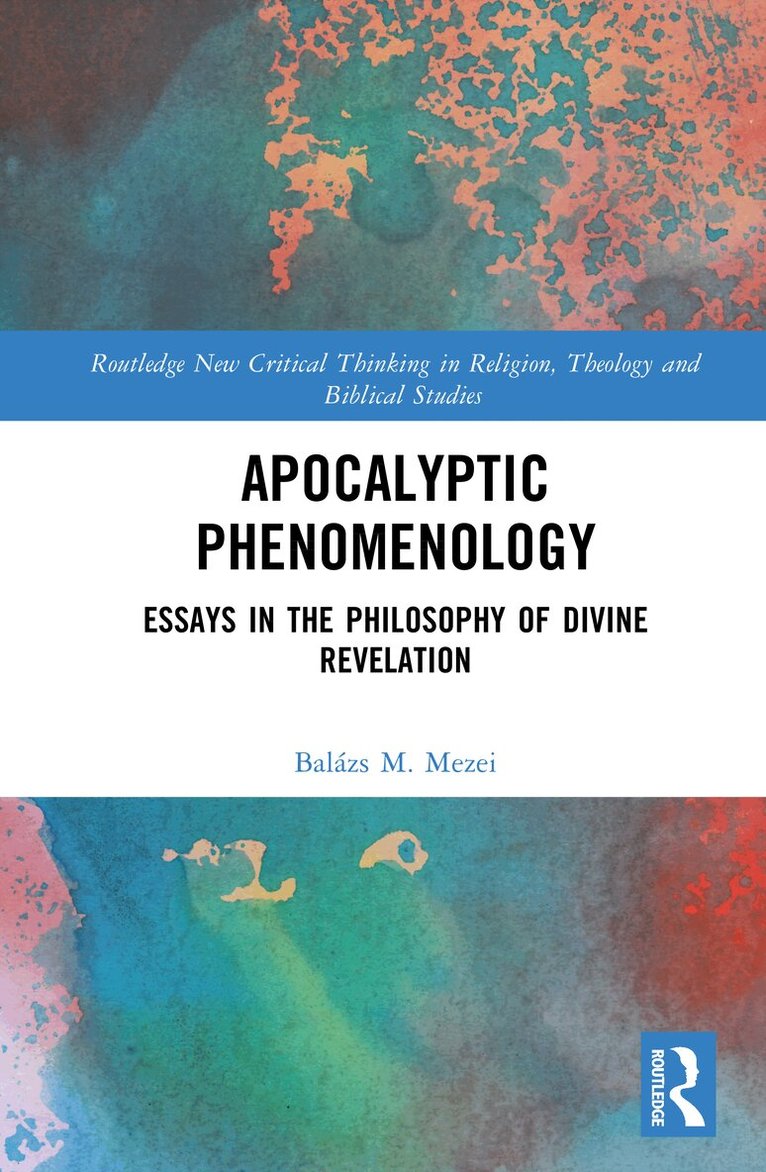
    Apocalyptic Phenomenology

    Essays in the Philosophy of Divine Revelation

    AvBalázs M. Mezei

    Inbunden, Engelska, 2025

    Del i serien Routledge New Critical Thinking in Religion, Theology and Biblical Studies

    2 434 kr

    Beställningsvara. Skickas inom 10-15 vardagar. Fri frakt över 249 kr.

    Fler format och utgåvor

    E-bok

    805 kr

    E-bok

    774 kr

    Beskrivning

    This book provides a detailed view of the author’s conception of ‘apocalyptic phenomenology’, referring to the revelatory and self-disclosing nature of phenomenological thinking, a thinking that is central to our philosophical traditions today.The concept of ‘apocalyptic phenomenology’, i.e., a phenomenological theology that discloses the ultimate ground of being, God in the form of divine revelation, is original. At the same time, it is rooted in the phenomenological tradition of Offenbarung (revelation, revealing) as the basic feature of phenomena. In the author’s view, reality is self-disclosing, ‘apocalyptic’, and thus he explains the connections between the original, biblical notion of apocalupsis and the important developments of our philosophical traditions leading up to the ‘theological turn of phenomenology’. The chapters are framed around a focus on newness and engage with the work of key thinkers such as Edmund Husserl, Martin Heidegger, Paul Ricœur, Hans Urs von Balthasar, and Anton Günther.Apocalyptic Phenomenology will be of interest to scholars of both theology and philosophy.

    Produktinformation

    • Utgivningsdatum:2025-11-28
    • Mått:156 x 234 x 22 mm
    • Vikt:760 g
    • Format:Inbunden
    • Språk:Engelska
    • Serie:Routledge New Critical Thinking in Religion, Theology and Biblical Studies
    • Antal sidor:314
    • Förlag:Taylor & Francis Ltd
    • ISBN:9781041077114

    Utforska kategorier

    • Filosofiska discipliner inom Filosofi och religion
    • Religion: allmänt inom Filosofi och religion
    • Kristendom inom Filosofi och religion

    Mer om författaren

    Balázs M. Mezei is Full Professor of Philosophy at Corvinus University of Budapest, Hungary. His publications include Radical Revelation: A Philosophical Approach (2017) and Divine Revelation and the Sciences (2024).

    Recensioner i media

    “Revelation, or apocalypsis, as seen through the eyes of philosophy as phenomenology, is the central focus of this book. The present work continues the author’s previous excellent work(s), and is consistent with this previous work. The title of this volume is striking, in its coupling of phenomenology and apocalypse, and yet once explained a light is shone on many fundamental issues. Apocalyptic Phenomenology refers us to the revelatory and self-disclosing nature of phenomenological thinking, indeed to the self-disclosing nature of actuality itself. Two central dimensions are stressed: first that our thinking is fundamentally direct or intuitive; second, that the idea of newness is crucial, both as regards our thinking but also of actuality itself. Newness allows us a new approach to what is old, and also to what is absolute. The motto omnia nova is deployed to express the view.”William Desmond, KU Leuven, Belgium“Central to the author’s project is the idea that dogmatic theology is a discipline that focuses specifically on an historically grounded concept of revelation and thus necessarily presupposes a philosophy of revelation. He understands this philosophy as phenomenology, especially apocalyptic phenomenology, which he explores in this work, making the study highly valuable for students of both phenomenology and dogmatic theology. The Central European philosophers have been the leaders in the field of phenomenology and Balázs M. Mezei is the most original and engaging of these contemporary Central European voices.”Tracey Rowland, University of Notre Dame, Australia“Philosophy, and phenomenological research in particular, was never a kind of invention, but rather an uncovering and elaboration of what is always and everywhere true, only that it still needs to be spelled out. The pinnacle of uncovering and spelling out is revelation, understood as that which is unconditionally true and yet difficult to fathom. Inevitably, we think of religion and divine proclamation when we think of revelation. Balázs Mezei confirms in this book that this is not so wrong, for all acts of thinking and engaging with reality follow the structure of revelation: no confirmation without newness, no reality without self-disclosure, no phenomena without personhood, no finitude without the absolute; every unveiling of the unknown is a disclosure of the knowable; hence, human understanding is ‘apocalyptic’ in that it regards reality as self-disclosing. In this ‘radical’ sense, which opens the investigation towards the root of things, apocalyptic phenomenology is a new version of apophatic theology: rational, realistic, and without mysticism.”Paul Richard Blum, Loyola University Maryland, USA

    Innehållsförteckning

    • 1. Foreword 2. The Newness of Revelation 3. The Rise of Revelation in Phenomenology 4. Method and Revelation 5. The Hard Problem of Revelation 6. Apocalyptic Phenomenology 7. Phenomenology of the Supernatural 8. Reason, Faith, and Revelation 9. Organic Revelation 10. The Scientific Impact of Revelation 11. A Radical Philosophical Theology of Revelation 12. Revelation as the Source of Dialogue 13. Revelation as Newness