• Fri frakt över 249 kr
  • •
  • Snabba leveranser
  • •
  • Billiga böcker
Kundservice

Du är på sajten för privatpersoner.

Företag, bibliotek eller offentlig verksamhet?

Du handlar på classic.bokus.com, där alla dina funktioner finns intakta.
Till classic.bokus.com
Bokus logotyp. Gå till startsidan.
  • Erbjudanden
  • Nyheter
  • Student
  • Topplistor
  • Barn & ungdom
  • Bokus Play
  • E-böcker
  • Pocketböcker
  • Spel & pussel

10% rabatt på allt med kod: NYSTART10 →

Sidfot

Mina sidor

    Hjälp

    • Kundservice
    • Vanliga frågor och svar
    • Frakt och leverans
    • Retur vid ångerrätt
    • Reklamera vara
    • Betalning
    • Köpvillkor
    • Allmänna villkor
    • Information om webbplatsens tillgänglighet

    Om Bokus

    • Om oss
    • Pressrum
    • För studenter
    • För företag
    • För bibliotek och offentlig verksamhet
    • För leverantörer
    • Hållbarhet

    Populärt

    • Aktuella erbjudanden
    • Presentkort
    • Studentlitteratur
    • Nya böcker
    • Topplistor
    • Signerade böcker
    • Engelska böcker

    Inspiration

    • Boktips
    • BookTok
    • Populära bokserier
    • Barnbokskaraktärer
    • Populära författare
    Logotyp för Bokus
    Följ oss på Facebook (extern länk)Följ oss på Instagram (extern länk)Följ oss på YouTube (extern länk)Följ oss på TikTok (extern länk)
    bokus @ CookiesAnpassa cookiesIntegritetspolicyKöpvillkor
    Till Citymail hemsida (extern länk)Till Budbee hemsida (extern länk)Till Postnord hemsida (extern länk)Till Schenker hemsida (extern länk)Till Early Bird hemsida (extern länk)Till Walleys hemsida (extern länk)
    1. Samhälle och politik
    2. Samhälle och kultur
    3. Kultur och medier
    4. Referensverk och tvärvetenskap

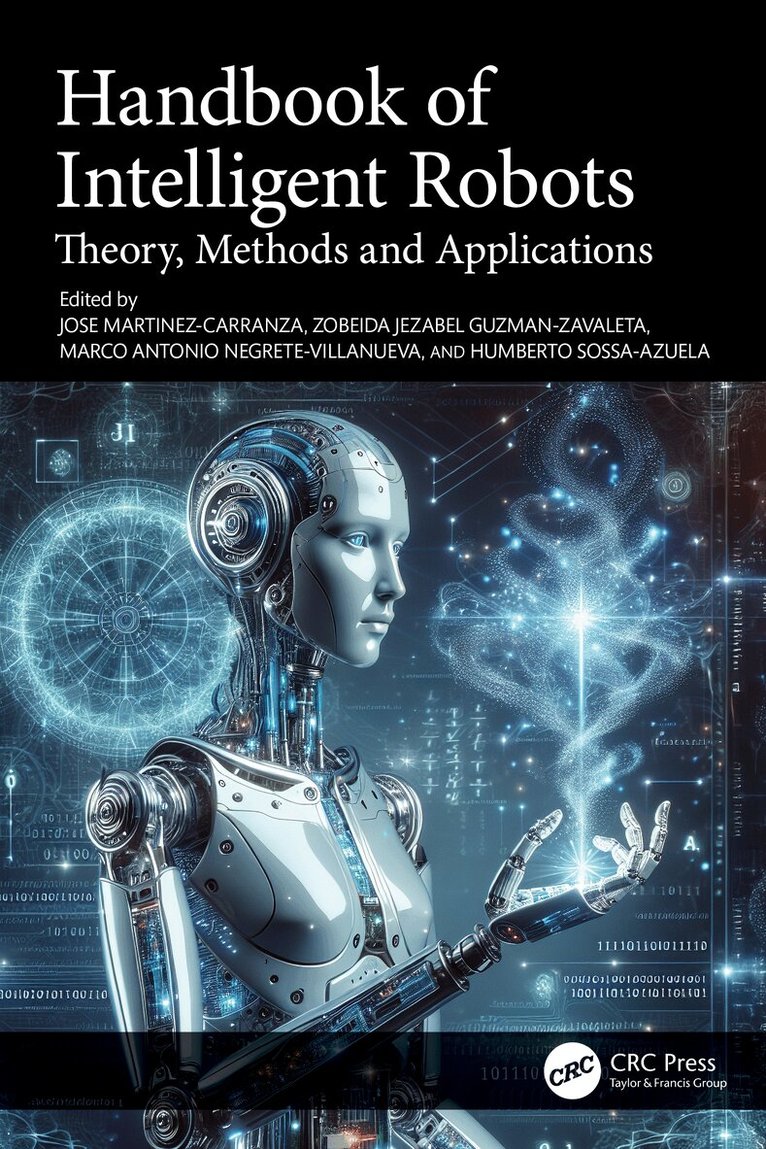
    Handbook of Intelligent Robots

    Theory, Methods and Applications

    AvJose Martinez-Carranza,Zobeida Jezabel Guzman-Zavaleta

    Inbunden, Engelska, 2026

    2 645 kr

    Beställningsvara. Skickas inom 10-15 vardagar. Fri frakt över 249 kr.

    Beskrivning

    This handbook introduces some of the most relevant techniques used to develop intelligent robotic systems and provides several examples of applications where robots equipped with AI are deployed to solve a task.Handbook of Intelligent Robots: Theory, Methods and Applications is split into two main parts. The first part reviews key methods for developing intelligent robots implemented across various robotic systems, including service robots, micro aerial vehicles, manipulators, and humanoids, among others, deployed in diverse applications. The second part of the book provides several examples of applications where robotics systems are leveraged by AI and machine learning techniques to address real life applications, thus providing insights into the challenges and limitations of deploying robotic systems outside the laboratory. The main goal of the book is to familiarize the reader with the most recent concepts and techniques that are enabling robots to update their learned models online, to perform them efficiently on embedded processors, and to enable sophisticated interaction with the environment using spatial AI techniques such as visual simultaneous localization and mapping. To this end, the reader will delve into techniques such as continual learning, binary neural networks, neural controllers, fuzzy controllers, generation of time-optimal trajectories, generative models, natural language processing for robotics, and robot audition.This book is intended for electrical, computer and mechanical engineers interested in robotics and AI as well as those interested in robots deployed in real life scenarios. It will be useful to postgraduate students seeking reviews of the state of the art regarding AI methods for robotics such as visual SLAM, continual learning, neural networks, and transformers.

    Produktinformation

    • Utgivningsdatum:2026-06-28
    • Mått:156 x 234 x 32 mm
    • Vikt:1 230 g
    • Format:Inbunden
    • Språk:Engelska
    • Antal sidor:558
    • Förlag:Taylor & Francis Ltd
    • ISBN:9781041079798

    Utforska kategorier

    • Referensverk och tvärvetenskap inom Samhälle och politik
    • Energiteknik inom Naturvetenskap och teknik
    • Elektronik och kommunikationer inom Naturvetenskap och teknik

    Mer om författaren

    Dr. Jose Martinez-Carranza is a Senior Researcher C (Equivalent to Full Professor) in the Computer Sciences Department at INAOE. In 2015, he received the Royal Society Newton Advanced Fellowship distinction, awarded by the Newton Fund. His team, QuetzalC++, has participated in highly prestigious international competitions, winning various awards, notably 1st Place in the IROS 2017 Autonomous Drone Racing competition, 1st Place Regional (Latin America) of the OpenCV AI Competition 2021, and ranked 10th in the A2RL Abu Dhabi Drone Racing Competition 2025. He has published 150 articles in scientific journals, book chapters, and international conference proceedings. He served as President of the Mexican Robotics Federation (2024-2025).Dr. Zobeida Jezabel Guzman-Zavaleta is the Managing Director of the Doctorate Department at the Universidad de las Americas Puebla (UDLAP) in Mexico. She also oversees the institutional STEM strategy and leads the Artificial Intelligence research group at UDLAP. Dr. Guzma´n holds a PhD and a master’s degree in science with a specialization in Computational Sciences from the Institute of Astrophysics, Optics, and Electronics (INAOE), as well as a Bachelor’s degree in Computer Science from the Benemérita Universidad Auto´noma de Puebla (BUAP). In 2023, she coordinated the PhD in Intelligent Systems program at UDLAP (SNP-CONAHCYT) and has been a full-time professor at the university since 2019. Her research focuses on advancing cutting-edge techniques in computer vision, machine learning, deep learning, processing digital images, video, and audio, and steganography and watermarking for data security and concealment.Dr. Marco Antonio Negrete-Villanueva is currently an Associate Professor at UNAM, and a member of the Board of Directors of theMexican Robotics Federation and Head of the Signal Processing Department at the School of Engineering, UNAM. He holds a PhD in Computer Science and a Master’sdegree in Automatic Control from the National Autonomous University of Mexico. Dr. Marco Negrete has worked on mobile robots focusing on autonomous navigation, movement planning, computer vision and manipulation. He has participated in several international competitions with humanoid and domestic service robots. His interests also include automatic control,self-driving cars and behavioral sciences.Dr. Humberto Sossa-Azuela is a full-time professor at the National Polytechnic Institute of Mexico and serves as the Director of the Centre for Research in Computing. He is an Emeritus Member of the National System of Researchers, member of the Mexican Academy of Sciences, the Academy of Engineering and Fellow of the Mexican Society for Artificial Intelligence. He has a PhD in Computer Science from the National Polytechnic Institute of Grenoble, France. In addition, He has been distinguished with several awards and distinctions, for instance, the National Computing Prize by the Mexican Academy of Computing (AMEXCOMP), as well as the National Prize from the Cuban Academy of Sciences in the field of Natural and Exact Sciences. In 2024, he was bestowed an Honorary Doctorate by the Technological Institute of Higher Education in Ecatepec. Dr Sossa is the author of five textbooks, holds 13 patents, 32 copyrights, and has published over 490 conference and journal papers. His research areas include Artificial Intelligence, Machine Learning, Artificial Neural Networks, Image Analysis, Pattern Recognition, Robotics, and Metaverses.

    Innehållsförteckning

    • 1. A Review on Theory and Applications for AI and Robotics. 2. Deep Learning for Robotics: from CNN to Transformers. 3. Continual Learning for Robotics in the Open World. 4. Efficient Learning through Binary Neural Networks. 5. Model Predictive Control for Robotics. 6. Fuzzy Controllers. 7. Neural Controllers. 8. Generation of Time-Optimal Trajectories. 9. A Review of visual SLAM systems in Challenging Scenarios. 10. Deep Neural Networks for Mapless Navigation in Indoor Environments. 11. Robot Audition for Egocentric Estimation. 12. Natural Language Processing for Robotics.