• Fri frakt över 249 kr
  • •
  • Snabba leveranser
  • •
  • Billiga böcker
Kundservice

Du är på sajten för privatpersoner.

Företag, bibliotek eller offentlig verksamhet?

Du handlar på classic.bokus.com, där alla dina funktioner finns intakta.
Till classic.bokus.com
Bokus logotyp. Gå till startsidan.
  • Erbjudanden
  • Nyheter
  • Student
  • Topplistor
  • Barn & ungdom
  • Bokus Play
  • E-böcker
  • Pocketböcker
  • Spel & pussel

10% rabatt på allt med kod: NYSTART10 →

Sidfot

Mina sidor

    Hjälp

    • Kundservice
    • Vanliga frågor och svar
    • Frakt och leverans
    • Retur vid ångerrätt
    • Reklamera vara
    • Betalning
    • Köpvillkor
    • Allmänna villkor
    • Information om webbplatsens tillgänglighet

    Om Bokus

    • Om oss
    • Pressrum
    • För studenter
    • För företag
    • För bibliotek och offentlig verksamhet
    • För leverantörer
    • Hållbarhet

    Populärt

    • Aktuella erbjudanden
    • Presentkort
    • Studentlitteratur
    • Nya böcker
    • Topplistor
    • Signerade böcker
    • Engelska böcker

    Inspiration

    • Boktips
    • BookTok
    • Populära bokserier
    • Barnbokskaraktärer
    • Populära författare
    Logotyp för Bokus
    Följ oss på Facebook (extern länk)Följ oss på Instagram (extern länk)Följ oss på YouTube (extern länk)Följ oss på TikTok (extern länk)
    bokus @ CookiesAnpassa cookiesIntegritetspolicyKöpvillkor
    Till Citymail hemsida (extern länk)Till Budbee hemsida (extern länk)Till Postnord hemsida (extern länk)Till Schenker hemsida (extern länk)Till Early Bird hemsida (extern länk)Till Walleys hemsida (extern länk)
    1. Data och IT
    2. Systemvetenskap och AI
    3. Artificiell intelligens

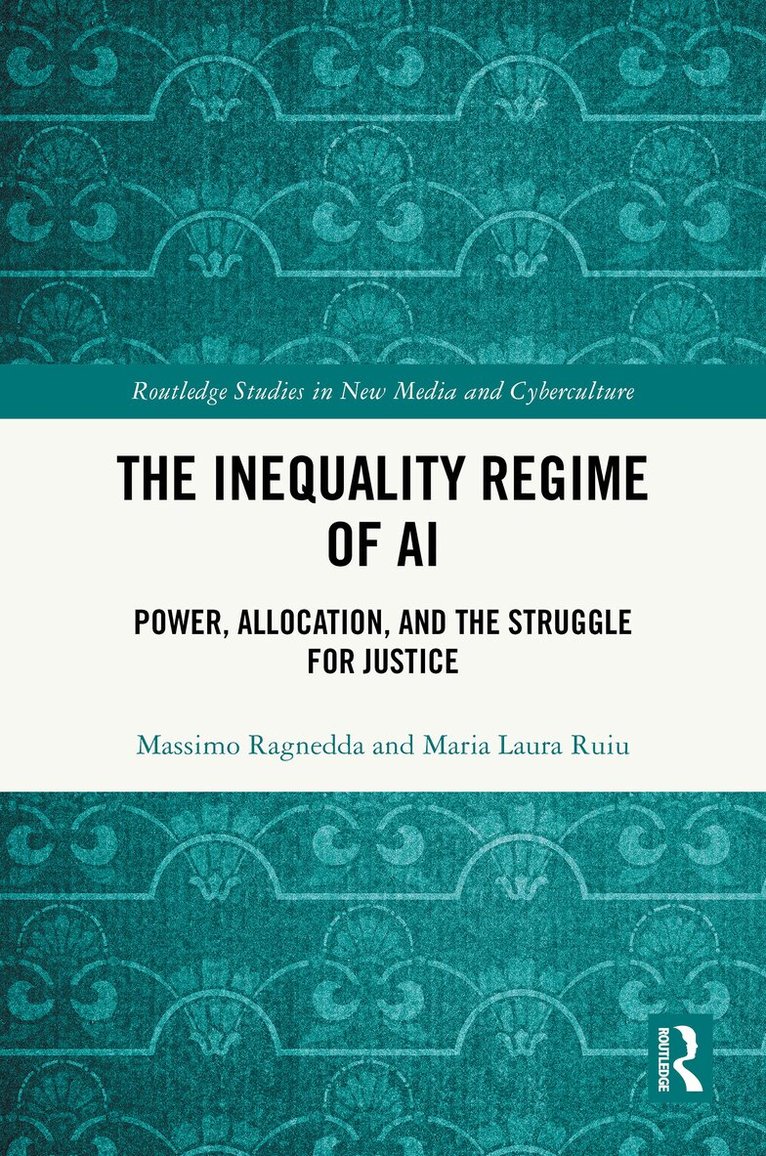
    Inequality Regime of AI

    Power, Allocation, and the Struggle for Justice

    AvMassimo Ragnedda,Maria Laura Ruiu

    Inbunden, Engelska, 2026

    Del i serien Routledge Studies in New Media and Cyberculture

    2 421 kr

    Beställningsvara. Skickas inom 10-15 vardagar. Fri frakt över 249 kr.

    Beskrivning

    Does artificial intelligence (AI) empower humanity, or does it merely automate the stratifications of the past? In The Inequality Regime of AI, the authors offer a critical sociology of artificial power, arguing that AI represents a fundamental ontological shift in how social life is organized, valued, and governed.Moving beyond the traditional digital divide, this book introduces the concept of the Inequality Regime of AI. The authors trace a profound transition from inequalities of participation to inequalities of prediction, where social power is concentrated in the hands of those who own and control the means of cognition. Through a global lens, the volume exposes the hidden architectures of the algorithmic age: from the predictive cage of automated governance and the digital feudalism of rentier platforms to the extractive computational metabolism that binds AI to planetary resource depletion. Drawing on Southern epistemologies and the concept of techno-colonialism, the book reveals how AI stabilizes social hierarchies while presenting them as objective, efficient, and inevitable. However, the authors do not stop at critique. They advocate for a “praxis of freedom”, proposing a shift from extractive models toward redistributive infrastructures and the algorithmic commons.Grounded in a relational ethics of care and critical literacy, this volume is essential reading for scholars and students of sociology, media studies, political science, and the ethics of technology seeking to understand, and contest, the new architectures of global power.

    Produktinformation

    • Utgivningsdatum:2026-06-15
    • Mått:156 x 234 x 13 mm
    • Vikt:510 g
    • Format:Inbunden
    • Språk:Engelska
    • Serie:Routledge Studies in New Media and Cyberculture
    • Antal sidor:180
    • Förlag:Taylor & Francis Ltd
    • ISBN:9781041173687

    Utforska kategorier

    • Artificiell intelligens inom Data och IT
    • Sociologi inom Samhälle och politik
    • Informationsteknik: allmänt inom Data och IT

    Mer om författaren

    Massimo Ragnedda is a Professor in Media and Communications at Sharjah University, UAE.Maria Laura Ruiu is an Associate Professor in Media and Communication at the American University of Sharjah, UAE.

    Recensioner i media

    "In The Inequality Regime of AI, Ragnedda and Ruiu provide much-needed foundational sociological grammar for our algorithmic era. Moving the field far beyond the ‘digital divide’, they generate a fresh foundational concept: the insidious 'AI stratification spiral' through which historical inequalities are mathematically naturalized and automated. By conceptualizing AI as a regime that monopolizes the 'means of cognition,' Ragnedda and Ruiu reveal how the 'allocative turn' in social institutions functions as a new form of symbolic violence. As such their work does not merely treat AI technologies; rather it is a critical mapping of how predictive power reorganizes the social order, making it an essential text for any scholar of social stratification and global power."-- Laura Robinson, Professor of Sociology, Santa Clara University, USA"This is a timely intervention that frames AI not as a neutral tool marred by occasional bias, but as a structuring force in a new Inequality Regime. By shifting the focus from participation gaps to asymmetries in prediction, the book argues that power now lies with those who control the means of cognition. Concepts such as the Predictive Cage, digital feudalism, and computational metabolism offer a rigorous vocabulary for understanding how automated systems stabilize hierarchy while extracting both social and planetary resources. The authors do not stop at critique: their call for redistributive infrastructures and an algorithmic commons is concrete, ambitious, but mostly necessary. This is an important contribution that supports shaping debates across technology, politics, and society."-- Alexander van Deursen, Professor of Digital Inequality and Director of the Centre for Digital Inclusion, University of Twente, the Netherlands

    Innehållsförteckning

    • Introduction. The Social Question of Artificial Intelligence: Framing Justice, Power, and Collective Intelligence in the Age of AI Part 1. From Digital Divides to Inequality Regimes 1. AI as an Inequality Regime; 2. The Roots of AI Inequality: From Digital Divides to the Allocative Turn; 3. The Core Fractures: Data, Algorithm, and Governance Part 2. Architectures of Allocation 4. The Algorithmic Habitus: Micro-politics of the Self; 5. Institutionalising Inequality: Labour, Welfare, and Education; 6. Bias as Structural, Symbolic, and Algorithmic Violence Part 3. Global Orders of Extraction 7. AI and Environmental Inequalities: From Digital to Ecological Regimes; 8. Techno-Colonialism: Data, Labour, and Epistemic Extractivism; 9. Digital Feudalism and the Algorithmic Commons Part 4. Horizons of Justice 10. Literacies of Liberation; 11. From Inequality Regime to Redistributive Infrastructures