• Fri frakt över 249 kr
  • •
  • Snabba leveranser
  • •
  • Billiga böcker
Kundservice

Du är på sajten för privatpersoner.

Företag, bibliotek eller offentlig verksamhet?

Du handlar på classic.bokus.com, där alla dina funktioner finns intakta.
Till classic.bokus.com
Bokus logotyp. Gå till startsidan.
  • Erbjudanden
  • Nyheter
  • Student
  • Topplistor
  • Barn & ungdom
  • Bokus Play
  • E-böcker
  • Pocketböcker
  • Spel & pussel

10% rabatt på allt med kod: NYSTART10 →

Sidfot

Mina sidor

    Hjälp

    • Kundservice
    • Vanliga frågor och svar
    • Frakt och leverans
    • Retur vid ångerrätt
    • Reklamera vara
    • Betalning
    • Köpvillkor
    • Allmänna villkor
    • Information om webbplatsens tillgänglighet

    Om Bokus

    • Om oss
    • Pressrum
    • För studenter
    • För företag
    • För bibliotek och offentlig verksamhet
    • För leverantörer
    • Hållbarhet

    Populärt

    • Aktuella erbjudanden
    • Presentkort
    • Studentlitteratur
    • Nya böcker
    • Topplistor
    • Signerade böcker
    • Engelska böcker

    Inspiration

    • Boktips
    • BookTok
    • Populära bokserier
    • Barnbokskaraktärer
    • Populära författare
    Logotyp för Bokus
    Följ oss på Facebook (extern länk)Följ oss på Instagram (extern länk)Följ oss på YouTube (extern länk)Följ oss på TikTok (extern länk)
    bokus @ CookiesAnpassa cookiesIntegritetspolicyKöpvillkor
    Till Citymail hemsida (extern länk)Till Budbee hemsida (extern länk)Till Postnord hemsida (extern länk)Till Schenker hemsida (extern länk)Till Early Bird hemsida (extern länk)Till Walleys hemsida (extern länk)
    1. Samhälle och politik
    2. Sociologi och antropologi
    3. Antropologi

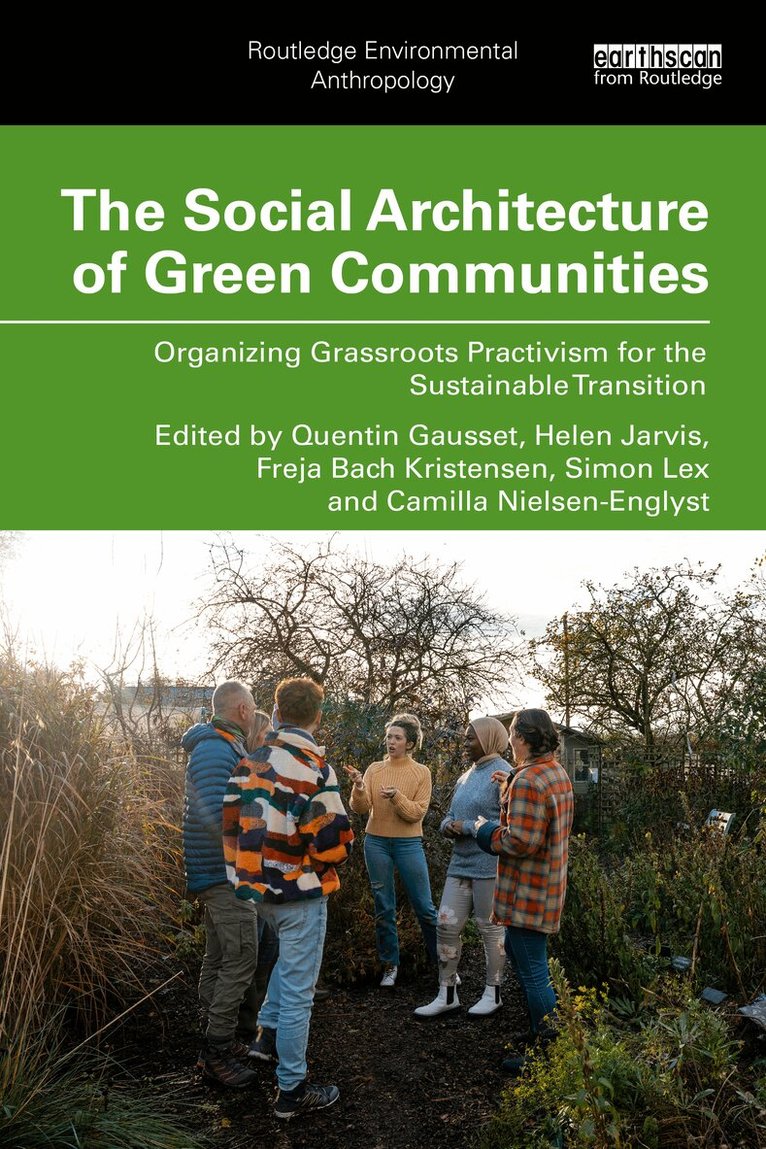
    Social Architecture of Green Communities

    Organizing Grassroots Practivism for the Sustainable Transition

    AvQuentin Gausset,Helen Jarvis

    Inbunden, Engelska, 2026

    Del i serien Routledge Environmental Anthropology

    2 421 kr

    Slutsåld

    Beskrivning

    Using case studies from 10 European and North American countries, this book discusses the challenges connected to designing viable social architectures in a variety of green communities in urban and rural areas, and in affluent districts and government-subsidized social housing.Global warming constitutes one of the greatest challenges of our time, but governmental responses have so far been slow and insufficient. Consequently, an increasing number of people have joined a variety of green communities to engage in collective environmental action at the grassroots level. Green communities have the potential to deliver deep and long-lasting behavioral change and carbon footprint reductions, whilst increasing the life satisfaction of participants; however, despite these benefits, they are not spreading as fast as we might expect. Exploring eco-communities, sustainable co-housing, transition towns, organic food cooperatives, green neighborhoods, repair cafés, and more, this book examines why these green communities aren’t developing more rapidly, and considers the challenges that they face to their success. By assessing the problems associated with the management of collective life and decision-making, the book provides the reflexive and analytical tools required to better understand the conditions required for their survival and scalability.Focusing on how the social architecture of green communities contributes to enriching our understanding of social sustainability as a condition for environmental sustainability, this book will be of value to students and scholars across the social sciences, particularly those with an interest in environmental anthropology, sustainability, sociology, public policy, and communication studies.

    Produktinformation

    • Utgivningsdatum:2026-10-02
    • Mått:156 x 234 x undefined mm
    • Format:Inbunden
    • Språk:Engelska
    • Serie:Routledge Environmental Anthropology
    • Antal sidor:282
    • Förlag:Taylor & Francis Ltd
    • ISBN:9781041293323

    Utforska kategorier

    • Antropologi inom Samhälle och politik
    • Miljövetenskap och miljöpolitik inom Naturvetenskap och teknik

    Mer om författaren

    Quentin Gausset received his PhD in anthropology from the Free University of Brussels and is Associate Professor in Anthropology at the University of Copenhagen. He has 30 years of experience with interdisciplinary research on natural resource management and environmental conflicts, based on fieldworks in Africa, South-East Asia and Denmark.Helen Jarvis is a UK based scholar-activist who has enduring interests in the lived realities of communal living, such as cohousing, and grassroots socio-spatial interventions that align social and environmental justice with green sharing economies. Since 2024, Helen has continued to publish and campaign for social and ecological justice as an independent scholar consultant, with Professor Emeritus status.Simon Lex is Deputy Head of Education and Associate Professor at the Department of Anthropology, University of Copenhagen. His primary research interests are within climate, organizational and business anthropology. He is a PI of the Grand Solution project “DART: The Danish Model for Citizen Engagement in the Renewable Energy Transition” and co-editor of the Journal of Business anthropology.Freja Bach Kristensen is a PhD fellow at the Department of Anthropology and is specialized in the fields of urban anthropology, community development and the green transition. She has extensive experience with civil society collaborations both within and outside academia having worked as a consultant within urban development and citizen involvement for more than 7 years. Camilla Nielsen-Englyst holds a degree in Educational Studies from Roskilde University and is a grassroots activist rooted in the ecovillage and cohousing movements. For the past decade, her work has focused on connecting research, development, and practice.

    Innehållsförteckning

    • The social architecture of green communities: An introduction 1. People-powered green placemaking in the United Kingdom: Multi-level strategies and a theory of change 2. Eros unredeemed: Post-patriarchal soft power and inclusivity in the Tamera and Monte Verità communities 3. Majority-rule, sociocracy and do-ocracy: Micropolitics in Danish green communities 4. Communes, eco-villages, eco-habitats, and alternative networks: A typology of green communities and the role of subsistence in ecological living 5. The social architecture of constructive disobedience: Collective resistance in the Danish energy transition 6. Applying participatory methods of green communities to transform rurban areas of Northwestern Germany 7. The practices of sharing: Negotiating spaces and things in three intentional community case studies 8. Communitarian ‘Inhabiting’: Empathic forms and conflict resolution spaces 9. Sustainability brokering and green community building in Danish social housing 10. Slow practivism: Volunteering in Dutch urban gardens 11. Community gardens and the act of food sharing: The impact of community engagement Conclusion: Lessons learned from the social architecture of green communities