• Fri frakt över 249 kr
  • •
  • Snabba leveranser
  • •
  • Billiga böcker
Kundservice

Du är på sajten för privatpersoner.

Företag, bibliotek eller offentlig verksamhet?

Du handlar på classic.bokus.com, där alla dina funktioner finns intakta.
Till classic.bokus.com
Bokus logotyp. Gå till startsidan.
  • Erbjudanden
  • Nyheter
  • Student
  • Topplistor
  • Barn & ungdom
  • Bokus Play
  • E-böcker
  • Pocketböcker
  • Spel & pussel

10% rabatt på allt med kod NYSTART10 →

Sidfot

Mina sidor

    Hjälp

    • Kundservice
    • Vanliga frågor och svar
    • Frakt och leverans
    • Retur vid ångerrätt
    • Reklamera vara
    • Betalning
    • Köpvillkor
    • Allmänna villkor
    • Information om webbplatsens tillgänglighet

    Om Bokus

    • Om oss
    • Pressrum
    • För studenter
    • För företag
    • För bibliotek och offentlig verksamhet
    • För leverantörer
    • Hållbarhet

    Populärt

    • Aktuella erbjudanden
    • Presentkort
    • Studentlitteratur
    • Nya böcker
    • Topplistor
    • Signerade böcker
    • Engelska böcker

    Inspiration

    • Boktips
    • BookTok
    • Populära bokserier
    • Barnbokskaraktärer
    • Populära författare
    Logotyp för Bokus
    Följ oss på Facebook (extern länk)Följ oss på Instagram (extern länk)Följ oss på YouTube (extern länk)Följ oss på TikTok (extern länk)
    bokus @ CookiesAnpassa cookiesIntegritetspolicyKöpvillkor
    Till Citymail hemsida (extern länk)Till Budbee hemsida (extern länk)Till Postnord hemsida (extern länk)Till Schenker hemsida (extern länk)Till Early Bird hemsida (extern länk)Till Walleys hemsida (extern länk)
    1. Samhälle och politik
    2. Samhälle och kultur
    3. Kultur och medier
    4. Referensverk och tvärvetenskap

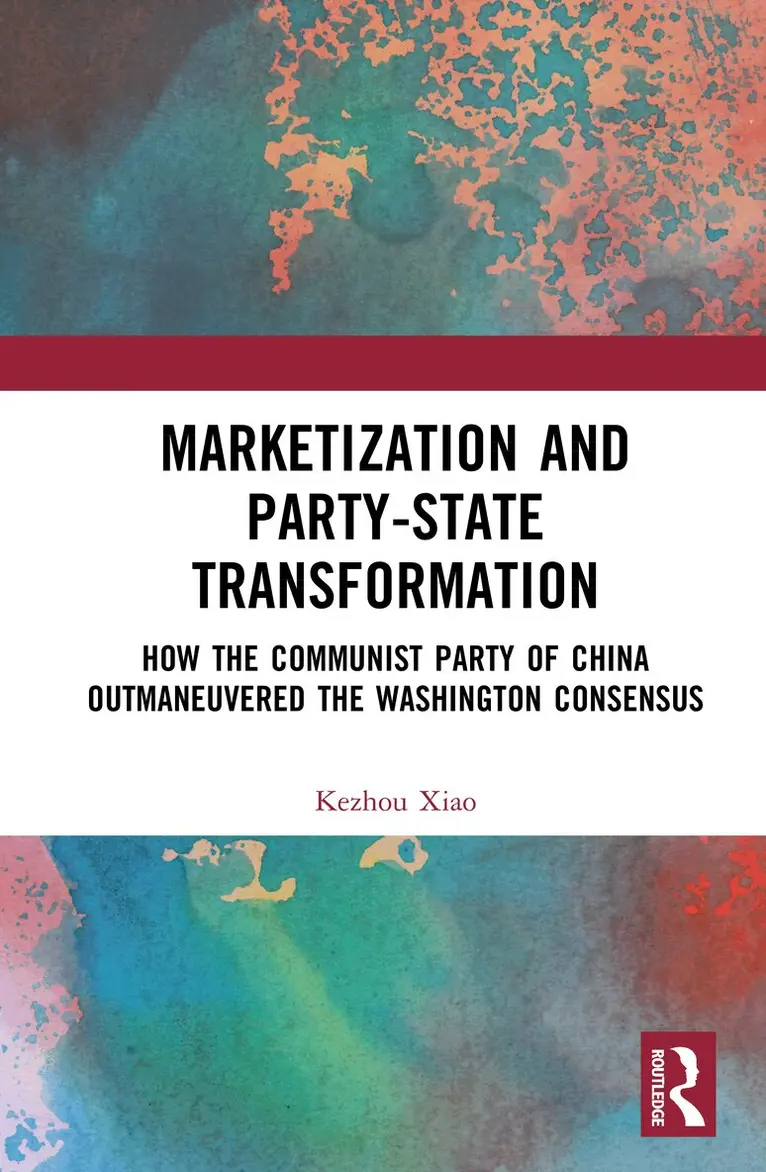
    Marketization and Party-State Transformation

    How the Communist Party of China Outmaneuvered the Washington Consensus

    AvKezhou Xiao

    Inbunden, Engelska, 2026

    2 423 kr

    Slutsåld

    Beskrivning

    When the Berlin Wall fell in 1989, the Communist Party of China faced terminal crisis — yet it averted collapse and engineered history’s most dramatic economic ascent by rejecting Washington’s prescriptions for liberal democratic transition and transforming the party-state into a Socialist Developmental State.Formalizing the political logic of China’s marketization through a political economy model of endogenous talent allocation, the book demonstrates that the core instrument of the party-state’s transformation was not industrial policy but cadre policy. The strategic management of officials, shaped by leadership dynamics at the apex of the party, created the institutional impetus that drove China’s Socialist Big Push. Furthermore, the proposed framework contributes to the understanding of China’s post-2012 trajectory under Xi Jinping in relation to China’s growth momentum and political dynamics.The book will appeal to scholars and students of comparative political economy, economic development, and Chinese politics, as well as policymakers with a focus on Sino-US competition in the age of AI.

    Produktinformation

    • Utgivningsdatum:2026-12-04
    • Mått:156 x 234 x undefined mm
    • Format:Inbunden
    • Språk:Engelska
    • Antal sidor:280
    • Förlag:Taylor & Francis Ltd
    • ISBN:9781041413196

    Utforska kategorier

    • Referensverk och tvärvetenskap inom Samhälle och politik
    • Politik och statsskick inom Samhälle och politik
    • Internationell ekonomi inom Ekonomi och Ledarskap

    Mer om författaren

    Kezhou Xiao is Assistant Professor at the Institute of Guangdong, Hong Kong and Macao Development Studies, Sun Yat-sen University. His research examines the political economy of China’s reform and development, focusing on state-business relations, cadre policy, and party-state transformation. He received his Ph.D. in Economics from the London School of Economics and Political Science.

    Recensioner i media

    “Why did China’s party-state thrive while communist regimes elsewhere collapsed? Kezhou Xiao argues that the Communist Party of China outmaneuvered the Washington Consensus by embracing its economic program while rejecting its political prescriptions — transforming itself into a Socialist Developmental State. Two cadre policy instruments proved decisive: the Central Advisory Commission, which retired the revolutionary old guard, and the Four Modernizations of Cadres, which installed market-oriented technocrats. Combining formal theory, original biographical data, and quasi-experimental evidence, this book shows that organizational self-transformation, not liberalization alone, powered China’s economic takeoff — with profound implications for theories of development, transition, and authoritarian resilience.”Yuhua Wang, Ford Foundation Professor of Modern China Studies, Harvard University“China demonstrates a strong case of how a party-state system could possibly engineer a market transition? By tracing how China’s cadre system reform restructured the incentives and capacities of the officials, and rebuilt the organizational foundations through which pro-growth policy was designed, contested, and implemented, Kezhou Xiao’s book offers a rigorous and compelling account of how political change enabled economic change.”Zhang Jun, Professor of Economics and Dean, School of Economics, Fudan University“Few questions matter more for understanding China than how its cadres were remade. With rich empirical analysis, this book shows how marketization transformed the recruitment, composition, and logic of the party-state from within — and why that legacy shapes governance in the Xi Jinping era. Clear, original, and essential reading for students of contemporary Chinese politics.”Cheng Li, Professor of Political Science and Founding Director, Centre on Contemporary China and the World, The University of Hong Kong“For a generation, the Washington Consensus shaped how outsiders understood — and misunderstood — China’s development. Kezhou Xiao’s Marketization and Party-State Transformation offers a long-overdue corrective grounded in original data. Through meticulous analysis of commission rivalry, cadre selection, and the Four Modernizations, Xiao demonstrates that China’s market transition was not a concession to neoliberal orthodoxy but a product of deliberate party-state transformation. This book reframes the central debate in China’s political economy at exactly the moment when that debate matters most.”Cui Zhiyuan, Professor of Political Economy, School of Public Policy and Management, Tsinghua University“Students of state-business relations have long sought to explain how China’s party-state managed market transition without the institutional blueprints prescribed by Western development economics. Kezhou Xiao’s Marketization and Party-State Transformation provides a compelling answer. Through careful analysis of commission rivalry and cadre selection, he reveals the specific political mechanisms through which reform consensus was built and implemented from within the party-state. For scholars of political-business interaction and local governance in China, this is essential and illuminating reading.”Dongya Huang, Professor and Associate Dean, School of Government, Sun Yat-sen University

    Innehållsförteckning

    • 1 Introduction: China as a Post-Cold War World Outlier 2 A Proposed Framework: Marketization and Party-State Transformation 3 The Making of a Socialist Developmental State: Endogenous Talent Reallocation and Statecraft of Marketization 4 Technocrats, Technopols, and the Politics of Market Reform: Commission Rivalry and the Forging of the Socialist Developmental State 5 Fostering Quality Market Institutions: The Central Advisory Commission and the Four Modernizations of Cadres 6 Conclusion: Possible Future