• Fri frakt över 249 kr
  • •
  • Snabba leveranser
  • •
  • Billiga böcker
Kundservice

Du är på sajten för privatpersoner.

Företag, bibliotek eller offentlig verksamhet?

Du handlar på classic.bokus.com, där alla dina funktioner finns intakta.
Till classic.bokus.com
Bokus logotyp. Gå till startsidan.
  • Erbjudanden
  • Nyheter
  • Student
  • Topplistor
  • Barn & ungdom
  • Bokus Play
  • E-böcker
  • Pocketböcker
  • Spel & pussel

10% rabatt på allt med kod: NYSTART10 →

Sidfot

Mina sidor

    Hjälp

    • Kundservice
    • Vanliga frågor och svar
    • Frakt och leverans
    • Retur vid ångerrätt
    • Reklamera vara
    • Betalning
    • Köpvillkor
    • Allmänna villkor
    • Information om webbplatsens tillgänglighet

    Om Bokus

    • Om oss
    • Pressrum
    • För studenter
    • För företag
    • För bibliotek och offentlig verksamhet
    • För leverantörer
    • Hållbarhet

    Populärt

    • Aktuella erbjudanden
    • Presentkort
    • Studentlitteratur
    • Nya böcker
    • Topplistor
    • Signerade böcker
    • Engelska böcker

    Inspiration

    • Boktips
    • BookTok
    • Populära bokserier
    • Barnbokskaraktärer
    • Populära författare
    Logotyp för Bokus
    Följ oss på Facebook (extern länk)Följ oss på Instagram (extern länk)Följ oss på YouTube (extern länk)Följ oss på TikTok (extern länk)
    bokus @ CookiesAnpassa cookiesIntegritetspolicyKöpvillkor
    Till Citymail hemsida (extern länk)Till Budbee hemsida (extern länk)Till Postnord hemsida (extern länk)Till Schenker hemsida (extern länk)Till Early Bird hemsida (extern länk)Till Walleys hemsida (extern länk)
    1. Naturvetenskap och teknik
    2. Matematik och naturvetenskap
    3. Naturvetenskap:allmänt
    4. Naturvetenskapens historia

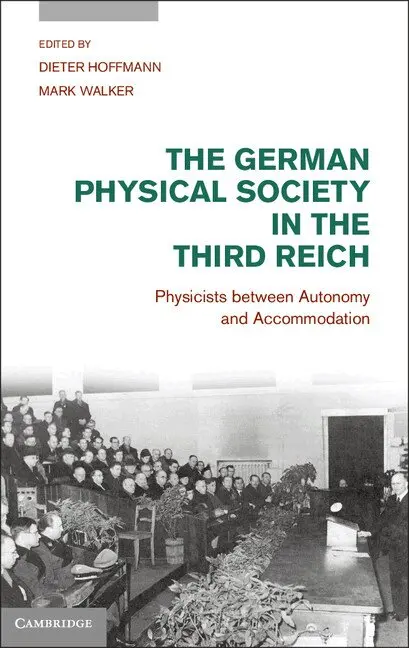
    The German Physical Society in the Third Reich

    Physicists between Autonomy and Accommodation

    AvDieter Hoffmann,Mark Walker

    Inbunden, Engelska, 2011

    1 764 kr

    Beställningsvara. Skickas inom 10-15 vardagar. Fri frakt över 249 kr.

    Beskrivning

    This is a history of one of the oldest and most important scientific societies, the German Physical Society, during the Nazi regime and immediate postwar period. When Hitler was appointed chancellor of Germany in 1933, the Physical Society included prominent Jewish scientists as members, including Fritz Haber and Albert Einstein. As Jewish scientists lost their jobs and emigrated, the Society gradually lost members. In 1938, under pressure from the Nazi Ministry of Science, Education and Culture, the Society forced out the last of its Jewish colleagues. This action was just the most prominent example of the tension between accommodation and autonomy that characterized the challenges facing physicists in the Society. They strove to retain as much autonomy as possible, but tried to achieve this by accommodating themselves to Nazi policies, which culminated in the campaign by the Society's president to place physics in the service of the war effort.

    Produktinformation

    • Utgivningsdatum:2011-12-05
    • Mått:164 x 241 x 37 mm
    • Vikt:810 g
    • Format:Inbunden
    • Språk:Engelska
    • Antal sidor:482
    • Förlag:Cambridge University Press
    • ISBN:9781107006843
    • Översättare:Ann M. Hentschel

    Utforska kategorier

    • Naturvetenskapens historia inom Naturvetenskap och teknik

    Mer om författaren

    Dieter Hoffmann is a Senior Fellow at the Max Planck Institute for the History of Science and a Professor of History of Science at Humboldt University in Berlin. Hoffmann has co-authored two books in English: Science under Socialism: East Germany in Comparative Perspective (1999) and The Emergence of Modern Physics (1996), as well as several books published in German. Hoffmann is a member of the editorial boards for journals Physikalische Blätter and Physics in Perspective. His articles have appeared in Physics in Perspective and Physics Today. He is a member of the German Physical Society; the German Society for the History of Science, Technology and Medicine; and the History of Science Society. Mark Walker is the John Bigelow Professor of History at Union College. He is the author of Nazi Science: Myth, Truth, and the German Atom Bomb (1995) and German National Socialism and the Quest for Nuclear Power, 1939–1949 (Cambridge University Press, 1989). He has co-authored several books, including The Kaiser Wilhelm Society under National Socialism (Cambridge University Press, 2009), Politics and Science in Wartime: Comparative International Perspectives on the Kaiser Wilhelm Institutes (2005) and Science and Ideology: A Comparative History (2003). His articles have appeared in the Journal of Contemporary History, Physics Today, Historical Studies in the Natural Sciences, Nature, Physics in Perspective, Minerva and Metascience.

    Recensioner i media

    'This fine volume explores in detail for the first time in English the role of the German Physical Society from the Nazi takeover of power in 1933 into the early postwar years, and includes comparisons with chemical and mathematical societies. The book is an important contribution to the ongoing discussion of the possibility as well as the costs of the relative autonomy of science in dictatorships, and also to our understanding of the institutional and cultural reconstruction of the sciences in West Germany after 1945.' Mitchell G. Ash, University of Vienna

    Innehållsförteckning

    • Foreword Eberhard Umbach; 1. The German Physical Society under National Socialism in context Mark Walker; 2. Boundaries and authority in the physics community in the Third Reich Richard H. Beyler; 3. Marginalization and expulsion of physicists under National Socialism: what was the German Physical Society's role? Stefan L. Wolff; 4. The German Physical Society and Aryan physics Michael Eckert; 5. The Ramsauer era and self-mobilization of the German Physical Society Dieter Hoffmann; 6. The Planck medal Richard H. Beyler, Michael Eckert and Dieter Hoffmann; 7. The German Physical Society and research Gerhard Simonsohn; 8. The German Mathematicians Association during the Third Reich: professional policy within the web of National Socialist ideology Volker Remmert; 9. 'To the Duce, the Tenno, and our Führer: a threefold Seig Heil': The German Chemical Society and the Association of German Chemists during the Nazi era Ute Deichmann; 10. Distrust, bitterness, and sentimentality: on the mentality of German physicists in the immediate postwar period Klaus Hentschel; 11. Cleanliness among our circle of colleagues: the German Physical Society's policy toward its past Gerhard Rammer.