• Fri frakt över 249 kr
  • •
  • Snabba leveranser
  • •
  • Billiga böcker
Kundservice

Du är på sajten för privatpersoner.

Företag, bibliotek eller offentlig verksamhet?

Du handlar på classic.bokus.com, där alla dina funktioner finns intakta.
Till classic.bokus.com
Bokus logotyp. Gå till startsidan.
  • Erbjudanden
  • Nyheter
  • Student
  • Topplistor
  • Barn & ungdom
  • Bokus Play
  • E-böcker
  • Pocketböcker
  • Spel & pussel

10% rabatt på allt med kod NYSTART10 →

Sidfot

Mina sidor

    Hjälp

    • Kundservice
    • Vanliga frågor och svar
    • Frakt och leverans
    • Retur vid ångerrätt
    • Reklamera vara
    • Betalning
    • Köpvillkor
    • Allmänna villkor
    • Information om webbplatsens tillgänglighet

    Om Bokus

    • Om oss
    • Pressrum
    • För studenter
    • För företag
    • För bibliotek och offentlig verksamhet
    • För leverantörer
    • Hållbarhet

    Populärt

    • Aktuella erbjudanden
    • Presentkort
    • Studentlitteratur
    • Nya böcker
    • Topplistor
    • Signerade böcker
    • Engelska böcker

    Inspiration

    • Boktips
    • BookTok
    • Populära bokserier
    • Barnbokskaraktärer
    • Populära författare
    Logotyp för Bokus
    Följ oss på Facebook (extern länk)Följ oss på Instagram (extern länk)Följ oss på YouTube (extern länk)Följ oss på TikTok (extern länk)
    bokus @ CookiesAnpassa cookiesIntegritetspolicyKöpvillkor
    Till Citymail hemsida (extern länk)Till Budbee hemsida (extern länk)Till Postnord hemsida (extern länk)Till Schenker hemsida (extern länk)Till Early Bird hemsida (extern länk)Till Walleys hemsida (extern länk)
    1. Naturvetenskap och teknik
    2. Matematik och naturvetenskap
    3. Biologi
    4. Däggdjur

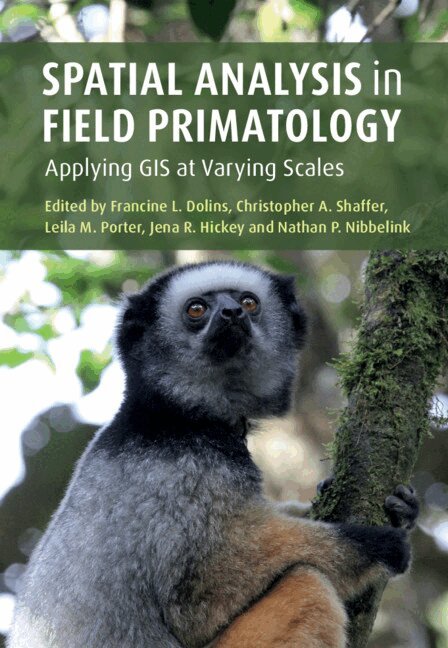
    Spatial Analysis in Field Primatology

    Applying GIS at Varying Scales

    AvFrancine L. Dolins,Christopher A. Shaffer

    Inbunden, Engelska, 2021

    1 473 kr

    Beställningsvara. Skickas inom 10-15 vardagar. Fri frakt över 249 kr.

    Beskrivning

    From foraging patterns in a single tree to social interactions across a home range, how primates use space is a key question in the field of primate behavioral ecology. Drawing on the latest advances in spatial analysis tools, this book offers practical guidance on applying geographic information systems (GIS) to central questions in primatology. An initial methodological section discusses niche modelling, home range analysis and agent-based modelling, with a focus on remote data collection. Research-based chapters demonstrate how ecologists apply this technology to a suite of topics including: calculating the intensity of use of both range and travel routes, assessing the impacts of logging, mining and hunting, and informing conservation strategies.

    Produktinformation

    • Utgivningsdatum:2021-02-18
    • Mått:175 x 250 x 26 mm
    • Vikt:1 080 g
    • Format:Inbunden
    • Språk:Engelska
    • Antal sidor:460
    • Förlag:Cambridge University Press
    • ISBN:9781107062306

    Utforska kategorier

    • Däggdjur inom Naturvetenskap och teknik
    • Däggdjur inom Djur och Natur

    Mer om författaren

    Francine L. Dolins is an Associate Professor of Comparative Psychology at the University of Michigan-Dearborn, USA. Her research investigates spatial cognition, navigation and foraging behavior with nonhuman primates in the lab using virtual reality, and also conducts field research, to integrate the understanding of species' cognitive capacities with socio-ecological factors. She has published two edited books with Cambridge University Press: Attitudes to Animals: Views in Animal Welfare (1999); and Spatial Cognition, Spatial Perception: Mapping the Self and Space (2010). Christopher A. Shaffer is Assistant Professor of Anthropology at Grand Valley State University, Michigan, and Principal Investigator of the Konashen Ecosystem Health Project. His primary research and teaching interests focus on community ecology and behavioral ecology, particularly in the context of human-nonhuman animal interactions and natural resource management. Leila M. Porter is Professor of Anthropology and Presidential Engagement Professor at Northern Illinois University. She studies the behavior and ecology of tamarins and Goeldi's monkeys in South America, specifically their diet, ranging, and patterns of infant care. Jena R. Hickey served as the Conservation Scientist for the International Gorilla Conservation Programme (IGCP) for 5 years. With over 20 years of professional experience, Jena has held positions with state and federal agencies, academic institutions, and not-for-profit organizations. She focuses on species occurrence, abundance, spatial distributions, movements, and habitat use, as well as how anthropogenic factors shape these response variables. Nathan P. Nibbelink is Professor of GIS and Spatial Ecology in the Warnell School of Forestry and Natural Resources, University of Georgia. He serves as Director of the Center for Integrative Conservation Research and the Integrative Conservation Ph.D. program. His research uses spatially explicit models to address landscape connectivity in a changing world, and to inform conservation and management of species and ecosystems.

    Recensioner i media

    '… the editors provide an excellent primer on GPS and GIS fundamentals that deftly expands to include research findings using more advanced methods. This resource covers applications of GPS and GIS directly relevant to readers from many areas of conservation biology who already use or want to use telemetry, GPS, or GIS analysis. This reviewer recommends the volume to any interested reader: it is not just for primatologists and will be an excellent reference for all researchers and students with biogeography, wildlife management, or technical GIS interests. Highly recommended.' C. A. Badurek, Choice

    Innehållsförteckning

    • Part I. GPS for Primatologists: Introduction Leila M. Porter; 1. Why place matters, and its use in primate behavioral and ecological research Francine L. Dolins; 2. Fundamentals of GPS AND GIS Nathan P. Nibbelink and Joanna Hatt; 3. 'Next-gen' tracking in primatology: opportunities and challenges Margaret C. Crofoot; 4. The ethical implications, and practical consequences, of attaching remote telemetry apparatus to macaques Amy Klegarth, Agustín Fuentes, Lisa Jones-Engel, Greg Marshall and Kyler Abernathy; 5. Processing geospatial data in R: a primer Allison Howard and Roger Mundry; 6. Estimating travel distance and linearity of primate routes: ideas on how to clean and smooth track data collected with a handheld GPS Karline R. L. Janmaat, Simone D. Ban and Roger Mundry; Part II. GIS Analysis in Fine-Scale Space: Introduction Christopher A. Shaffer; 7. Home range analysis: why the methods matter Sarah A. Boyle; 8. Quantifying resource dispersion in free-ranging bearded sakis in Guyana: what is a patch? Christopher A. Shaffer; 9. Interpreting small-scale patterns of ranging by primates: what does it mean, and why does it matter? Mitchell T. Irwin and Jean-Luc Raharison; 10. Determining the presence of habitual travel route networks in orangutans (pongo pygmaeus morio) in Kutai National Park, Borneo Adam O. Bebko; 11. Finding fruit in a tropical rainforest: a comparison of the foraging patterns of two distinct fruit-eating primates across years Leila M. Porter, Paul Garber, Christopher Boesch and Karline R. L. Janmaat; 12. Random walk analyses in primates Amy L. Schreier and Matt Grove; 13. The use of small-scale spatial analysis to evaluate primate behavior and welfare in captive settings Stephen R. Ross and Marisa A. Shender; 14. The promise of spatially explicit agent-based models for primatology research Anthony Di Fiore; Part III. GIS Analysis in Broad-Scale Space: Introduction Francine L. Dolins; 15. Modeling niches and mapping distributions: progress and promise of ecological niche models for primate research Kenneth L. Chiou and Mary E. Blair; 16. Does reduced habitat quality or increased hunter access explain defaunation of fragmented forests? Bonobos as a case study Jena R. Hickey and Michael J. Conroy; 17. Landscape ecology of deforestation processes and lemur biogeography in Madagascar Travis S. Steffens and Shawn M. Lehman; 18. Quantitative methods for primate biogeography and macroecology Jason M. Kamilar and Lydia Beaudrot; 19. GIS and GPS techniques in an ethnoprimatological investigation of St Kitts green monkey (chlorocebus sabaeus) crop-foraging behavior Kerry M. Dore, Daniel Sewell, Eduardo M. Mattenet and Trudy R. Turner; 20. Conclusion Francine L. Dolins.