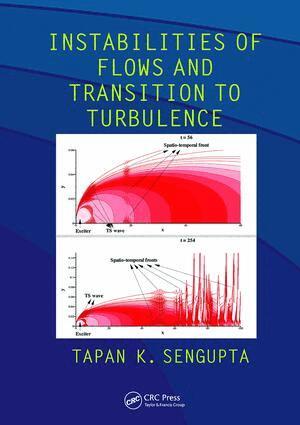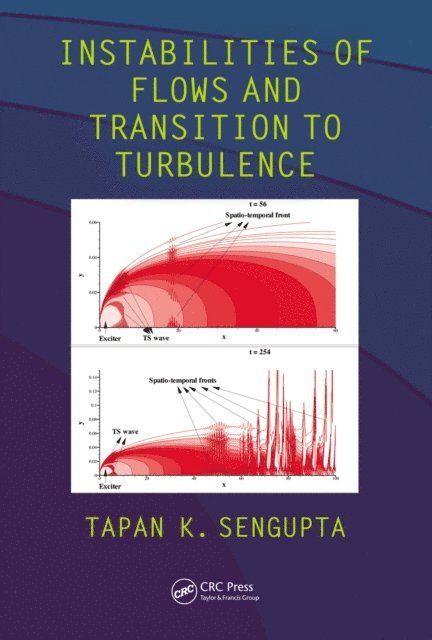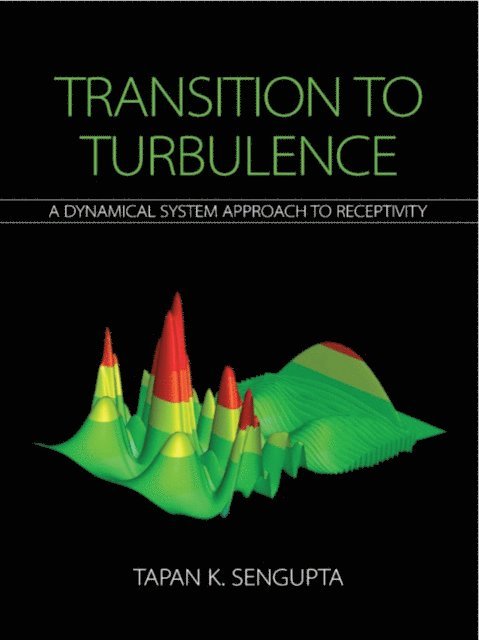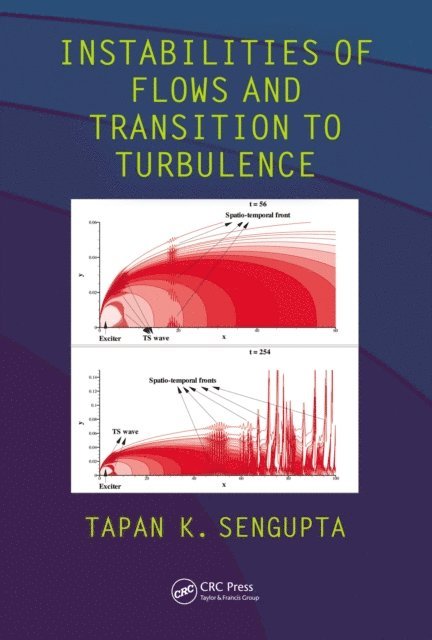
Transition to Turbulence
A Dynamical System Approach to Receptivity
2 483 kr
Beställningsvara. Skickas inom 11-20 vardagar. Fri frakt över 249 kr.
Beskrivning
Produktinformation
- Utgivningsdatum:2021-09-30
- Mått:190 x 248 x 35 mm
- Vikt:1 170 g
- Format:Inbunden
- Språk:Engelska
- Antal sidor:638
- Förlag:Cambridge University Press
- ISBN:9781108490412
Utforska kategorier
Mer om författaren
Tapan K. Sengupta is Visiting Professor at the department of Mechanical Engineering, Indian Institute of Technology (ISM) Dhanbad, India. He has previously held the position of Professor at the department of Aerospace Engineering, Indian Institute of Technology Kanpur, India. His research areas include transition and turbulence, unsteady aerodynamics, bluff body flows, flow control and computational fluid dynamics. He has taught courses including engineering thermodynamics, incompressible aerodynamics, compressible aerodynamics, computational fluid dynamics, boundary layer instability and transition, and advanced computation fluid dynamics at undergraduate and graduate levels. He is a Press author and has published a book entitled High Accuracy Computing Methods: Fluid Flows and Wave Phenomena (2013).
Innehållsförteckning
- Chapter 1. Receptivity, Instability and Transition: A Perspective; 1.1 Historical Introduction; 1.1.1 Introduction to Flow Instability; 1.1.2 Inviscid Instability Theory; 1.1.3 Role of Dissipation on Instability; 1.1.4 Viscous Instability: Linear Equations; 1.1.5 Temporal, Spatial, and Spatio-temporal Instability Studies; 1.1.6 Similarity Profile for Equilibrium Flow: Tollmien–Schlichting Waves from the Orr–Sommerfeld Equation; 1.1.7 Instability Theory, Experiments and Some Unanswered Questions; 1.2 Introduction to Receptivity Analysis; 1.3 Simple Concepts in Instability Studies; 1.3.1 Kelvin–Helmholtz Instability; 1.3.2 Taylor–Green Vortex Instability; 1.3.3 Equilibrium Solution of the Two-dimensional Taylor–Green Vortex Problem; 1.3.4 Results of the Taylor–Green Vortex Problem Simulation; 1.4 Closing Remarks; Chapter 2. Dynamical System Theory and Role of Equilibrium Flows; 2.1 Conservation Equations; 2.1.1 Conservation of Mass or Continuity; 2.1.2 Conservation of Translational Momentum; 2.1.3 Navier–Stokes Equations in Derived Variables; 2.1.4 Governing Equations for Rotational form of the (~V; ~!)-formulation; 2.1.5 Evolution Equation for Solenoidality Error in (~V; ~!)-formulation; 2.2 Boundary Layer Theory for Equilibrium Flow; 2.2.1 Thin Shear Layer Equation for Two-dimensional Steady Flow; 2.2.2 Boundary Layers Integral Properties; 2.2.3 Displacement Thickness; 2.2.4 Momentum Thickness; 2.3 Limitations of Boundary Layer Equation and Steady Separation; 2.4 Solving Boundary Layer Equation and Similarity Transformation; 2.4.1 Similarity Transform and Analysis; 2.4.2 Zero Pressure Gradient Boundary Layer; 2.4.3 Stagnation Point or the Hiemenz Flow; 2.5 Closing Remarks; Chapter 3. Fundamentals of Scientific Computing; 3.1 Computing Space-Time Dependent Flows; 3.2 The Bi-DirectionalWave Equation; 3.2.1 Three-dimensional Plane Waves; 3.2.2 Requirements for Spatial Discretization; 3.3 Upwind Schemes for Higher Reynolds Number Flows; 3.3.1 General Compact Schemes; 3.3.2 First Derivatives Obtained by Compact Scheme; 3.3.3 Selection of Compact Schemes; 3.4 Global Spectral Analysis: Resolution; 3.4.1 Spectral Accuracy of Some Compact Schemes; 3.5 Time Integration Schemes; 3.6 Analysis of Convection–Diffusion Equation; 3.6.1 Spectral Analysis of Numerical Schemes; 3.6.2 RK4-OUCS3-CD2 Scheme; 3.6.3 RK4-NCCD Scheme; 3.7 Role of Diffusion and Relation to Rotationality; 3.7.1 Enstrophy Transport Equation; 3.8 Spatial and Temporal Scales in Turbulent Flows; 3.8.1 Spatial Scales in Turbulent Flows; 3.8.2 Temporal Scales in Turbulent Flows; 3.9 Two- and Three-Dimensional Turbulent Flows; 3.10 Time-Averaged and Unsteady Flows; 3.11 Closing Remarks; Chapter 4. Instability and Transition; 4.1 Introduction; 4.2 Inviscid Instability of Parallel Flows; 4.2.1 Inviscid Instability Mechanism; 4.2.2 Is there Spatial Inviscid Instability?; 4.2.3 Role of Viscous Terms: Early Developments; 4.3 Linear Viscous Stability Theory; 4.4 Properties of the Orr–Sommerfeld Equation: Developing Solution Method; 4.4.1 Compound Matrix Method (CMM); 4.5 Instability Analysis with the Orr–Sommerfeld Equation; 4.5.1 Grid Search Method: Eigen-Spectrum; 4.6 Other Linear Instability Theories; 4.6.1 Role of Fourier–Laplace Transform: Abel and Tauber Theorems; 4.6.2 Temporal, Spatial and Spatio-temporal Growth Routes; 4.6.3 Signal Problem Assumption: Progress or Impediment?; 4.6.4 Temporal Instability Theory: A Case-Study with CMM; 4.7 Instability Properties using the Orr–Sommerfeld Equation; 4.7.1 Effects of Pressure Gradient on Instability of Boundary Layers; 4.8 Closing Remarks; Chapter 5. Receptivity Analysis: Relation with Instability Experiments; 5.1 Introduction; 5.2 Linear Receptivity of Boundary Layer: Bromwich Contour Integral Method; 5.2.1 Receptivity to Wall Excitation: Frequency Response for Signal Problem; 5.2.2 Near-field Response of Localized Excitat
Mer från samma författare
High-Performance Computing of Big Data for Turbulence and Combustion
Sergio Pirozzoli, Tapan K. Sengupta
Inbunden, 2019
1 076 kr
High-Performance Computing of Big Data for Turbulence and Combustion
Sergio Pirozzoli, Tapan K. Sengupta
Häftad, 2020
1 076 kr
Computational Aerodynamics and Aeroacoustics
Tapan K. Sengupta, Yogesh G. Bhumkar
Inbunden, 2020
1 183 kr
Advances In Computation, Modeling And Control Of Transitional And Turbulent Flows
SenGupta Tapan K, Tapan K Sengupta, Sanjiva K Lele, Katepalli R Sreenivasan, P A Davidson
Inbunden, 2016
2 677 kr
Du kanske också är intresserad av
Computational Aerodynamics and Aeroacoustics
Tapan K. Sengupta, Yogesh G. Bhumkar
Inbunden, 2020
1 183 kr
High-Performance Computing of Big Data for Turbulence and Combustion
Sergio Pirozzoli, Tapan K. Sengupta
Inbunden, 2019
1 076 kr
High-Performance Computing of Big Data for Turbulence and Combustion
Sergio Pirozzoli, Tapan K. Sengupta
Häftad, 2020
1 076 kr
- -22%