• Fri frakt över 249 kr
  • •
  • Snabba leveranser
  • •
  • Billiga böcker
Kundservice

Du är på sajten för privatpersoner.

Företag, bibliotek eller offentlig verksamhet?

Du handlar på classic.bokus.com, där alla dina funktioner finns intakta.
Till classic.bokus.com
Bokus logotyp. Gå till startsidan.
  • Erbjudanden
  • Student
  • Topplistor
  • Barn & ungdom
  • Bokus Play
  • E-böcker
  • Ljudböcker
  • Pocketböcker
  • Spel och pussel

Pocketfynda! Hundratals böcker för 49 kr/st →

Sidfot

Mina sidor

    Hjälp

    • Kundservice
    • Vanliga frågor och svar
    • Frakt och leverans
    • Retur vid ångerrätt
    • Reklamera vara
    • Betalning
    • Köpvillkor
    • Allmänna villkor
    • Information om webbplatsens tillgänglighet

    Om Bokus

    • Om oss
    • Pressrum
    • För studenter
    • För företag
    • För bibliotek och offentlig verksamhet
    • För leverantörer
    • Hållbarhet

    Populärt

    • Aktuella erbjudanden
    • Presentkort
    • Studentlitteratur
    • Nya böcker
    • Topplistor
    • Signerade böcker
    • Engelska böcker

    Inspiration

    • Boktips
    • BookTok
    • Barnbokskaraktärer
    • Populära författare
    Logotyp för Bokus
    Följ oss på Facebook (extern länk)Följ oss på Instagram (extern länk)Följ oss på YouTube (extern länk)Följ oss på TikTok (extern länk)
    bokus @ CookiesAnpassa cookiesIntegritetspolicyKöpvillkor
    Till Citymail hemsida (extern länk)Till Budbee hemsida (extern länk)Till Postnord hemsida (extern länk)Till Schenker hemsida (extern länk)Till Early Bird hemsida (extern länk)Till Walleys hemsida (extern länk)
    1. Naturvetenskap och teknik
    2. Matematik och naturvetenskap
    3. Matematik
    4. Matematisk statistik

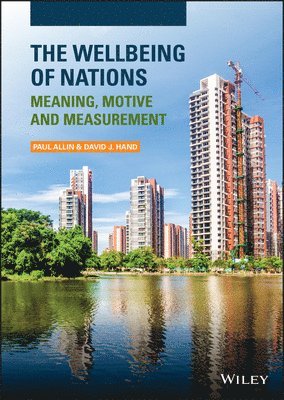
    Wellbeing of Nations

    Meaning, Motive and Measurement

    AvPaul Allin,David J. Hand

    Inbunden, Engelska, 2014

    807 kr

    Skickas . Fri frakt över 249 kr.

    Beskrivning

    THE WELLBEING OF NATIONSMEANING, MOTIVE AND MEASUREMENT ‘A great book that adds much needed well-reasoned argument and weight to the global debate on how we better measure what is getting better and what is not. Hand and Allin chart a series of paths away from the beguiling simplicity of GDP, show where those routes began and to where they might lead. Slowly we are learning to better count what really matters in our lives. This book explains the international collaboration behind this new learning and moves it far forward.’Daniel Dorling, School of Geography and the Environment, University of Oxford How and why to use new measures of national wellbeing We have known for many years that standard measures of a country’s economic performance, like GDP and GNP, fail to tell the whole story about progress and wellbeing. The Wellbeing of Nations explores national and cross-national initiatives to build wider measures. It covers economic performance, quality of life, the state of the environment, progress, development and sustainability. The authors take the view that national wellbeing — how a country is doing — embraces all these aspects and so measures of real progress need these dimensions. This book: Presents insights drawn from a wide range of national and international developments and provides an extensive appendix of resource materials.Provides an in-depth study of the UK measuring national wellbeing programme, with which both authors continue to be involved.Explores all the main approaches to wellbeing, such as developments to the national economic accounts, Sen’s capabilities approach and the concept and measurement of sustainable development.Offers a historical perspective on progress and examines current developments in this field.The authors note that it is still early days in the practical application of these wider measures by government and business, but that use should be the main factor driving their development and production. Aspirations are high and there is much to be gained by the use of such wider measures of national wellbeing, progress and development around the world. The Wellbeing of Nations is aimed at statisticians, economists, social researchers and policy makers in government, including national and international statistics offices. Academics in development studies, economics, environmental studies, positive psychology, health research, anthropology, political studies and sociology will also benefit from this book.

    Produktinformation

    • Utgivningsdatum:2014-09-26
    • Mått:170 x 244 x 20 mm
    • Vikt:590 g
    • Format:Inbunden
    • Språk:Engelska
    • Antal sidor:288
    • Förlag:John Wiley & Sons Inc
    • ISBN:9781118489574

    Utforska kategorier

    • Matematisk statistik inom Naturvetenskap och teknik
    • Sociologi inom Samhälle och politik
    • Politik och statsskick inom Samhälle och politik

    Mer om författaren

    Paul Allin and David J. Hand, Department of Mathematics, Imperial College, London, UK

    Recensioner i media

    “Although there are brief discussions of technical topics like measurement theory, the book will be useful to researchers across a range of disciplines and the interested general reader.”  (Significance, 15 June 2015)

    Innehållsförteckning

    • List of Tables and Figures viiiPreface ix1 What is national wellbeing and why measure it? 11.1 Motivation: Why measure wellbeing? 31.2 What is individual wellbeing? 81.3 Aspects of individual wellbeing 111.4 How to measure individual wellbeing? 161.4.1 Basics of measurement 161.4.2 What is measured matters 181.5 Properties of measurements 211.5.1 Validity 211.5.2 Reliability 221.6 Objective or subjective? 221.7 Combining multiple aspects 231.8 What is national wellbeing? 261.9 And how to measure national wellbeing? 271.10 Structure of the book 30References 312 A short history of national wellbeing and its measurement 352.1 The good society and philosophies of the role of government, from ancient times 362.2 Utilitarianism 392.3 The American constitution 412.4 Official statistics – statistics about the state and about the state of society 422.5 National accounts and GDP 442.6 More to life than GDP 512.7 Social indicator movement and measuring quality of life 532.8 Health and wellbeing 562.9 Rise of measurement of psychological wellbeing (life satisfaction, happiness, worthwhile lives) 582.10 The Easterlin paradox 612.11 Taking note of the change in the quality of the goods and services we use 622.12 Capability approach to quality of life (Sen) and the human development index 632.13 Social capital and public value 652.14 Limits to growth and sustainable development indicators 672.14.1 Sustainable development indicators 692.14.2 Green growth indicators 722.14.3 Natural resource accounting 732.15 Commentary 75References 773 Recent developments: Towards economic, social and environmental accounts 833.1 Mismeasuring our lives: The report by the Commission on the Measurement of Economic Performance and Social Progress 853.2 Replacing the Millennium Development Goals 903.3 A new global movement? 933.4 Commentary 104References 1104 Measuring individual wellbeing 1154.1 On quantification 1194.2 Single measures of wellbeing 1234.3 Combining aspects of wellbeing 1254.3.1 Causes, effects, and correlates 1264.3.2 Subjective components of wellbeing 1274.3.3 Weighted sums 1294.4 Components of individual wellbeing 1324.5 The frailty of memory 1374.6 The devil’s in the details 1384.7 Conclusion 142References 1435 Preparing to measure national wellbeing 1465.1 Towards a user requirement for measures of national wellbeing and progress 1475.2 Towards a framework to measure the progress of societies 1525.3 Constructing measures of progress and national wellbeing: Identifying and meeting user requirements 1605.4 Commentary 166References 1686 How to measure national wellbeing? 1716.1 Drawing on the national economic accounts 1726.2 Extending the national accounts 1816.2.1 Consider income and consumption jointly with wealth 1836.2.2 Give more prominence to the distribution of income, consumption and wealth 1856.2.3 Broaden income measures to nonmarket activities 1876.3 Indicator sets describing social and environmental conditions relating to wellbeing 1906.3.1 Improve measures of people’s health, education, personal activities and environmental conditions 1916.3.2 Quality-of-life indicators in all the dimensions covered should assess inequalities in a comprehensive way 1936.3.3 Surveys should be designed to assess the links between various quality-of-life domains for each person, and this information should be used when designing policies in various fields 1936.3.4 Statistical offices should provide the information needed to aggregate across quality-of-life dimensions, allowing the construction of different indexes 1946.3.5 Sustainability assessment requires a well-identified dashboard of indicators 1996.3.6 The environmental aspects of sustainability deserve a separate follow-up based on a well-chosen set of physical indicators 2036.4 Survey-based data on subjective wellbeing 2046.5 Developments in measuring national wellbeing and progress around the world 2056.6 Important issues in the measurement of national wellbeing 209References 2127 Wellbeing policy and measurement in the UK 217References 2338 Conclusions 2368.1 Progress 2368.2 Measuring wellbeing 2418.3 New technologies, new data? 2448.4 Beyond the economy 2458.5 The future 249References 250Appendix: Sources of methods and measures of wellbeing and progress 253Further reading 269Index 271