• Fri frakt över 249 kr
  • •
  • Snabba leveranser
  • •
  • Billiga böcker
Kundservice

Du är på sajten för privatpersoner.

Företag, bibliotek eller offentlig verksamhet?

Du handlar på classic.bokus.com, där alla dina funktioner finns intakta.
Till classic.bokus.com
Bokus logotyp. Gå till startsidan.
  • Erbjudanden
  • Nyheter
  • Student
  • Topplistor
  • Barn & ungdom
  • Bokus Play
  • E-böcker
  • Pocketböcker
  • Spel & pussel

Må bättre, för mindre! Upp till 50% rabatt på hälsoböcker

Sidfot

Mina sidor

    Hjälp

    • Kundservice
    • Vanliga frågor och svar
    • Frakt och leverans
    • Retur vid ångerrätt
    • Reklamera vara
    • Betalning
    • Köpvillkor
    • Allmänna villkor
    • Information om webbplatsens tillgänglighet

    Om Bokus

    • Om oss
    • Pressrum
    • För studenter
    • För företag
    • För bibliotek och offentlig verksamhet
    • För leverantörer
    • Hållbarhet

    Populärt

    • Aktuella erbjudanden
    • Presentkort
    • Studentlitteratur
    • Nya böcker
    • Topplistor
    • Signerade böcker
    • Engelska böcker

    Inspiration

    • Boktips
    • BookTok
    • Populära bokserier
    • Barnbokskaraktärer
    • Populära författare
    Logotyp för Bokus
    Följ oss på Facebook (extern länk)Följ oss på Instagram (extern länk)Följ oss på YouTube (extern länk)Följ oss på TikTok (extern länk)
    bokus @ CookiesAnpassa cookiesIntegritetspolicyKöpvillkor
    Till Citymail hemsida (extern länk)Till Budbee hemsida (extern länk)Till Postnord hemsida (extern länk)Till Schenker hemsida (extern länk)Till Early Bird hemsida (extern länk)Till Walleys hemsida (extern länk)
    1. Ekonomi och Ledarskap
    2. Nationalekonomi
    3. Mikroekonomi

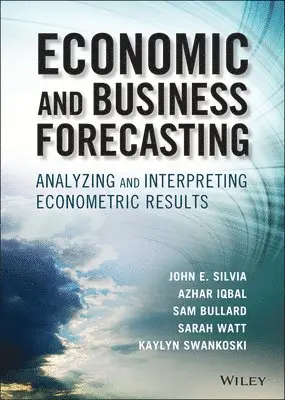
    Economic and Business Forecasting

    Analyzing and Interpreting Econometric Results

    AvJohn E. Silvia,Azhar Iqbal

    Inbunden, Engelska, 2014

    Del i serien Wiley and SAS Business Series

    548 kr

    Beställningsvara. Skickas inom 5-8 vardagar. Fri frakt över 249 kr.

    Beskrivning

    Discover the secrets to applying simple econometric techniques to improve forecasting Equipping analysts, practitioners, and graduate students with a statistical framework to make effective decisions based on the application of simple economic and statistical methods, Economic and Business Forecasting offers a comprehensive and practical approach to quantifying and accurate forecasting of key variables. Using simple econometric techniques, author John E. Silvia focuses on a select set of major economic and financial variables, revealing how to optimally use statistical software as a template to apply to your own variables of interest. Presents the economic and financial variables that offer unique insights into economic performanceHighlights the econometric techniques that can be used to characterize variablesExplores the application of SAS software, complete with simple explanations of SAS-code and outputIdentifies key econometric issues with practical solutions to those problemsPresenting the "ten commandments" for economic and business forecasting, this book provides you with a practical forecasting framework you can use for important everyday business applications.

    Produktinformation

    • Utgivningsdatum:2014-05-09
    • Mått:191 x 262 x 36 mm
    • Vikt:880 g
    • Format:Inbunden
    • Språk:Engelska
    • Serie:Wiley and SAS Business Series
    • Antal sidor:400
    • Förlag:John Wiley & Sons Inc
    • ISBN:9781118497098

    Utforska kategorier

    • Mikroekonomi inom Ekonomi och Ledarskap

    Mer om författaren

    JOHN E. SILVIA is a Managing Director and the Chief Economist for Wells Fargo Securities. In 2010, he was recognized for the Best Inflation Forecast, the Best Overall Forecast, and the Best Personal Consumption Expenditures Forecast by The Federal Reserve Bank of Chicago. AZHAR IQBAL is an Econometrician and Vice President at Wells Fargo Securities where he provides quantitative analysis to the Economics group as well as modeling and forecasting of macro and financial variables. He has spoken at the American Economic Association, Econometric Society, and other international conferences. SAM BULLARD is a Managing Director and Senior Economist at Wells Fargo Securities providing analysis and commentary on financial markets and macroeconomic developments. SARAH WATT is an Economist with Wells Fargo Securities. She covers the U.S. macro economy, including labor market trends. She also works closely with senior members of her team to produce special reports and regional economic commentary on several U.S. states. KAYLYN SWANKOSKI is an Economic Analyst at Wells Fargo Securities.

    Innehållsförteckning

    • Preface xiiiAcknowledgments xviiChapter 1 Creating Harmony Out of Noisy Data 1Effective Decision Making: Characterize the Data 2Chapter 2 First, Understand the Data 27Growth: How Is the Economy Doing Overall? 30Personal Consumption 31Gross Private Domestic Investment 33Government Purchases 35Net Exports of Goods and Services 36Real Final Sales and Gross Domestic Purchases 37The Labor Market: Always a Core Issue 37Establishment Survey 39Data Revision: A Special Consideration 42The Household Survey 43Marrying the Labor Market Indicators Together 48Jobless Claims 48Inflation 49Consumer Price Index: A Society’s Inflation Benchmark 50Producer Price Index 53Personal Consumption Expenditure Deflator: The Inflation Benchmark for Monetary Policy 55Interest Rates: Price of Credit 56The Dollar and Exchange Rates: The United States in a Global Economy 58Corporate Profits 60Summary 62Chapter 3 Financial Ratios 63Profitability Ratios 64Summary 73Chapter 4 Characterizing a Time Series 75Why Characterize a Time Series? 76How to Characterize a Time Series 77Application: Judging Economic Volatility 101Summary 109Chapter 5 Characterizing a Relationship between Time Series 111Important Test Statistics in Identifying Statistically Significant Relationships 115Simple Econometric Techniques to Determine a Statistical Relationship 119Advanced Econometric Techniques to Determine a Statistical Relationship 120Summary 126Additional Reading 127Chapter 6 Characterizing a Time Series Using SAS Software 129Tips for SAS Users 130The DATA Step 131The PROC Step 135Summary 156Chapter 7 Testing for a Unit Root and Structural Break Using SAS Software 157Testing a Unit Root in a Time Series: A Case Study of the U.S. CPI 158Identifying a Structural Change in a Time Series 162The Application of the HP Filter 169Application: Benchmarking the Housing Bust, Bear Stearns, and Lehman Brothers 172Summary 177Chapter 8 Characterizing a Relationship Using SAS 179Useful Tips for an Applied Time Series Analysis 179Converting a Dataset from One Frequency to Another 182Application: Did the Great Recession Alter Credit Benchmarks? 215Summary 221Chapter 9 The 10 Commandments of Applied Time Series Forecasting for Business and Economics 223Commandment 1: Know What You Are Forecasting 224Commandment 2: Understand the Purpose of Forecasting 226Commandment 3: Acknowledge the Cost of the Forecast Error 226Commandment 4: Rationalize the Forecast Horizon 229Commandment 5: Understand the Choice of Variables 231Commandment 6: Rationalize the Forecasting Model Used 232Commandment 7: Know How to Present the Results 234Commandment 8: Know How to Decipher the Forecast Results 235Commandment 9: Understand the Importance of Recursive Methods 238Commandment 10: Understand Forecasting Models Evolve over Time 239Summary 240Chapter 10 A Single-Equation Approach to Model-Based Forecasting 241The Unconditional (Atheoretical) Approach 242The Conditional (Theoretical) Approach 251Recession Forecast Using a Probit Model 257Summary 261Chapter 11 A Multiple-Equations Approach to Model-Based Forecasting 263The Importance of the Real-Time Short-Term Forecasting 265The Individual Forecast versus Consensus Forecast: Is There an Advantage? 266The Econometrics of Real-Time Short-Term Forecasting: The BVAR Approach 268Forecasting in Real Time: Issues Related to the Data and the Model Selection 275Case Study: WFC versus Bloomberg 280Summary 288Appendix 11A: List of Variables 289Chapter 12 A Multiple-Equations Approach to Long-Term Forecasting 291The Unconditional Long-Term Forecasting: The BVAR Model 293The BVAR Model with Housing Starts 296The Model without Oil Price Shock 298The Model with Oil Price Shock 304Summary 306Chapter 13 The Risks of Model-Based Forecasting: Modeling, Assessing, and Remodeling 307Risks to Short-Term Forecasting: There Is No Magic Bullet 308Risks of Long-Term Forecasting: Black Swan versus a Group of Black Swans 310Model-Based Forecasting and the Great Recession/Financial Crisis: Worst-Case Scenario versus Panic 314Summary 315Chapter 14 Putting the Analysis to Work in the Twenty-First-Century Economy 317Benchmarking Economic Growth 318Industrial Production: Another Case of Stationary Behavior 322Employment: Jobs in the Twenty-First Century 324Inflation 331Interest Rates 337Imbalances between Bond Yields and Equity Earnings 338A Note of Caution on Patterns of Interest Rates 345Business Credit: Patterns Reminiscent of Cyclical Recovery 347Profits 348Financial Market Volatility: Assessing Risk 349Dollar 351Economic Policy: Impact of Fiscal Policy and the Evolution of the U.S. Economy 353The Long-Term Deficit Bias and Its Economic Implications 358Summary 362Appendix: Useful References for SAS Users 365About the Authors 367Index 369