• Fri frakt över 249 kr
  • •
  • Snabba leveranser
  • •
  • Billiga böcker
Kundservice

Du är på sajten för privatpersoner.

Företag, bibliotek eller offentlig verksamhet?

Du handlar på classic.bokus.com, där alla dina funktioner finns intakta.
Till classic.bokus.com
Bokus logotyp. Gå till startsidan.
  • Erbjudanden
  • Nyheter
  • Student
  • Topplistor
  • Barn & ungdom
  • Bokus Play
  • E-böcker
  • Pocketböcker
  • Spel & pussel

10% rabatt på allt med kod NYSTART10 →

Sidfot

Mina sidor

    Hjälp

    • Kundservice
    • Vanliga frågor och svar
    • Frakt och leverans
    • Retur vid ångerrätt
    • Reklamera vara
    • Betalning
    • Köpvillkor
    • Allmänna villkor
    • Information om webbplatsens tillgänglighet

    Om Bokus

    • Om oss
    • Pressrum
    • För studenter
    • För företag
    • För bibliotek och offentlig verksamhet
    • För leverantörer
    • Hållbarhet

    Populärt

    • Aktuella erbjudanden
    • Presentkort
    • Studentlitteratur
    • Nya böcker
    • Topplistor
    • Signerade böcker
    • Engelska böcker

    Inspiration

    • Boktips
    • BookTok
    • Populära bokserier
    • Barnbokskaraktärer
    • Populära författare
    Logotyp för Bokus
    Följ oss på Facebook (extern länk)Följ oss på Instagram (extern länk)Följ oss på YouTube (extern länk)Följ oss på TikTok (extern länk)
    bokus @ CookiesAnpassa cookiesIntegritetspolicyKöpvillkor
    Till Citymail hemsida (extern länk)Till Budbee hemsida (extern länk)Till Postnord hemsida (extern länk)Till Schenker hemsida (extern länk)Till Early Bird hemsida (extern länk)Till Walleys hemsida (extern länk)
    1. Språk och ordböcker
    2. Språk: referensverk och allmänt
    3. Skrivande och redigering

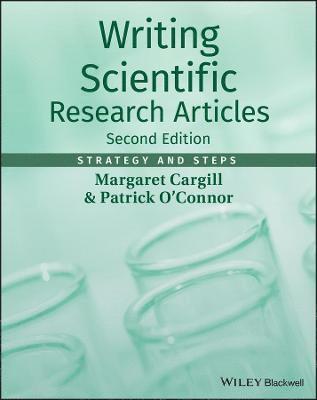
    Writing Scientific Research Articles

    Strategy and Steps

    AvMargaret Cargill,Patrick D. T. O'Connor

    Häftad, Engelska, 2013

    321 kr

    Beställningsvara. Skickas inom 5-8 vardagar. Fri frakt över 249 kr.

    Fler format och utgåvor

    Häftad

    393 kr

    Beskrivning

    This book shows scientists how to apply their analysis and synthesis skills to overcoming the challenge of how to write, as well as what to write, to maximise their chances of publishing in international scientific journals. The book uses analysis of the scientific article genre to provide clear processes for writing each section of a manuscript, starting with clear ‘story’ construction and packaging of results. Each learning step uses practical exercises to develop writing and data presentation skills based on reader analysis of well-written example papers. Strategies are presented for responding to referee comments, and for developing discipline-specific English language skills for manuscript writing and polishing. The book is designed for scientists who use English as a first or an additional language, and for individual scientists or mentors or a class setting. In response to reader requests, the new edition includes review articles and the full range of research article formats, as well as applying the book’s principles to writing funding applications.Web support for this book is available at www.writeresearch.com.au

    Produktinformation

    • Utgivningsdatum:2013-05-10
    • Mått:218 x 274 x 15 mm
    • Vikt:680 g
    • Format:Häftad
    • Språk:Engelska
    • Antal sidor:240
    • Upplaga:2
    • Förlag:John Wiley and Sons Ltd
    • ISBN:9781118570708

    Utforska kategorier

    • Skrivande och redigering inom Språk och ordböcker
    • Naturvetenskap:allmänt inom Naturvetenskap och teknik

    Mer om författaren

    Margaret Cargill is an applied linguist with over 20 years experience as a research communication educator. Her current research centres on innovative collaborative methods for helping scientists develop high-level skills for communicating their research findings effectively in the international arena. She has worked extensively in Australia, Europe and Asia with scientists of many language and cultural backgrounds.Patrick O’Connor is a research ecologist, environmental consultant and science educator. His work over the last 15 years has focussed on the use of scientific principles in designing and evaluating environmental programs for governments and statutory authorities in Australia. His research interests and scientific publications span fields of terrestrial ecology and detection of change in plant and animal communities.

    Recensioner i media

    “This volume will be useful for upper-level undergraduates, ESL students, and graduate students who need assistance in writing for publication.  Summing Up: Recommended.  Upper-division undergraduates and graduate students.”  (Choice, 1 November 2013) “As was the case with its predecessor, the second edition of Writing Scientific Research Articles will be of most value to early-career scientists with little writing experience. It should also be read by research scientists who do not have English as their first language. The book could also serve as a refresher in scientific writing for experienced scientists, and it contains a lot of sound advice that should be heeded by English-speaking researchers.”  (Aquaculture International, 1 August 2013)"I liked many aspects of this book. The text is well written and easy to read, as you would hope with a book on writing. The tone is formal, and I had no trouble imagining the authors presenting the material in a series of lectures." ( Bulletin of the Entomological Society of Canada 2013)

    Innehållsförteckning

    • Preface to the second edition ixPreface to the first edition xiSection 1: A framework for success 11 How the book is organized, and why 31.1 Getting started with writing for international publication 31.2 Publishing in the international literature 41.3 What do you need to know to select your target journal? 61.4 Aims of this book 71.5 How the book is structured 82 Research article structures 112.1 Conventional article structures: AIMRaD (Abstract, Introduction, Materials and methods, Results, and Discussion) and its variations 113 Reviewers’ criteria for evaluating manuscripts 173.1 Titles as content signposts 18Section 2: When and how to write each article section 214 Results as a “story”: the key driver of an article 235 Results: turning data into knowledge 255.1 Figure, table, or text? 265.2 Designing figures 265.3 Designing tables 295.4 Figure legends and table titles 316 Writing about results 336.1 Structure of Results sections 336.2 Functions of Results sentences 346.3 Verb tense in Results sections 347 The Methods section 377.1 Purpose of the Methods section 377.2 Organizing Methods sections 387.3 Use of passive and active verbs 398 The Introduction 438.1 Argument stages towards a compelling Introduction 438.2 Stage 1: Locating your project within an existing field of scientific research 438.3 Using references in Stages 2 and 3 478.4 Avoiding plagiarism when using others’ work 508.5 Indicating the gap or research niche 518.6 Stage 4: The statement of purpose or main activity 528.7 Stages 5 and 6: Highlighting benefit and mapping the article 528.8 Suggested process for drafting an Introduction 538.9 Editing for logical flow 549 The Discussion section 599.1 Important structural issues 599.2 Information elements to highlight the key messages 609.3 Negotiating the strength of claims 6210 The title 6510.1 Strategy 1: Provide as much relevant information as possible, but be concise 6510.2 Strategy 2: Use keywords prominently 6510.3 Strategy 3: Choose strategically: noun phrase, statement, or question? 6610.4 Strategy 4: Avoid ambiguity in noun phrases 6711 The Abstract 6911.1 Why Abstracts are so important 6911.2 Selecting additional keywords 6911.3 Abstracts: typical information elements 6912 Writing review articles 7312.1 What editors want to publish 7512.2 The “take-home-message” of a review 7512.3 The structure of review articles 8312.4 Visual elements in review articles: tables, figures, and boxes 8412.5 Checklist for review article manuscripts 8612.6 Submission and revision of review articles 86Section 3: Getting your manuscript published 8913 Submitting a manuscript 9113.1 Five practices of successful authors 9113.2 Understanding the peer-review process 9213.3 Understanding the editor’s role 9313.4 The contributor’s covering letter 9313.5 Understanding the reviewer’s role 9413.6 Understanding the editor’s role (continued) 9714 How to respond to editors and reviewers 99 14.1 Rules of thumb 9914.2 How to deal with manuscript rejection 9914.3 How to deal with “conditional acceptance” or “revise and resubmit” 10115 A process for preparing a manuscript 10915.1 Initial preparation steps 10915.2 Editing procedures 11015.3 A pre-review checklist 113Section 4: Developing your writing and publication skills further 11516 Skill-development strategies for groups and individuals 11716.1 Journal clubs 11716.2 Writing groups 11816.3 Selecting feedback strategies for different purposes 11816.4 Becoming a reviewer 12016.5 Training for responding to reviewers 12117 Developing discipline-specific English skills 12317.1 Introduction 12317.2 Error types and editor expectations of language use 12317.3 Strategic (and acceptable!) language re-use: sentence templates 12517.4 More about noun phrases 12817.5 Concordancing: a tool for developing your discipline-specific English 12917.6 Using the English articles (a/an, the) appropriately in science writing 13317.7 Using “which” and “that” 13618 Writing funding proposals 13918.1 Introduction 13918.2 A process for preparing and submitting a funding proposal 14018.3 Easy mistakes to make 143Section 5: Provided example articles 14519 PEA1: Kaiser et al. (2003) 14720 PEA2: Britton-Simmons and Abbott (2008) 15921 PEA3: Ganci et al. (2012) 171Answer pages 185Appendix: Measures of journal impact and quality 213A.1 Journal impact 213A.2 Using indices of journal quality 214References 217Index 219