• Fri frakt över 249 kr
  • •
  • Snabba leveranser
  • •
  • Billiga böcker
Kundservice

Du är på sajten för privatpersoner.

Företag, bibliotek eller offentlig verksamhet?

Du handlar på classic.bokus.com, där alla dina funktioner finns intakta.
Till classic.bokus.com
Bokus logotyp. Gå till startsidan.
  • Erbjudanden
  • Nyheter
  • Student
  • Topplistor
  • Barn & ungdom
  • Bokus Play
  • E-böcker
  • Pocketböcker
  • Spel & pussel

10% rabatt på allt med kod: NYSTART10 →

Sidfot

Mina sidor

    Hjälp

    • Kundservice
    • Vanliga frågor och svar
    • Frakt och leverans
    • Retur vid ångerrätt
    • Reklamera vara
    • Betalning
    • Köpvillkor
    • Allmänna villkor
    • Information om webbplatsens tillgänglighet

    Om Bokus

    • Om oss
    • Pressrum
    • För studenter
    • För företag
    • För bibliotek och offentlig verksamhet
    • För leverantörer
    • Hållbarhet

    Populärt

    • Aktuella erbjudanden
    • Presentkort
    • Studentlitteratur
    • Nya böcker
    • Topplistor
    • Signerade böcker
    • Engelska böcker

    Inspiration

    • Boktips
    • BookTok
    • Populära bokserier
    • Barnbokskaraktärer
    • Populära författare
    Logotyp för Bokus
    Följ oss på Facebook (extern länk)Följ oss på Instagram (extern länk)Följ oss på YouTube (extern länk)Följ oss på TikTok (extern länk)
    bokus @ CookiesAnpassa cookiesIntegritetspolicyKöpvillkor
    Till Citymail hemsida (extern länk)Till Budbee hemsida (extern länk)Till Postnord hemsida (extern länk)Till Schenker hemsida (extern länk)Till Early Bird hemsida (extern länk)Till Walleys hemsida (extern länk)
    1. Naturvetenskap och teknik
    2. Teknik och industri
    3. Energiteknik

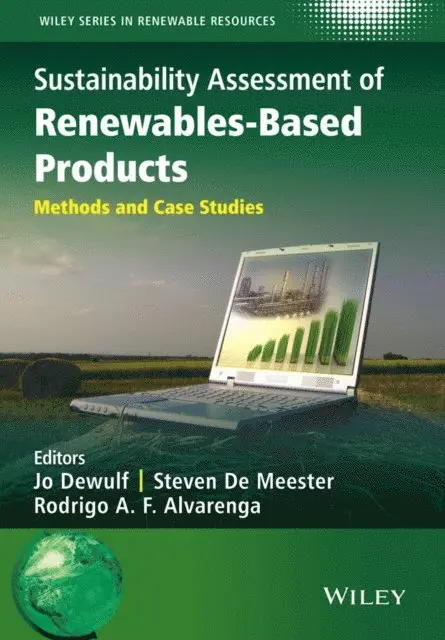
    Sustainability Assessment of Renewables-Based Products

    Methods and Case Studies

    AvJo Dewulf,Steven De Meester

    Inbunden, Engelska, 2016

    Del i serien Wiley Series in Renewable Resource

    1 580 kr

    Beställningsvara. Skickas inom 11-20 vardagar. Fri frakt över 249 kr.

    Beskrivning

    Over the past decade, renewables-based technology and sustainability assessment methods have grown tremendously. Renewable energy and products have a significant role in the market today, and the same time sustainability assessment methods have advanced, with a growing standardization of environmental sustainability metrics and consideration of social issues as part of the assessment.Sustainability Assessment of Renewables-Based Products: Methods and Case Studies is an extensive update and sequel to the 2006 title Renewables-Based Technology: Sustainability Assessment. It discusses the impressive evolution and role renewables have taken in our modern society, highlighting the importance of sustainability principles in the design phase of renewable-based technologies, and presenting a wide range of sustainability assessment methods suitable for renewables-based technologies, together with case studies to demonstrate their applications.This book is a valuable resource for academics, businesses and policy makers who are active in contributing to more sustainable production and consumption.For more information on the Wiley Series in Renewable Resources, visit www.wiley.com/go/rrsTopics covered include: The growing role of renewables in our societySustainability in the design phase of products and processesPrinciples of sustainability assessmentLand use analysisWater use analysisMaterial and energy flow analysisExergy and cumulative exergy analysisCarbon and environmental footprint methodsLife Cycle Assessment (LCA), social Life Cycle Assessment and Life Cycle Costing (LCC)Case studies: renewable energy, bio-based chemicals and bio-based materials.

    Produktinformation

    • Utgivningsdatum:2016-01-22
    • Mått:175 x 252 x 25 mm
    • Vikt:758 g
    • Format:Inbunden
    • Språk:Engelska
    • Serie:Wiley Series in Renewable Resource
    • Antal sidor:400
    • Förlag:John Wiley & Sons Inc
    • ISBN:9781118933947

    Utforska kategorier

    • Energiteknik inom Naturvetenskap och teknik
    • Miljövetenskap och miljöpolitik inom Naturvetenskap och teknik

    Mer om författaren

    Prof. Dr. Jo Dewulf, Institute for Environment and Sustainability, JRC, European Commision, Italy and Sustainable Organic Chemistry and Technology, Ghent University, BelgiumProfessor Dewulf performs research in the areas of environmental chemistry, environmental technology and clean technology at Ghent University. Since December  2013, he has been working as a senior researcher in the Institute for Environment and Sustainability at the Joint Research Institute of the European Commission. Key in his work is managing natural resources in a technically efficient way, performing thermodynamics based sustainability analysis at process, plant and cradle-to-gate level to support the development and assessment of new technologies.Supported by:Dr Steven De Meester, Sustainable Organic Chemistry and Technology, Ghent University, BelgiumDr De Meester works on the development of sustainability assessment methodologies for new technologies and applications of Life Cycle Assessment in industry.Dr Rodrigo Alvarenga, Universidade Federal de Santa Catarina, Brazil

    Innehållsförteckning

    • List of Contributors xviiSeries Editor’s Preface xxiiiPreface xxvii1 The Growing Role of Biomass for Future Resource Supply—Prospects and Pitfalls 1Helmut Haberl1.1 Introduction 11.2 Global Ecological and Socioeconomic Biomass Flows 31.3 Global Biomass Potentials in 2050 51.4 Critical Socio-Ecological Feedbacks and Sustainability Issues 91.5 Conclusions 12Acknowledgements 12References 132 The Growing Role of Photovoltaic Solar, Wind and Geothermal Energy as Renewables for Electricity Generation 19W.G.J.H.M. van Sark, J.G. Schepers, and J.D.A.M. van Wees2.1 General Introduction 192.2 Photovoltaic Solar Energy 212.3 Wind Energy 242.4 Geothermal Energy 282.5 Conclusion 33References 343 Assessment of Sustainability within Holistic Process Design 37Alexei Lapkin, Philipp]Maximilian Jacob, Polina Yaseneva, Charles Gordon, and Amy Peace3.1 Introduction: Holistic Process Design from Unit Operations to Systems Science Methods 373.2 Use of Life Cycle Assessment in Holistic Process Design 403.3 A Decision-Tree Methodology for Complex Process Design 413.4 Generation of New Synthesis Routes in Bio-Based Supply Chains 453.5 Conclusions 47Acknowledgements 48References 484 A Mass Balance Approach to Link Sustainable Renewable Resources in Chemical Synthesis with Market Demand 51Claudius Kormann and Andreas Kicherer4.1 Introduction 514.2 Renewable Feedstock: Market Drivers, Political Frame 524.3 Traceability of Biomass as Feedstock in the Chemical Industry 534.4 Standard of Mass Balance in Chemical Synthesis 574.5 Sustainability Aspects of Renewable Resources 604.6 Discussion 614.7 Vision and Summary 62References 635 Early R&D Stage Sustainability Assessment: The 5 Pillar Method 65Akshay D. Patel, John A. Posada, Li Shen, and Martin K. Patel5.1 Introduction 655.2 Methodology 675.3 Case Study 735.4 Validation Case Study 755.5 Critical Review and Outlook 765.6 Conclusion 79References 796 Assessing the Sustainability of Land Use: A Systems Approach 81Miguel Brandão6.1 Introduction 816.2 Methodological Issue 1: Consequential Analysis of Land Use Decisions 826.3 Methodological Issue 2: Land Use Impacts on Ecosystems 876.4 Methodological Issue 3: Land Use Impacts on Climate 896.5 Methodological Issue 4: Economic and Social Impact Assessment 906.6 Methodological Issue 5: Integrating Environmental and Economic Assessments 926.7 Discussion 936.8 Conclusions 94References 947 Water Use Analysis 97Francesca Verones, Stephan Pfister, and Markus Berger7.1 Introduction 977.2 Methods and Tools for Assessing the Sustainable Use of Water 987.3 Case Study: Water Consumption Analysis of Biofuels and Fossil Fuels 1027.4 Discussion and Conclusion 105References 1068 Material Intensity of Food Production and Consumption 109Lucia Mancini and Michael Lettenmeier8.1 Introduction 1098.2 Material Flow Based Approaches for Assessing Sustainable Production and Consumption Systems 1108.3 MIPS Concept and Methodology 1118.4 Material Intensity of Food Systems 1138.5 Results of MIPS for Agricultural Products and Foodstuffs 1188.6 Conclusions 121References 1229 Material and Energy Flow Analysis 125Goto Naohiro, Nova Ulhasanah, Hirotsugu Kamahara, Udin Hasanudin, Ryuichi Tachibana, and Koichi Fujie9.1 Background 1259.2 Methodology 1289.3 Case Study 1319.4 Conclusion 139Acknowledgements 139References 13910 Exergy and Cumulative Exergy Use Analysis 141Sofie Huysman, Thomas Schaubroeck, and Jo Dewulf10.1 What Is Exergy 14110.2 Calculation of Exergy 14210.3 Applications of Exergy 14410.4 Cumulative Exergy Use Analysis 14610.5 Conclusions 151References 15211 Carbon and Environmental Footprint Methods for Renewables based Products and Transition Pathways to 2050 155Geoffrey P. Hammond11.1 Introduction 15511.2 Carbon and Environmental (or Eco) Footprinting 15911.3 The Relationship between Environmental Footprint Analysis (EFA) and Environmental Life]Cycle Assessment (LCA) 16611.4 Carbon and Environmental Footprints Associated with Global Biofuel Production 16711.5 Carbon and Environmental Footprints of Low Carbon Transition Pathways 17111.6 Concluding Remarks 174Acknowledgements 175References 17612 Tracking Supply and Demand of Biocapacity through Ecological Footprint Accounting 179David Lin, Alessandro Galli, Michael Borucke, Elias Lazarus, Nicole Grunewald, Jon Martindill, David Zimmerman, Serena Mancini, Katsunori Iha, and Mathis Wackernagel12.1 Summary and Rationale 17912.2 Methodology 18212.3 Usage Recommendations 19312.4 Future Developments 195References 19513 Life Cycle Assessment and Sustainability Supporting Decision Making by Business and Policy 201Sala Serenella, Fabrice Mathieux, and Rana Pant13.1 Life Cycle Assessment: A Systemic Approach to Evaluate Impacts 20113.2 LCA: Supporting Sustainability Assessment 20513.3 Role of LCA in Supporting Decisions in Business and Policy Context 20613.4 Tools and Support to Put LCA into Practice 21013.5 Conclusion and the Way Forward 211Acknowledgements 211References 21214 Life Cycle Costing 215Andreas Ciroth, Jutta Hildenbrand, and Bengt Steen14.1 Life Cycle Costing – Definition and Principles 21514.2 Environmental LCC 21614.3 Societal LCC 22014.4 LCC and Renewables 22114.5 Example Case 222References 22815 Social Life Cycle Assessment: Methodologies and Practice 229Alessandra Zamagni, Pauline Feschet, Anna Irene De Luca, Nathalie Iofrida, and Patrizia Buttol15.1 Introduction 22915.2 Social Life Cycle Assessment: Scientific Background 23015.3 Social Life Cycle Assessment in Practice 23215.4 SLCA and Life Cycle Sustainability Assessment: Methodological Challenges 23415.5 Conclusions and Outlook 236References 23716 Life Cycle Assessment of Solar Technologies 241F. Ardente, M. Cellura, S. Longo, and M. Mistretta16.1 Introduction 24116.2 Solar Technologies 24216.3 Life Cycle Assessment (LCA) and Solar Technologies 24516.3.1 Solar Thermal Plants 24616.3.2 Photovoltaic Plants 24616.3.3 Concentrating Solar Power (CSP) Plants and Solar Heating/Cooling Plants 24916.4 Assessment of Solar Technologies 24916.5 Conclusions 256References 25617 Assessing the Sustainability of Geothermal Utilization 259Ruth Shortall, Gudni Axelsson, and Brynhildur Davidsdottir17.1 Introduction 25917.2 Sustainable Geothermal Utilization 26017.3 Broader Sustainability Assessment of Energy Developments 26617.4 Sustainability Assessment Framework for Geothermal Power 26617.5 Conclusion 271References 27118 Biofuels from Terrestrial Biomass: Sustainability Assessment of Sugarcane Biorefineries in Brazil 275Otavio Cavalett, Marcos D.B. Watanabe, Alexandre Souza, Mateus F. Chagas, Tassia L. Junqueira, and Antonio Bonomi18.1 Introduction 27518.2 The Virtual Sugarcane Biorefinery (VSB) 27618.3 Methods Used in the VSB 27718.4 Biorefinery Scenarios Case Study 27918.5 Final Remarks 286Acknowledgements 286References 28719 Algae as Promising Biofeedstock; Searching for Sustainable Production Processes and Market Applications 289Sue Ellen Taelman, Steven De Meester, and Jo Dewulf19.1 Introduction 28919.2 Algae Background 29019.3 Algal Cultivation and Processing Methods 29219.4 Algae: Production and Potential Applications 29419.5 Environmental Sustainability of Algae Production 29819.6 Conclusions 302References 30320 Life Cycle Assessment of Biobased and Fossil Based Succinic Acid 307Marieke Smidt, Jeroen den Hollander, Henk Bosch, Yang Xiang, Maarten van der Graaf, Anne Lambin, and Jean]Pierre Duda20.1 Production of Succinic Acid 30720.2 Life Cycle Assessment: Biobased Succinic Acid and Fossil]Based Equivalent 31020.3 Sensitivity Analysis 31620.4 Conclusions 319References 32021 Biobased Poly Vinylchloride (PVC) 323Rodrigo A.F. Alvarenga, Zdenek Hruska, Alain Wathelet, and Jo Dewulf21.1 Introduction 32321.2 Life Cycle Assessment of Biobased PVC 32421.3 Carbon Footprint of Biobased Product 32921.4 Environmental Sustainability of Bioethanol Use 33021.5 Conclusions 331References 33222 Evaluation of Wood Cascading 335Karin Höglmeier, Gabriele Weber-Blaschke, and Klaus Richter22.1 Introduction 33522.2 Environmental Assessment of Wood Cascading by LCA 33822.3 Discussion and Conclusion 343Acknowledgements 345References 34523 Time]Dependent Life Cycle Assessment of Bio-Based Packaging Materials 347Maartje N. Sevenster23.1 Introduction 34723.2 Methodology 35123.3 Results 35323.4 Discussion 35723.5 Conclusions 358References 35824 Conclusions 361Jo Dewulf24.1 The Importance of Renewables]Based Products and Services 36124.2 The Need for Sustainability Assessment for Renewables: Even More Than in the Past 36224.3 The Growing Sustainability Assessment Toolbox 36324.4 Outlook: Pending Challenges 364Index