• Fri frakt över 249 kr
  • •
  • Snabba leveranser
  • •
  • Billiga böcker
Kundservice

Du är på sajten för privatpersoner.

Företag, bibliotek eller offentlig verksamhet?

Du handlar på classic.bokus.com, där alla dina funktioner finns intakta.
Till classic.bokus.com
Bokus logotyp. Gå till startsidan.
  • Erbjudanden
  • Nyheter
  • Student
  • Topplistor
  • Barn & ungdom
  • Bokus Play
  • E-böcker
  • Pocketböcker
  • Spel & pussel

10% rabatt på allt med kod: NYSTART10 →

Sidfot

Mina sidor

    Hjälp

    • Kundservice
    • Vanliga frågor och svar
    • Frakt och leverans
    • Retur vid ångerrätt
    • Reklamera vara
    • Betalning
    • Köpvillkor
    • Allmänna villkor
    • Information om webbplatsens tillgänglighet

    Om Bokus

    • Om oss
    • Pressrum
    • För studenter
    • För företag
    • För bibliotek och offentlig verksamhet
    • För leverantörer
    • Hållbarhet

    Populärt

    • Aktuella erbjudanden
    • Presentkort
    • Studentlitteratur
    • Nya böcker
    • Topplistor
    • Signerade böcker
    • Engelska böcker

    Inspiration

    • Boktips
    • BookTok
    • Populära bokserier
    • Barnbokskaraktärer
    • Populära författare
    Logotyp för Bokus
    Följ oss på Facebook (extern länk)Följ oss på Instagram (extern länk)Följ oss på YouTube (extern länk)Följ oss på TikTok (extern länk)
    bokus @ CookiesAnpassa cookiesIntegritetspolicyKöpvillkor
    Till Citymail hemsida (extern länk)Till Budbee hemsida (extern länk)Till Postnord hemsida (extern länk)Till Schenker hemsida (extern länk)Till Early Bird hemsida (extern länk)Till Walleys hemsida (extern länk)
    1. Kultur
    2. Designböcker
    3. Grafisk design

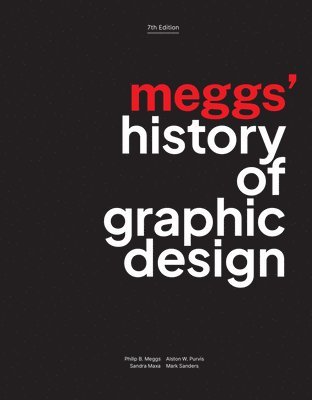
    Meggs' History of Graphic Design

    AvPhilip B. Meggs,Alston W. Purvis

    Inbunden, Engelska, 2025

    1 134 kr

    Beställningsvara. Skickas inom 5-8 vardagar. Fri frakt över 249 kr.

    Fler format och utgåvor

    Inbunden

    1 120 kr

    Beskrivning

    The bestselling graphic design reference, restructured by themes to represent motivations for visual communication over timeGraphic designers must have a thorough understanding of the field’s rich history in order to inspire and inform their work. Meggs’ History of Graphic Design is the industry’s original reference, serving as an essential resource for a generation of professionals, scholars, and students. With over 1,400 high-quality images throughout, this visually stunning text guides you through artistic innovators, breakthrough tools and technologies, and significant artifacts that have pushed the boundaries of graphic design throughout its history. The initial publication of this book was heralded as a landmark, and author Philip B. Meggs is credited with significantly shaping the academic field of graphic design.This new edition foregrounds cultural and social context and elevates diverse voices that are pivotal contributors to the history of graphic design. This seventh edition also covers: Artifacts, methods, designers, and events from pre-history to the twenty-first centuryTechnological advancements in media and design, from the earliest technologies to recent developmentsA timeline for studying graphic history from multiple viewpoints and culturally diverse approachesUpdated ancillary materials, including an instructor’s manual with discussion questions and a guide for transitioning from the previous editionYou can’t master a field without knowing its history. Meggs’ History of Graphic Design presents a diverse, visually spectacular history of graphic design for students and professionals. The updates to this edition solidify its continuing legacy as a must-have in any contemporary graphic design library.

    Produktinformation

    • Utgivningsdatum:2025-12-04
    • Mått:221 x 279 x 33 mm
    • Vikt:1 905 g
    • Format:Inbunden
    • Språk:Engelska
    • Antal sidor:528
    • Upplaga:7
    • Förlag:John Wiley & Sons Inc
    • ISBN:9781119743293

    Utforska kategorier

    • Grafisk design inom Kultur
    • Illustrationskonst och kommersiell konst inom Kultur
    • Typografi och kalligrafi inom Kultur

    Mer om författaren

    Sandra Maxa (Baltimore, MD) is Director of the Graphic Design Master of Arts program at the Maryland Institute College of Art (MICA) where she teaches design theory, process and typography. Her research investigates the connection between mapping, narrative and culture. She has also taught at Pratt Institute, Parsons The New School for Design, and Rutgers University - Newark. Mark Sanders (Baltimore, MD), has taught typography, systems, and interaction design with research focused on reinventing typographic and digital frameworks to address the expanding roles and mediums of design. He has taught at Maryland Institute College of Art (MICA), Pratt Institute, Parsons The New School for Design, and Rutgers University - Newark. As partners at the multi-disciplinary studio Q Collective, Sandra and Mark produce work that reflects a deep interest in identity, interactivity, history and visual culture. Sandra and Mark are also co-authors of the 6th and 7th editions of Typographic Design: Form and Communication.

    Recensioner i media

    "We have come a long way over 42 years, and that’s apparent here. Philip Meggs’ tendency toward bold, poetic claims (“The invention of writing brought the luster of civilization to people and made it possible to preserve hard-won knowledge”) now seems dated, and has given way to more neutral, objective wordings (“Writing enabled the recording and transmission of ideas across time and space.”) The idea of a master narrative and the Eurocentric bias of earlier editions of this text have been pressured, and forced to make room for multiplicity and inclusivity. The history of graphic design appears, here, fresher, livelier and more relevant... Naturally, there is always more work to do: the sea of images that comprise the history of graphic design is vast, centerless, and heaving. But Sanders and Maxa, capable guides, have done their part in steering this ship on its latest voyage."--Kerr Houston, Bmore Art, November 11, 2025Charting the Sea: Meggs’ History of Graphic Design - BmoreArt"The 7th Edition is a reformation — dismantling the core barriers that have kept many of us from realizing our full potential in this field. It will make a transformative difference for years to come. The next generation of designers will find themselves in the history of graphic design and propel the industry forward."--Cheryl D. Holmes-Miller, PRINT Magazine, November 4, 2025New Edition of 'Meggs' History of Graphic Design' Reforms the Canon – PRINT Magazine

    Innehållsförteckning

    • Preface to the Seventh Edition xPreface to the First Edition xiiAcknowledgments xivChapter 1: Timeline 2Pre-History and the Origins of Writing | 75,000 bce–500 bce 2Writing, Paper, and Printing | 500 bce– 1450 3Renaissance Design and Modern Typography | 1450–1800 5The Industrial Revolution | 1800–1899 7Graphic Design in the Modern Era | 1900–1950 10The Rise of Design Culture and Media | 1950–2000 14Digital Design Comes of Age | 2000–Present 19Chapter 2: Overview of Graphic Design History 22Chapter 3: Writing 34Prehistoric visual communications 36Early writing in Mesopotamia 36Egyptian hieroglyphs 39Cretan pictographs 43The North Semitic (Phoenician) alphabet 45The Aramaic alphabet and its descendants 45The Greek alphabet 50The Latin alphabet 50Early writing in Mesoamerica 54Chinese scripts 55Chinese script styles 58The Korean alphabet 60African writing systems 64Cherokee syllabary 65Chapter 4: Exalting 68The Book of the Dead in Egypt 70Palm leaf manuscripts in South and Southeast Asia 72Illuminated manuscripts in Europe 73Judaic manuscripts 88Islamic manuscripts 88Ethiopian manuscripts 89Chapter 5: Inventing 94Origin and early evolution of printing in China 96Movable type is invented 98Movable type comes to Europe 99Innovating the printing press 103Mechanization of typesetting 104Printing images 105Lithography simplifies and expands printing 108Printing in color 108Victorian typeface designs 109Mavericks of composition and form 112Dada and Surrealism—making new truths 112Reimagining photography 114Russian avant-garde—inventing by combination 114Experimenting as practice 115A universally understood language 118Typographic invention in the Netherlands 118Graphic design expressionism 119Phototypography 120Calligraphic abstraction 121Figurative typography 121Experiments in graphic space 122Graphic design tactility 126Digital design revolution 127Spatial elasticity of layout, typography, and imagery 129The digital-type foundry 133Digital image manipulation and composition 135Chapter 6: Persuading 136Early printing and the Christian church 138The Industrial Revolution and the rise of commercial culture 142Innovations in typography for advertising 142Wood type and the letterpress poster 146Advertising cards, packaging, and posters 147The rise of American editorial design and advertising agencies 148The advertising poster in Europe 149Posters in Eastern Europe and Russia 153The Bauhaus influence on advertising 156Independent voices in the Netherlands 157New approaches to photography in advertising 158From illustration to modernism in American advertising 160International Typographic Style in advertising 161Advertising at mid-century 167Postmodern design and advertising 174Expanding brands and media 178Chapter 7: Unifying 180Early visual sign systems 182Unifying early typography 182Establishing book design systems 184Standardization of typographic forms 188Art Nouveau—unifying decoration, structure, and function 189The decorative arts expand to publishing 194Standardization of visual systems 200Constructivism—visually programming the total object 205Universal systems for art and design 207The new typography; form from the functions of the text 209International Typographic Style—a unity of design elements 212The corporate identity program 215Design systems for government 220Design systems for the Olympic Games 224Unity and variability through digital typefaces 228Chapter 8: Representing 230Prehistoric visual representation 232Mesopotamian, Egyptian, and Greek visual representation 232Chinese chops 233Early marks for books and printers 234Early business trademarks 234Indigenous beadwork and symbols 235Representation of Native culture and identity 238Symbolic representation in advertising 239Representation of Black culture and identity 241Symbolizing the Bauhaus philosophy 244Representation through clarity and order 244Symbols and American modernism 245Visual identity systems in America 246Global identity and the Olympics 253Representing with image 256Currency and postage stamps 258Postmodern design and representation 259Branding and identity 262Chapter 9: Explaining 264Early illustrated books 266The German illustrated book 269The Renaissance—innovations in book design 273Victorian children’s books 278The rise of infographics 280Pictographic histories 284Informational graphics at mid-century 286Information architecture 292Visual storytelling 296Chapter 10: Refining 298The Italian Renaissance 300“Scientific” typeface refinement 301Rococo era 301Caslon and Baskerville 302Modern style fonts 306Private presses communicate to the imagination 307The Arts and Crafts movement 307Cubism’s elemental forms 312De Stijl—reducing the language of form 313Constructivism’s geometric forms 314Twentieth-century typeface design 318New typography in the Netherlands 319Tschichold returns to traditional typography 320Refining form and communication in America 320Phototypography expands options for designers 324Bending graphic design traditions 326New-wave typography 327Retro and vernacular design 330Expressive typography and design 331Digital typeface design and historic sources 337Chapter 11: Interpreting 340Visualizing the unknown 342Space as the essence of design 342The Glasgow School—abstraction and symbolic drawing 343The Vienna Secession—interpreting through symbols 344Interpretive typography in Europe 348Cubism 349Interpretations of De Stijl 351Expressionism 354American books, magazines, and records at mid-century 355CCA expresses ideas in advertisements 366Posters and the conceptual image 366The Polish poster 368The conceptual studio 369Album cover art expands 373Experimentation with digital tools 374Editorial design in the late twentieth century 375Motion graphics and film titles 379Contemporary poster design 384Chapter 12: Criticizing 392The Arts and Crafts movement 394U.S. political cartoons 401Futurism 402Dada 406Supermannerism 409Postmodern design 412First Things First manifestos 416Critical practice in the Netherlands 417Critical editorial design 418Chapter 13: Mobilizing 422World War I posters 424Posters in Germany between the Wars 427Russian Suprematism and Constructivism 427Spanish Civil War posters 434Posters and the Great Depression in America 435Mobilizing Resources for World War II 438Antiwar posters 442Mobilizing for racial equality 444Cuban Revolution posters 448Solidarity campaign in Poland 450Feminism and design 450Posters as environmental activism 454Graphic design as political activism 454Art and Design Movements and Styles 456Bibliography: 7th edition 460Bibliography: previous editions 464Image Credits 492Index 497Colophon 510About the Companion Website 511