• Fri frakt över 249 kr
  • •
  • Snabba leveranser
  • •
  • Billiga böcker
Kundservice

Du är på sajten för privatpersoner.

Företag, bibliotek eller offentlig verksamhet?

Du handlar på classic.bokus.com, där alla dina funktioner finns intakta.
Till classic.bokus.com
Bokus logotyp. Gå till startsidan.
  • Erbjudanden
  • Student
  • Topplistor
  • Barn & ungdom
  • Bokus Play
  • E-böcker
  • Ljudböcker
  • Pocketböcker
  • Spel och pussel

Pocketfynda! Hundratals böcker för 49 kr/st →

Sidfot

Mina sidor

    Hjälp

    • Kundservice
    • Vanliga frågor och svar
    • Frakt och leverans
    • Retur vid ångerrätt
    • Reklamera vara
    • Betalning
    • Köpvillkor
    • Allmänna villkor
    • Information om webbplatsens tillgänglighet

    Om Bokus

    • Om oss
    • Pressrum
    • För studenter
    • För företag
    • För bibliotek och offentlig verksamhet
    • För leverantörer
    • Hållbarhet

    Populärt

    • Aktuella erbjudanden
    • Presentkort
    • Studentlitteratur
    • Nya böcker
    • Topplistor
    • Signerade böcker
    • Engelska böcker

    Inspiration

    • Boktips
    • BookTok
    • Barnbokskaraktärer
    • Populära författare
    Logotyp för Bokus
    Följ oss på Facebook (extern länk)Följ oss på Instagram (extern länk)Följ oss på YouTube (extern länk)Följ oss på TikTok (extern länk)
    bokus @ CookiesAnpassa cookiesIntegritetspolicyKöpvillkor
    Till Citymail hemsida (extern länk)Till Budbee hemsida (extern länk)Till Postnord hemsida (extern länk)Till Schenker hemsida (extern länk)Till Early Bird hemsida (extern länk)Till Walleys hemsida (extern länk)
    1. Samhälle och politik
    2. Sociologi och antropologi
    3. Antropologi

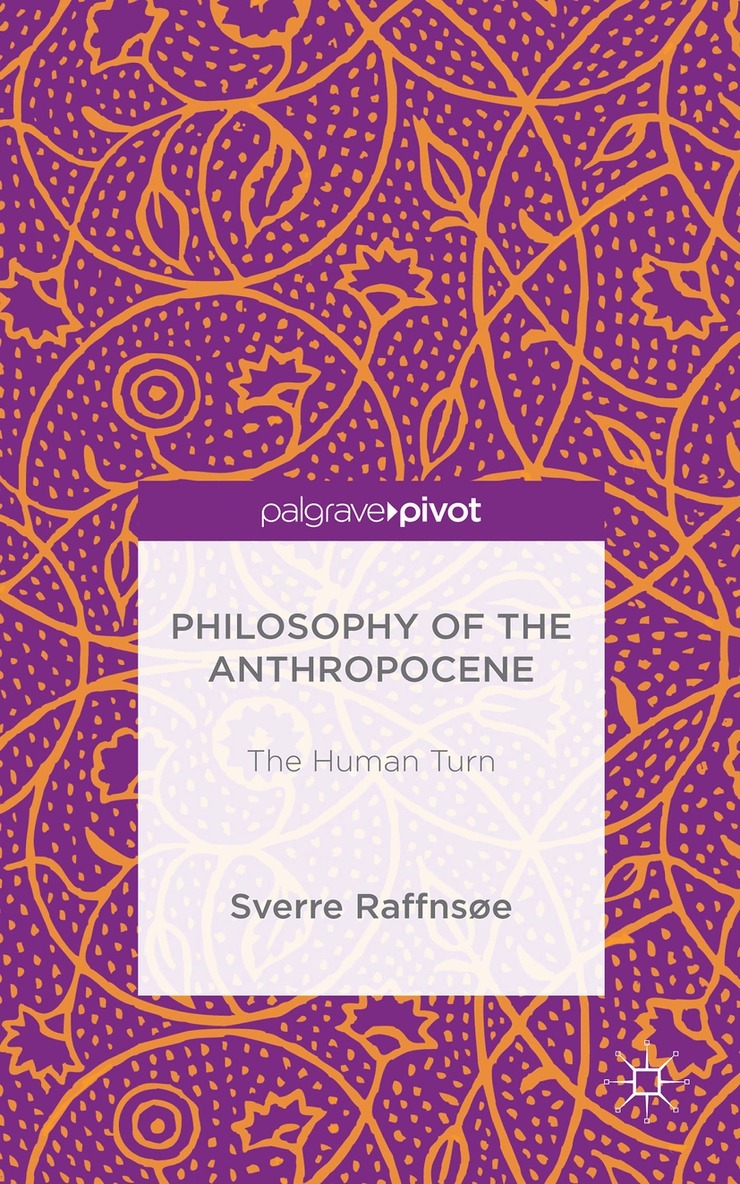
    Philosophy of the Anthropocene

    The Human Turn

    AvSverre Raffnsøe

    Inbunden, Engelska, 2016

    596 kr

    Beställningsvara. Skickas inom 10-15 vardagar. Fri frakt över 249 kr.

    Fler format och utgåvor

    E-bok

    838 kr

    Beskrivning

    The Anthropocene is heralded as a new epoch distinguishing itself from all foregoing eons in the history of the Earth. It is characterized by the overarching importance of the human species in a number of respects, but also by the recognition of human dependence and precariousness. A critical human turn affecting the human condition is still in the process of arriving in the wake of an initial Copernican Revolution and Kant's ensuing second Copernican Counter-revolution.Within this landscape, issues concerning the human - its finitude, responsiveness, responsibility, maturity, auto-affection and relationship to itself - appear rephrased and re-accentuated as decisive probing questions. In this book Sverre Raffnsøe explores how the change has ramifications for the kinds of knowledge that can be acquired concerning human beings and for the human sciences as a study of human existential beings in the world.

    Produktinformation

    • Utgivningsdatum:2016-01-05
    • Mått:140 x 216 x 11 mm
    • Vikt:265 g
    • Format:Inbunden
    • Språk:Engelska
    • Antal sidor:75
    • Förlag:Palgrave Macmillan
    • ISBN:9781137526694

    Utforska kategorier

    • Antropologi inom Samhälle och politik
    • Filosofiska discipliner inom Filosofi och religion

    Mer om författaren

    Sverre Raffnsøe is Professor of Philosophy and Editor-in-Chief of Foucault Studies at Copenhagen Business School, Denmark. In addition to Foucault: Studienhandbuch (2010), Foucault: A Research Companion (Palgrave, 2014), Nietzsche's 'Genealogie der Moral' (2007) and Coexistence without Common Sense, Vol. I-III (doctoral dissertation 2002, 911 pages), he is the author of books and articles on philosophical aesthetics, management philosophy, social philosophy and recent French and German philosophy.

    Recensioner i media

    Review of The Human Turn: The Makings of a Contemporary Relational Topography In preparing this review, I've read the author's proposal and the first 77 pages of his manuscript, as well as perused the remainder of the manuscript. On the basis of this reading, I can recommend publication of the project, with certain qualifications detailed below. The manuscript is focused on exploring the ways in which human beings' relationships to global environmental processes, to history, and to themselves (via theory, practice, and policy), have changed in recent history, leading up to and into the moment that some geologists have dubbed the 'Anthropocene,' and offers suggestions (at both a theoretical and policy level) for how best to orient ourselves to these changes, some of which are ongoing. The manuscript supplies a variety of novel and instructive elements for its readers, including case studies, some terminological and conceptual innovations, and reviews of existing literature on selected topics of relevance. It also employs two very well chosen stylistic devices: (1) a series of excurses that provide extended discussion of select issues - for instance: a medieval murder trial in which a family of pigs were the defendants (12-14), the expression of an 'anthropocentric' human relationship to environments in the genre of landscape painting (39-45), and the origination of the humanities in the 18th century (88-94) - and (2) illustrations drawn from a variety of historical and contemporary sources, which add historical and sensory depth to the work, in addition to being interesting (and clearly carefully chosen) in their own right. I believe the manuscript has great potential as a textbook or monograph in the growing field of works about 'the human' and human beings' relationships to nature and to technology, a literature that blossoms at the border of philosophy and various empirical sciences. For all of these reasons, I recommend its eventual publication. For all of its notable strengths, however, I have some hesitation about the manuscript in its current form. The problem is, I find myself unconvinced by a number of Raffnsoe's formulations. The author's ingenuity in collecting interesting cases and images is occasionally compromised by a seeming overconfidence about the strength of particular arguments and the lack of engagement with literature or evidence that would be useful for making the arguments in question. To give just one example (more could be given): the author writes that 'the growth of the human population has meant that a very significant part of the planet's dry biomass is now allocated to human bodies' (46), but he neglects to provide comparative figures for biomass allocation before and after the supposed 'human turn,' nor even a citation to an article or book chapter that could provide this information. The most serious problem concerns the notion of a 'human turn' itself. I have no problem believing that the variety of issues discussed in the manuscript share a common theme (roughly, the radically altered character of the human place in the world in the course of modernity, as marked, for instance, by the notion of the Anthropocene, and how we ought to orient ourselves to these changes). What I doubt is that the notion of a 'human turn' is the best way to organize the variety of insights, cases, and subsidiary topics that the author has collected. For one thing, the author appears to be the only person who has ever discussed a so-called 'human turn.' Such terminological innovation would be legitimate if the author could make clear precisely what this turn is, and make the case that it is in fact taking place. But these obligations are only barely met. Regarding the first obligation, for instance, the author writes in the proposal that '[t]he title ... denotes a general turn towards the human, and the turning of the human in new directions' (1). But clearly these are two distinguishable developments: (i) an increased concern to map and understand the relevance of human factors to what happens in the world more generally; and (ii) a change in the contours of these factors themselves. Other ambiguities concern whether the turn is something that is already underway or is a programmatic change that the author is arguing for; or whether the turn is primarily institutional and ecological, or primarily theoretical. Regarding gaps in the argument: After a few pages of relatively non-specific description of the so-called turn and its significance (3-7), the author recounts the recent conviction of several earthquake experts for manslaughter (9-11), and then concludes that the example 'makes it clear that the attribute of being human has assumed a new position and a new role' (15). This conclusion wildly overstates the strength of this particular argument (an induction on the basis of a single case). In order for the events in question to constitute a 'turn,' they must be new; and, naturally, one would wonder why any form of anthropocentrism, even the Ancient Greek Protagoras's quip that 'man is the measure of all things,' is not an instance of a 'human turn.' (The author makes efforts to distinguish this Protagorean moment, as well as an 'anthropocentric turn' of the 18th century, from the 'human turn,' but these distinctions suggest that, at the very least, the choice of 'the human' as the title for the new turn in question is arbitrary and misleading.) Furthermore, competing claims in favor of anti-humanism or post-humanism (which the author dubs a 'post-human turn') are not addressed as competitors, but rather seem to be treated by the author as components of a more comprehensive change that, again, he labels the 'human turn' - though, in the final lines of the MS, he also concedes that they may point forward to a new turn beyond the human turn. All in all, these features frankly suggest to me that the notion of a 'human turn' is not sufficiently clarified, nor its existence and coherence sufficiently argued for. I'm not sure whether the problem is solely terminological (so that it could be solved simply by changing the name, or by more clarification, early in the manuscript, of precisely what 'the human' means and why it is the appropriate title for this turn - perhaps more emphasis on the humble and uncontrollable yet variable nature of the 'human' would provide a good lead here), or substantive and logical, but I suspect it is a bit of both. The lengthy comparisons to previous 'turns' (the linguistic turn, etc.) comes across as a bit beside the point (a bit like academic journalism); and the use of deliberate ambiguity when using the term 'turn' (for instance, referring at one point to a human 'turn' towards the natural world as part of the human turn, implying that any 'turning' that humans might be doing will be counted as a part of the human turn) strikes me as basically confusing and unproductive. If the 'turn' language is to be preserved in the final manuscript, then I would say that what is needed much more clearly than these reviews of previous turns or this confusing terminological ambiguity is an account of what a 'turn' in this commonly used sense is, in general, and why turns are important (what is their overall significance for intellectual work, their connection to ontologies and vocabularies, etc.). It strikes me that the theme of (a) increased human influence upon global environments and global history (as marked by the notion of the 'Anthropocene'), coupled with (b) increased realization that anthropological factors (such as human action and desire) are only partially controllable from a public policy standpoint, might be a more strategic point around which to gather the admirable wealth of suggestive materials that the author has collected. (The term 'the Anthropogene,' on the other hand, I would recommend dropping, as it is both idiosyncratic - basically unused elsewhere - and seemingly not necessary for the main points that the author wants to make.) It is also possible that the notion of the 'Anthropocene,' which has at least some traction within geology and related disciplines, might be a sounder basis on which collect the materials and build an argument that they point to a single set of lessons. This is a theme already woven into the text as a whole. The book may indeed be productively read as a path-breaking exploration of the philosophical implications of the emergence of the Anthropocene. While there is already some literature (including many articles and book-length discussions) of the Anthropocene, which the author might fruitfully consult and discuss in more detail, there does appear to be a relative dearth of literature that explores the intellectual-historical and philosophical dimensions of this idea, including an account of the philosophical and intellectual changes that would be appropriate as a response to this new condition, and how to orient ourselves to the geological, human, and human-scientific history that precedes and leads up to and into the Anthropocene. With only minimal recasting, the author's text might explicitly fill this gap quite uniquely and effectively.

    Innehållsförteckning

    • Introduction: For Whom the Bell TollsThe Hour of the Pig…The Hour of Man?Redefining Humans and the Human ConditionNew VistasFirst Investigation:Exploring the role of Humans in the Anthropocene Landscape1. The Opening of a New Chapter in the World's History2. A Prominent Role in a Landscape Lush with Mutual Mediation3. The (Post)human ConditionSecond Investigation:Exploring the Human Turn as a Challenge for Humans and the Sciences4. The turn within and of the Human5. The Human Turn as it Appears within Central Fields of Knowledge, Capabilities and Skills6. The Human Turn: A Challenge for the Human Sciences7. Man at the Centre – the Legacy of the Humanities8. The Human Turn: A Turn within the Human Sciences9. A Copernican Turn