• Fri frakt över 249 kr
  • •
  • Snabba leveranser
  • •
  • Billiga böcker
Kundservice

Du är på sajten för privatpersoner.

Företag, bibliotek eller offentlig verksamhet?

Du handlar på classic.bokus.com, där alla dina funktioner finns intakta.
Till classic.bokus.com
Bokus logotyp. Gå till startsidan.
  • Erbjudanden
  • Nyheter
  • Student
  • Topplistor
  • Barn & ungdom
  • Bokus Play
  • E-böcker
  • Pocketböcker
  • Spel & pussel

10% rabatt på allt med kod: NYSTART10 →

Sidfot

Mina sidor

    Hjälp

    • Kundservice
    • Vanliga frågor och svar
    • Frakt och leverans
    • Retur vid ångerrätt
    • Reklamera vara
    • Betalning
    • Köpvillkor
    • Allmänna villkor
    • Information om webbplatsens tillgänglighet

    Om Bokus

    • Om oss
    • Pressrum
    • För studenter
    • För företag
    • För bibliotek och offentlig verksamhet
    • För leverantörer
    • Hållbarhet

    Populärt

    • Aktuella erbjudanden
    • Presentkort
    • Studentlitteratur
    • Nya böcker
    • Topplistor
    • Signerade böcker
    • Engelska böcker

    Inspiration

    • Boktips
    • BookTok
    • Populära bokserier
    • Barnbokskaraktärer
    • Populära författare
    Logotyp för Bokus
    Följ oss på Facebook (extern länk)Följ oss på Instagram (extern länk)Följ oss på YouTube (extern länk)Följ oss på TikTok (extern länk)
    bokus @ CookiesAnpassa cookiesIntegritetspolicyKöpvillkor
    Till Citymail hemsida (extern länk)Till Budbee hemsida (extern länk)Till Postnord hemsida (extern länk)Till Schenker hemsida (extern länk)Till Early Bird hemsida (extern länk)Till Walleys hemsida (extern länk)
    1. Naturvetenskap och teknik
    2. Matematik och naturvetenskap
    3. Biologi
    4. Biovetenskap

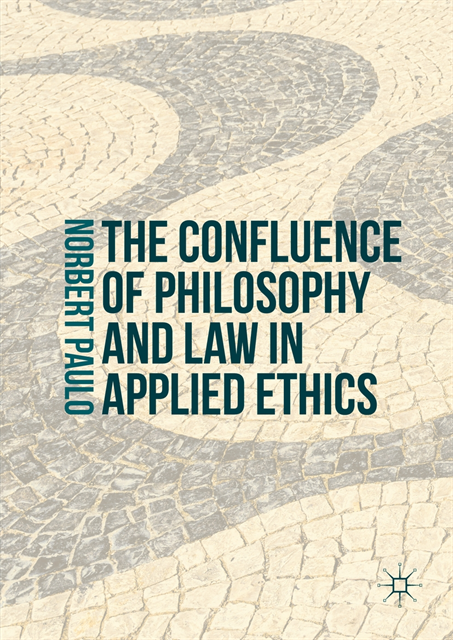
    Confluence of Philosophy and Law in Applied Ethics

    AvNorbert Paulo

    Inbunden, Engelska, 2016

    978 kr

    Beställningsvara. Skickas inom 10-15 vardagar. Fri frakt över 249 kr.

    Fler format och utgåvor

    E-bok

    1 333 kr

    Beskrivning

    The law serves a function that is not often taken seriously enough by ethicists, namely practicability. A consequence of practicability is that law requires elaborated and explicit methodologies that determine how to do things with norms. This consequence forms the core idea behind this book, which employs methods from legal theory to inform and examine debates on methodology in applied ethics, particularly bioethics. It is argued that almost all legal methods have counterparts in applied ethics, which indicates that much can be gained from comparative study of the two. The author first outlines methods as used in legal theory, focusing on deductive reasoning with statutes as well as analogical reasoning with precedent cases. He then examines three representative kinds of contemporary ethical theories, Beauchamp and Childress’s principlism, Jonsen and Toulmin’s casuistry, and two versions of consequentialism—Singer’s preference utilitarianism and Hooker’s rule-consequentialism—with regards to their methods. These examinations lead to the Morisprudence Model for methods in applied ethics.

    Produktinformation

    • Utgivningsdatum:2016-06-10
    • Mått:148 x 210 x 20 mm
    • Vikt:458 g
    • Format:Inbunden
    • Språk:Engelska
    • Antal sidor:250
    • Upplaga:16001
    • Förlag:Palgrave Macmillan
    • ISBN:9781137557339

    Utforska kategorier

    • Biovetenskap inom Naturvetenskap och teknik
    • Filosofiska discipliner inom Filosofi och religion
    • Juridik: metod och teori inom Juridik

    Mer om författaren

    Norbert Paulo is a lecturer in practical philosophy at the University of Salzburg, Austria. He holds a PhD in philosophy from Hamburg University, Germany, where he studied both philosophy and law. His primary research concerns applied ethics, ethical theory, philosophy of law, and empirical ethics.

    Innehållsförteckning

    • PART I: ETHICS AND LAW.- 1 The Black-Box Problem.- METHODS.- OUTLINE.- 2 Ethics, Applied Ethics, and Law.- TERMINOLOGY: ETHICS AND MORALITY.- ETHICS, APPLIED ETHICS, BIOETHICS.- ETHICS AND LAW.- CONCLUSION.- PART II: METHODS IN LEGAL THEORY.- 3 Norms.- ABSTRACT AND GENERAL NORMS.- PRINCIPLES AND RULES.- Dworkin on Principles.- Principles as Optimization Requirements.- 4 Norm Application.- DEDUCTIVE STRUCTURE.- INTERPRETATION.- RULES OF INTERPRETATION.- Some Intricacies.- REASONING WITH PRECEDENTS.- Precedents.- What is binding?.- Strict binding force?.- ANALOGICAL REASONING.- Brewer’s Theory of Analogical Reasoning.- The sequence of processes.- CONCLUSION.- 5 Norm Development.- EXPANSIONS.- Supplementation.- Conflict of principles: proportionality test.- The four steps.- Critique.- Gap-Filling.- Distinguishing.- REVISIONS.- Overruling.- Correction of Mistakes.- NEW LEGISLATION.- CONCLUSION.- PART III: METHODS IN CONTEMPORARY ETHICAL THEORIES.- 6 Principlism.- THE STRUCTURE OF PRINCIPLISM.- Clusters of Principles and the Common Morality.- Principles and Rules.- Ideals, Virtues, and Rights.- PRINCIPLISM’s NORMATIVE CONTENT.- Respect for Autonomy.- Nonmaleficence.- Beneficence, Impartiality, and Moral Status.- Justice.- Relationship.- THEORY OF JUSTIFICATION.- METHODS.- Specification.- The importance of revisions and expansions.- Richardson’s definition.- Interpretation.- Abandoning specification.- Balancing.- The constraining conditions and proportionality.- Critique and alternatives.- CONCLUSION.- 7 Casuistry.- THE BASICS.- THE STRUCTURE OF CASUISTRY.- Morphology.- Taxonomy.- Kinetics.- CRITIQUE.- Cases do not speak forthemselves.- What rules the case?.- Importance of the Taxonomy.- The Role of Paradigms.- Arbitrary Kinetics.- Casuistry’s Conventionality.- A BETTER STRUCTURE FOR CAUSISTRY.- Rules: Maxims and Paradigms.- Application of Paradigms.- Overruling and Distinguishing Paradigms.- Analogical Reasoning.- CONCLUSION.- 8 Consequentialism.- PETER SINGER’s PREFERENCE UTILITARIANISM.- The Practice of Singer’s Theory.- BRAD HOOKER’s RULE-CONSEQUENTIALISM.- The Basic Theory.- Structure.- Impartiality, Reflective Equilibrium, and Pluralism.- Prima Facie Rules, Interpretation, and Conflicts.- Hooker on Euthanasia.- CONCLUSION.- 9 The Morisprudence Model for Applied Ethics.- DEDUCTIVE NORM APPLICATION.- APPLICATION AND DEVELOPMENT.- WHY THE MORISPRIDENCE MODEL?.- Notes.- Bibliography.- Index