Inbunden, Engelska, 2014
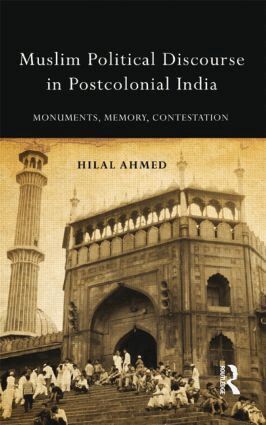
Muslim Political Discourse in Postcolonial India
Monuments, Memory, Contestation
Av Hilal Ahmed
1591 kr
Tillfälligt slut
Beskrivning
Produktinformation
- Utgivningsdatum: 2014-08-08
- Mått: 138 x 216 x 22 mm
- Vikt: 498 g
- Format: Inbunden
- Språk: Engelska
- Antal sidor: 344
- Förlag: Taylor & Francis Ltd
- ISBN: 9781138020160
Utforska kategorier
Mer om författaren
Hilal Ahmed is Assistant Professor, Centre for the Study of Developing Societies (CSDS), New Delhi.
Recensioner i media
‘Hilal Ahmed’s book is a pioneering exploration of the politics of historical monuments, an interdisciplinary work linking the analysis of law, history and politics. It offers a remarkable analysis of the ways in which reinterpreted images of the past work as resources for mobilization and action in the political present. The book also offers a fascinating analysis of the politics around the Jama Masjid in Delhi – showing how religious monuments transform into sites of the political public sphere. Ahmed provides an insightful examination of the construction of historical memory and a sophisticated exploration of the complex effects of democratic mobilization on the political identity of Indian Muslims.’—Sudipta Kaviraj, Professor of Indian Politics and Intellectual History, Middle Eastern, South Asian and African Studies, Columbia University, New York ‘What could be more concrete, more singular in meaning than a building? In fact, many different actors have made signage, use, disputation, and rituals have made India’s built past centrally important in defining nationalism and belonging. Citizens absorb the assumptions of national identities as wholly natural, and the historical meanings attached to sites and buildings are part of those identities. Hilal Ahmed’s book provides a fresh and original analysis to understanding cultural and political life in India’s culturally plural society today.’—Barbara Metcalf, Professor of History Emerita, University of California, Davis‘Hilal Ahmed analyses the way in which political groups, both Hindu and Muslim, have used the great monuments of the Indo-Islamic tradition for political mobilisation. His book is one of the most important and innovative pieces of research of recent times. No scholar in the field should ignore it.’—Francis Robinson, Professor of the History of South Asia, Royal Holloway, University of London'Ahmed's study is exceptionally successful in placing Indian Muslim political discourses into the wider context of postcolonial socio-political processes without having to compromise with the internal dynamics of the community" - Jahfar Shareef, Centre for the Study of Social Systems, Jawaharlal Nehru University, New Delhi (South Asia Research) "A highly significant contribution to a comprehensive understanding of the political significance of India’s Islamic architecture." - Santhi Kavuri-Bauer, South Asia: Journal of South Asian Studies Vol. 39, 301-302
Betyg & recensioner
0 recensioner
Inga recensioner tillgängliga.