• Fri frakt över 249 kr
  • •
  • Snabba leveranser
  • •
  • Billiga böcker
Kundservice

Du är på sajten för privatpersoner.

Företag, bibliotek eller offentlig verksamhet?

Du handlar på classic.bokus.com, där alla dina funktioner finns intakta.
Till classic.bokus.com
Bokus logotyp. Gå till startsidan.
  • Erbjudanden
  • Student
  • Topplistor
  • Barn & ungdom
  • Bokus Play
  • E-böcker
  • Ljudböcker
  • Pocketböcker
  • Spel & pussel

10% rabatt på allt med kod NYSTART10 →

Sidfot

Mina sidor

    Hjälp

    • Kundservice
    • Vanliga frågor och svar
    • Frakt och leverans
    • Retur vid ångerrätt
    • Reklamera vara
    • Betalning
    • Köpvillkor
    • Allmänna villkor
    • Information om webbplatsens tillgänglighet

    Om Bokus

    • Om oss
    • Pressrum
    • För studenter
    • För företag
    • För bibliotek och offentlig verksamhet
    • För leverantörer
    • Hållbarhet

    Populärt

    • Aktuella erbjudanden
    • Presentkort
    • Studentlitteratur
    • Nya böcker
    • Topplistor
    • Signerade böcker
    • Engelska böcker

    Inspiration

    • Boktips
    • BookTok
    • Populära bokserier
    • Barnbokskaraktärer
    • Populära författare
    Logotyp för Bokus
    Följ oss på Facebook (extern länk)Följ oss på Instagram (extern länk)Följ oss på YouTube (extern länk)Följ oss på TikTok (extern länk)
    bokus @ CookiesAnpassa cookiesIntegritetspolicyKöpvillkor
    Till Citymail hemsida (extern länk)Till Budbee hemsida (extern länk)Till Postnord hemsida (extern länk)Till Schenker hemsida (extern länk)Till Early Bird hemsida (extern länk)Till Walleys hemsida (extern länk)
    1. Ekonomi och Ledarskap
    2. Ledarskapsböcker
    3. Projektledning

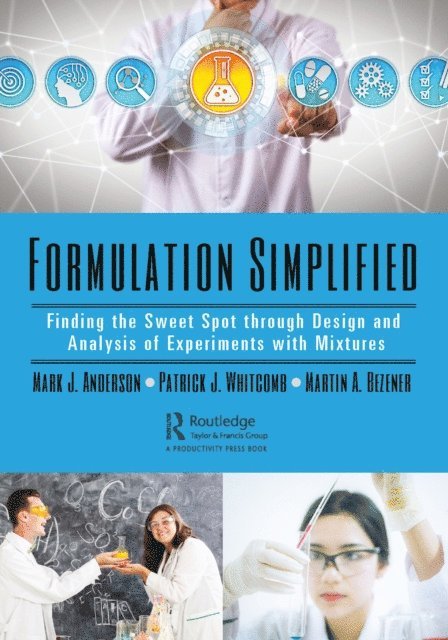
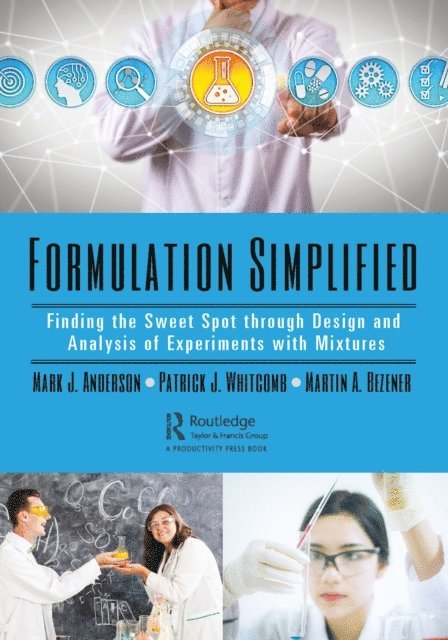
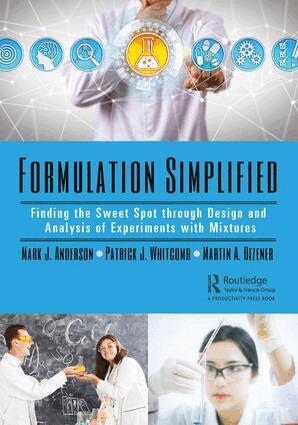
    Formulation Simplified

    Finding the Sweet Spot through Design and Analysis of Experiments with Mixtures

    AvMark J. Anderson,Patrick J. Whitcomb

    Inbunden, Engelska, 2018

    2 650 kr

    Beställningsvara. Skickas inom 10-15 vardagar. Fri frakt över 249 kr.

    Fler format och utgåvor

    Häftad

    822 kr

    Beskrivning

    Many chemists – especially those most brilliant in their field – fail to appreciate the power of planned experimentation. They dislike the mathematical aspects of statistical analysis. In addition, these otherwise very capable chemists also dismissed predictive models based only on empirical data. Ironically, in the hands of subject matter experts like these elite chemists, the statistical methods of mixture design and analysis provide the means for rapidly converging on optimal compositions. What differentiates Formulation Simplified from the standard statistical texts on mixture design is that the authors make the topic relatively easy and fun to read. They provide a whole new collection of insighful original studies that illustrate the essentials of mixture design and analysis. Solid industrial examples are offered as problems at the end of many chapters for those who are serious about trying new tools on their own. Statistical software to do the computations can be freely accessed via a web site developed in support of this book.

    Produktinformation

    • Utgivningsdatum:2018-04-20
    • Mått:178 x 254 x 19 mm
    • Vikt:566 g
    • Format:Inbunden
    • Språk:Engelska
    • Antal sidor:190
    • Förlag:Taylor & Francis Ltd
    • ISBN:9781138056046

    Utforska kategorier

    • Projektledning inom Ekonomi och Ledarskap
    • Naturvetenskap:allmänt inom Naturvetenskap och teknik
    • Maskinteknik och material inom Naturvetenskap och teknik

    Mer om författaren

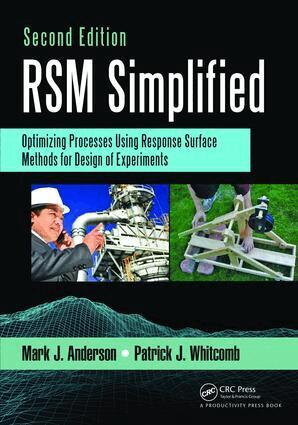
    Mark J. Anderson, PE, CQE, MBA, is a principal and general manager of Stat-Ease, Inc. (Minneapolis, Minnesota). He is a chemical engineer by profession, who also has a diverse array of experience in process development (earning a patent), quality assurance, marketing, purchasing, and general management. Before joining Stat-Ease, he spearheaded an award-winning quality improvement program (generating millions of dollars in pro-t for an international manufacturer) and served as general manager for a medical device manufacturer. His other achievements include an extensive portfolio of published articles on the design of experiments (DOE). Anderson authored (with Whitcomb) DOE Simplified: Practical Tools for Effective Experimentation, 3rd Edition (Productivity Press, 2015) and RSM Simplified: Optimizing Processes Using Response Surface Methods for Design of Experiments, 2nd Edition (Productivity Press, 2016).Patrick J. Whitcomb, MS, is the founding principal and president of Stat-Ease, Inc. Before starting his own business, he worked as a chemical engineer, quality assurance manager, and plant manager. Whitcomb developed Design-Ease® software, an easy-to-use program for design of two-level and general factorial experiments, and Design-Expert® software, an advanced user’s program for response surface, mixture, and combined designs. He has provided consulting and training on the application of design of experiments (DOE) and other statistical methods for decades. In 2013, the Minnesota Federation of Engineering, Science, and Technology Societies (MFESTS) awarded Whitcomb the Charles W. Britzius Distinguished Engineer Award for his lifetime achievements.Martin A. Bezener, PhD, is a principal and statistician with Stat-Ease, Inc. He did his graduate studies at the University of Minnesota, Twin Cities. There he spent a year at the Statistical Consulting Center of the School of Statistics working on a wide variety of projects with university researchers. He also taught undergraduate-level statistics for several years. In addition to his role as a consultant on DOE, Martin takes point at Stat-Ease for researching new methodology and developing algorithms for coding into the publisher’s software.

    Innehållsförteckning

    • Preface; Chapter 1: Getting Your Toe into Mixtures; Chapter 2: Triangulating Your Region of Formulation; Chapter 3: Simplex Lattice Design; Chapter 4: Constrained Mixtures; Chapter 5: Optimal Design; Chapter 6: Multicomponent Linear Constraints; Chapter 7: Multiple Response Optimization and Quality by Design; Chapter 8: Mixture Screening; Chapter 9: Mixture and Process, Amounts or Categorical FactorsChapter 10: Combining Mixture and Process Variables as Split Plots; Chapter 11: Advanced Tools; Chapter 12: Practical AspectsGlossaryReferences; Index; About the Software