• Fri frakt över 249 kr
  • •
  • Snabba leveranser
  • •
  • Billiga böcker
Kundservice

Du är på sajten för privatpersoner.

Företag, bibliotek eller offentlig verksamhet?

Du handlar på classic.bokus.com, där alla dina funktioner finns intakta.
Till classic.bokus.com
Bokus logotyp. Gå till startsidan.
  • Erbjudanden
  • Student
  • Topplistor
  • Barn & ungdom
  • Bokus Play
  • E-böcker
  • Ljudböcker
  • Pocketböcker
  • Spel & pussel

10% rabatt på allt med kod NYSTART10 →

Sidfot

Mina sidor

    Hjälp

    • Kundservice
    • Vanliga frågor och svar
    • Frakt och leverans
    • Retur vid ångerrätt
    • Reklamera vara
    • Betalning
    • Köpvillkor
    • Allmänna villkor
    • Information om webbplatsens tillgänglighet

    Om Bokus

    • Om oss
    • Pressrum
    • För studenter
    • För företag
    • För bibliotek och offentlig verksamhet
    • För leverantörer
    • Hållbarhet

    Populärt

    • Aktuella erbjudanden
    • Presentkort
    • Studentlitteratur
    • Nya böcker
    • Topplistor
    • Signerade böcker
    • Engelska böcker

    Inspiration

    • Boktips
    • BookTok
    • Populära bokserier
    • Barnbokskaraktärer
    • Populära författare
    Logotyp för Bokus
    Följ oss på Facebook (extern länk)Följ oss på Instagram (extern länk)Följ oss på YouTube (extern länk)Följ oss på TikTok (extern länk)
    bokus @ CookiesAnpassa cookiesIntegritetspolicyKöpvillkor
    Till Citymail hemsida (extern länk)Till Budbee hemsida (extern länk)Till Postnord hemsida (extern länk)Till Schenker hemsida (extern länk)Till Early Bird hemsida (extern länk)Till Walleys hemsida (extern länk)
    1. Psykologi och pedagogik
    2. Psykologi
    3. Psykologiska teorier och skolor
    4. Freudiansk psykologi

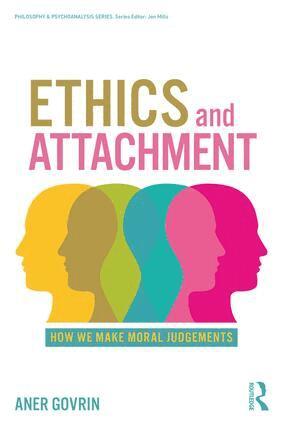
    Ethics and Attachment

    How We Make Moral Judgments

    AvAner Govrin

    Häftad, Engelska, 2018

    Del i serien Philosophy and Psychoanalysis

    568 kr

    Beställningsvara. Skickas inom 10-15 vardagar. Fri frakt över 249 kr.

    Fler format och utgåvor

    Inbunden

    2 418 kr

    E-bok

    671 kr

    E-bok

    671 kr

    Beskrivning

    Why are we disgusted when an elderly woman is robbed but sympathize with the actions of a Robin Hood? Why do acts of cruelty against a helpless kitten bother us more than does the trampling of ants? In Ethics and Attachment: How We Make Moral Judgments, psychoanalyst and philosopher Aner Govrin offers the attachment approach to moral judgment, an innovative new model of the process involved in making such moral judgments. Drawing on clinical findings from psychoanalysis, neuroscience and developmental psychology, the author argues that infants' experience in the first year of life provides them with the basic tools needed to reach complex moral judgments later in life. With reference to Winnicott and Bowlby, the author examines how attachments affect our abilities to apply to make moral decisions.With its wholly new ideas about moral judgments, Ethics and Attachment will be of great interest to ethics and moral philosophy scholars, law students, and psychoanalytic psychotherapists.

    Produktinformation

    • Utgivningsdatum:2018-10-24
    • Mått:156 x 234 x 17 mm
    • Vikt:444 g
    • Format:Häftad
    • Språk:Engelska
    • Serie:Philosophy and Psychoanalysis
    • Antal sidor:262
    • Förlag:Taylor & Francis Ltd
    • ISBN:9781138079786

    Utforska kategorier

    • Freudiansk psykologi inom Psykologi och pedagogik
    • Psykoterapi som behandlingsmetod inom Medicin
    • Filosofiska discipliner inom Filosofi och religion

    Mer om författaren

    Aner Govrin is a clinical psychologist, psychoanalyst and a director of a doctoral program in the Program for Hermeneutics and Cultural Studies at Bar-Ilan University, Israel. He is a member of Tel Aviv Institute for Contemporary Psychoanalysis (TAICP).

    Recensioner i media

    "Ethics and Attachment: How we Make Moral Judgments is brilliant. Every scholar and researcher concerned with the psychology of morality should read this scientifically sound, theoretically innovative, and gracefully written volume. While applying insights from psychoanalysis, attachment theory, and neuroscience into the morality field, it opens up new avenues of research on the contribution of child's attachment experiences to moral judgments later in life. I thoroughly enjoyed this book as both an attachment researcher and a person concerned with moral wrongs and the promotion of a more just and harmonious world."-Mario Mikulincer, Professor of Psychology, Interdisciplinary Center (IDC) Herzlyia, Israel"Govrin explores a revolutionary thesis with tight logic and irrefutable evidence, revealing that even our most complex moral judgments have a surprisingly simple beginning—the dyad of caregiver and infant. Through discussions that range from psychology to philosophy, ethics to evolution, Govrin leaves little doubt that he is a true scholar of morality, and that the elegant "Attachment Approach" to morality helps explain much about our judgments of good and evil. A must-read for anyone interested in moral psychology."-Kurt Gray, Associate Professor of Psychology and Neuroscience, University of North Carolina at Chapel Hill, USA "Drawing on sources as diverse as psychoanalysis and neuroscience as well as philosophy and attachment theory, Dr. Govrin discerns in the earliest years of life the basic cognitive and affective structures undergirding the complexity of moral life. He combines a careful analysis of moral conflicts with a sensitive and thorough exploration of how we evaluate them, both consciously and unconsciously. Ethics and Attachment: How We Make Moral Judgments is a masterpiece of creativity and scholarly integration that will be required reading for anyone interested in the psychology of moral judgment."-Ronald C. Naso, Ph.D., ABPP, psychoanalyst and clinical psychologist in independent practice, Stamford, CT, USA; current President, American Board and Academy of Psychoanalysis

    Innehållsförteckning

    • Chapter 1 Why we need a new psychology? Chapter 2 Morality and early interactions – main theories Chapter 3 The moral skills of infants Chapter 4 The building blocks of moral judgment Chapter 5 Decoding moral situations Chapter 6 Variance and consistency in moral judgment Chapter 7 The like-me criterion and turned-off dyads Chapter 8 The Prototype of evil Epilogue