• Fri frakt över 249 kr
  • •
  • Snabba leveranser
  • •
  • Billiga böcker
Kundservice

Du är på sajten för privatpersoner.

Företag, bibliotek eller offentlig verksamhet?

Du handlar på classic.bokus.com, där alla dina funktioner finns intakta.
Till classic.bokus.com
Bokus logotyp. Gå till startsidan.
  • Erbjudanden
  • Nyheter
  • Student
  • Topplistor
  • Barn & ungdom
  • Bokus Play
  • E-böcker
  • Pocketböcker
  • Spel & pussel

10% rabatt på allt med kod NYSTART10 →

Sidfot

Mina sidor

    Hjälp

    • Kundservice
    • Vanliga frågor och svar
    • Frakt och leverans
    • Retur vid ångerrätt
    • Reklamera vara
    • Betalning
    • Köpvillkor
    • Allmänna villkor
    • Information om webbplatsens tillgänglighet

    Om Bokus

    • Om oss
    • Pressrum
    • För studenter
    • För företag
    • För bibliotek och offentlig verksamhet
    • För leverantörer
    • Hållbarhet

    Populärt

    • Aktuella erbjudanden
    • Presentkort
    • Studentlitteratur
    • Nya böcker
    • Topplistor
    • Signerade böcker
    • Engelska böcker

    Inspiration

    • Boktips
    • BookTok
    • Populära bokserier
    • Barnbokskaraktärer
    • Populära författare
    Logotyp för Bokus
    Följ oss på Facebook (extern länk)Följ oss på Instagram (extern länk)Följ oss på YouTube (extern länk)Följ oss på TikTok (extern länk)
    bokus @ CookiesAnpassa cookiesIntegritetspolicyKöpvillkor
    Till Citymail hemsida (extern länk)Till Budbee hemsida (extern länk)Till Postnord hemsida (extern länk)Till Schenker hemsida (extern länk)Till Early Bird hemsida (extern länk)Till Walleys hemsida (extern länk)
    1. Samhälle och politik
    2. Samhälle och kultur
    3. Kultur och medier
    4. Referensverk och tvärvetenskap

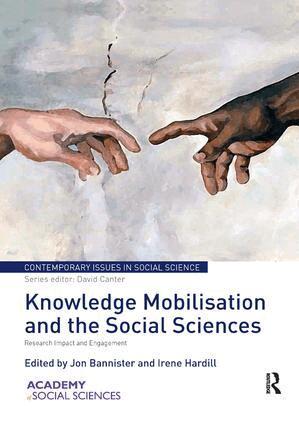
    Knowledge Mobilisation and Social Sciences

    Research Impact and Engagement

    AvJon Bannister,Irene Hardill

    Häftad, Engelska, 2017

    Del i serien Contemporary Issues in Social Science

    766 kr

    Beställningsvara. Skickas inom 10-15 vardagar. Fri frakt över 249 kr.

    Beskrivning

    The essays presented in this volume examine knowledge mobilisation and its relation to research impact and engagement. The social sciences matter because they can help us to understand and address the complex challenges confronting society. This is particularly true in an era of significant downward pressure on public expenditure, a consequence of the global fiscal crisis, when there is a striking need to ensure that policies are demonstrably effective and efficient. The impact agenda in the UK, reflected in parallel global debates, actively encourages the social sciences to make and demonstrate a difference; to justify and protect social science funding. This volume shows how knowledge mobilisation can be thought of systematically as a process, encompassing engagement, leading to the co-production and channelling of knowledge to make a difference in the economy and society. This book was originally published as a special issue of Contemporary Social Science.

    Produktinformation

    • Utgivningsdatum:2017-06-07
    • Mått:174 x 246 x undefined mm
    • Vikt:410 g
    • Format:Häftad
    • Språk:Engelska
    • Serie:Contemporary Issues in Social Science
    • Antal sidor:206
    • Förlag:Taylor & Francis Ltd
    • ISBN:9781138097605

    Utforska kategorier

    • Referensverk och tvärvetenskap inom Samhälle och politik
    • Sociologi inom Samhälle och politik
    • Offentlig förvaltning inom Samhälle och politik

    Mer om författaren

    Jon Bannister is Professor of Criminology at Manchester Metropolitan University, UK, and a Professorial Fellow at the University of Glasgow, UK. In promoting a civic agenda for the academy, Jon has supported the establishment of multiple knowledge mobilisation initiatives in the field of criminal justice.Irene Hardill is Professor of Public Policy, Northumbria University, UK, and a member of the Training and Skills Committee of the Economic and Social Research Council. She has a particular expertise in knowledge exchange and user engagement.

    Innehållsförteckning

    • Introduction: Knowledge mobilisation and the social sciences: dancing with new partners in an age of austerity Jon Bannister and Irene Hardill Part 1: Knowledge Mobilisation and Research Impact 1. Impact and knowledge mobilisation: what I have learnt as Chair of the Economic and Social Research Council Evaluation Committee Ann Buchanan 2. A model for knowledge mobilisation and implications for the education of social researchers Paul Ellwood, Richard Thorpe and Charlotte Coleman 3. Why social scientists should engage with natural scientists Philip Lowe, Jeremy Phillipson and Katy Wilkinson 4. Researching with impact in the Global South? Impact-evaluation practices and the reproduction of ‘development knowledge’ Glyn Williams 5. Research, policy and knowledge flows in education: what counts in knowledge mobilisation? Gemma Moss 6. Knowledge mobilisation and the civic academy: the nature of evidence, the roles of narrative and the potential of contribution analysis Jon Bannister and Anthony O’Sullivan Part 2: Knowledge Mobilisation and Engagement 7. Everyday ethics in community-based participatory research Sarah Banks and Andrea Armstrong with Kathleen Carter, Helen Graham, Peter Hayward, Alex Henry, Tessa Holland, Claire Holmes, Amelia Lee, Ann McNulty, Niamh Moore, Nigel Nayling, Ann Stokoe, Aileen Strachan 8. Mobilising knowledge in community – university partnerships: what does a community of practice approach contribute? Angie Hart, Ceri Davies, Kim Aumann, Etienne Wenger, Kay Aranda, Becky Heaver and David Wolff 9. ‘It’s what gets through people’s radars isn’t it’: relationships in social work practice and knowledge exchange Mark Smith, Heather Wilkinson and Michael Gallagher 10. Mobilising the experiential knowledge of clinicians, patients and carers for applied health-care research Pam Carter, Roger Beech, Domenica Coxon, Martin J. Thomas and Clare Jinks 11. Enlivening evidence-based policy through embodiment and emotions Irene Hardill and Sarah Mills 12. Rethinking policy-related research: charting a path using qualitative comparative analysis and complexity theory Tim Blackman 13. Intangible assets, absorbing knowledge and its impact on firm performance: theory, measurement and policy implications Richard Harris and John Moffat