• Fri frakt över 249 kr
  • •
  • Snabba leveranser
  • •
  • Billiga böcker
Kundservice

Du är på sajten för privatpersoner.

Företag, bibliotek eller offentlig verksamhet?

Du handlar på classic.bokus.com, där alla dina funktioner finns intakta.
Till classic.bokus.com
Bokus logotyp. Gå till startsidan.
  • Erbjudanden
  • Nyheter
  • Student
  • Topplistor
  • Barn & ungdom
  • Bokus Play
  • E-böcker
  • Pocketböcker
  • Spel & pussel

10% rabatt på allt med kod NYSTART10 →

Sidfot

Mina sidor

    Hjälp

    • Kundservice
    • Vanliga frågor och svar
    • Frakt och leverans
    • Retur vid ångerrätt
    • Reklamera vara
    • Betalning
    • Köpvillkor
    • Allmänna villkor
    • Information om webbplatsens tillgänglighet

    Om Bokus

    • Om oss
    • Pressrum
    • För studenter
    • För företag
    • För bibliotek och offentlig verksamhet
    • För leverantörer
    • Hållbarhet

    Populärt

    • Aktuella erbjudanden
    • Presentkort
    • Studentlitteratur
    • Nya böcker
    • Topplistor
    • Signerade böcker
    • Engelska böcker

    Inspiration

    • Boktips
    • BookTok
    • Populära bokserier
    • Barnbokskaraktärer
    • Populära författare
    Logotyp för Bokus
    Följ oss på Facebook (extern länk)Följ oss på Instagram (extern länk)Följ oss på YouTube (extern länk)Följ oss på TikTok (extern länk)
    bokus @ CookiesAnpassa cookiesIntegritetspolicyKöpvillkor
    Till Citymail hemsida (extern länk)Till Budbee hemsida (extern länk)Till Postnord hemsida (extern länk)Till Schenker hemsida (extern länk)Till Early Bird hemsida (extern länk)Till Walleys hemsida (extern länk)
    1. Samhälle och politik
    2. Politik och statsskick
    3. Statsskick och politiska processer

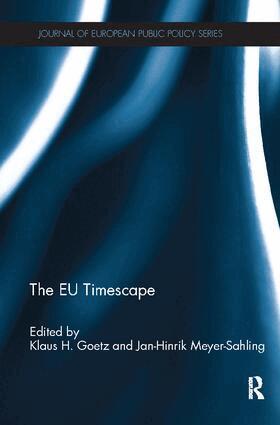
    EU Timescape

    AvKlaus Goetz,Jan-Hinrik Meyer-Sahling

    Häftad, Engelska, 2017

    Del i serien Journal of European Public Policy Series

    358 kr

    Beställningsvara. Skickas inom 10-15 vardagar. Fri frakt över 249 kr.

    Beskrivning

    The manner in which time is institutionalized is critical to how a political system works. Terms, time budgets and time horizons of collective and individual political actors; rights over timing, sequencing and speed in decision-making; and the temporal properties of policy matter to the distribution of power; efficiency and effectiveness of policy-making; and democratic legitimacy. This book makes a case for the systematic study of political time in the European Union (EU) - both as an independent and a dependent variable - and highlights the analytical value-added of a time-centred analysis. The book discusses previous scholarship on the institutionalization of political time and its consequences along the dimensions of polity, politics and policy; reviews dominant perspectives on political time, which centre on power, system performance and legitimacy; and presents case studies that illustrate the importance of time in the governance of the EU. This book was original published as a special issue of Journal of European Public Policy.

    Produktinformation

    • Utgivningsdatum:2017-05-31
    • Mått:156 x 234 x undefined mm
    • Vikt:330 g
    • Format:Häftad
    • Språk:Engelska
    • Serie:Journal of European Public Policy Series
    • Antal sidor:166
    • Förlag:Taylor & Francis Ltd
    • ISBN:9781138117297

    Utforska kategorier

    • Statsskick och politiska processer inom Samhälle och politik
    • Offentlig förvaltning inom Samhälle och politik

    Mer om författaren

    Klaus H. Goetz holds the Chair in German and European Politics and Government at the University of Potsdam, Germany.Jan-Hinrik Meyer-Sahling is a Lecturer in European Politics at the University of Nottingham, UK.

    Innehållsförteckning

    • 1. Political time in the EU: dimensions, perspectives, theories, Klaus H. Goetz and Jan-Hinrik Meyer-Sahling. 2. How does the EU tick? Five propositions on political time, Klaus H. Goetz. 3. The temporal constitution of the European Commission: a timely investigation, Luc Tholoniat. 4. Do elections set the pace? A quantitative assessment of the timing of European legislation, Laszlo Kovats. 5. Uses of time in the EU’s enlargement process, Graham Avery. 6. Policies, institutions and time: how the European Commission managed the temporal challenge of eastern enlargement, Katja Lass-Lennecke and Annika Werner. 7. The evolving timescapes of European economic governance: contesting and using time, Kenneth Dyson. 8. Politics in Time meets the politics of time: historical institutionalism and the EU timescape, Simon Bulmer. 9. The EU timescape: from notion to research agenda, Jan-Hinrik Meyer-Sahling and Klaus H. Goetz.