• Fri frakt över 249 kr
  • •
  • Snabba leveranser
  • •
  • Billiga böcker
Kundservice

Du är på sajten för privatpersoner.

Företag, bibliotek eller offentlig verksamhet?

Du handlar på classic.bokus.com, där alla dina funktioner finns intakta.
Till classic.bokus.com
Bokus logotyp. Gå till startsidan.
  • Erbjudanden
  • Nyheter
  • Student
  • Topplistor
  • Barn & ungdom
  • Bokus Play
  • E-böcker
  • Pocketböcker
  • Spel & pussel

10% rabatt på allt med kod NYSTART10 →

Sidfot

Mina sidor

    Hjälp

    • Kundservice
    • Vanliga frågor och svar
    • Frakt och leverans
    • Retur vid ångerrätt
    • Reklamera vara
    • Betalning
    • Köpvillkor
    • Allmänna villkor
    • Information om webbplatsens tillgänglighet

    Om Bokus

    • Om oss
    • Pressrum
    • För studenter
    • För företag
    • För bibliotek och offentlig verksamhet
    • För leverantörer
    • Hållbarhet

    Populärt

    • Aktuella erbjudanden
    • Presentkort
    • Studentlitteratur
    • Nya böcker
    • Topplistor
    • Signerade böcker
    • Engelska böcker

    Inspiration

    • Boktips
    • BookTok
    • Populära bokserier
    • Barnbokskaraktärer
    • Populära författare
    Logotyp för Bokus
    Följ oss på Facebook (extern länk)Följ oss på Instagram (extern länk)Följ oss på YouTube (extern länk)Följ oss på TikTok (extern länk)
    bokus @ CookiesAnpassa cookiesIntegritetspolicyKöpvillkor
    Till Citymail hemsida (extern länk)Till Budbee hemsida (extern länk)Till Postnord hemsida (extern länk)Till Schenker hemsida (extern länk)Till Early Bird hemsida (extern länk)Till Walleys hemsida (extern länk)
    1. Samhälle och politik
    2. Samhälle och kultur
    3. Kultur och medier
    4. Medievetenskap

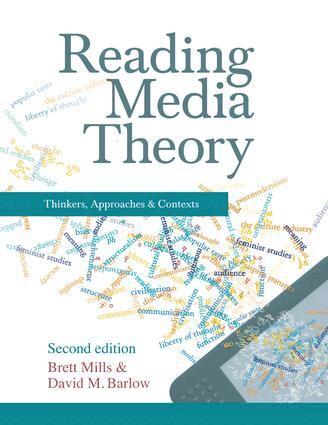
    Reading Media Theory

    Thinkers, Approaches and Contexts

    AvBrett Mills,David M. Barlow

    Inbunden, Engelska, 2015

    2 184 kr

    Beställningsvara. Skickas inom 10-15 vardagar. Fri frakt över 249 kr.

    Fler format och utgåvor

    Häftad

    962 kr

    Beskrivning

    What does the Frankfurt School have to say about the creative industries? Does the spread of Google prove we now live in an information society? How is Madonna an example of postmodernism? How new is new media? Does the power of Facebook mean we're all media makers now?This groundbreaking volume – part reader, part textbook - helps you to engage thoroughly with some of the major voices that have come to define the landscape of theory in media studies, from the public sphere to postmodernism, from mass communication theory to media effects, from production to reception and beyond. But much more than this, by providing assistance and questions directly alongside the readings, it crucially helps you develop the skills necessary to become a critical, informed and analytical reader. Each reading is supported on the facing page by author annotations which provide comments, dissect the arguments, explain key ideas and terminology, make references to other relevant material, and pose questions that emerge from the text.Key features: Opening chapters: ‘What is theory?’ and ‘What is reading?’ bring alive the importance of both as key parts of media scholarship Pre-reading: substantial Introductory sections set each text and its author in context and show the relevance of the reading to contemporary culture Post-reading: Reflection sections summarise each reading’s key points and suggests further areas to explore and think about 4 types of annotations help you engage with the reading – context, content, structure, and writing style …. as well as questions to provoke further thought Split into 4 sections – Reading theory, Key thinkers and schools, Approaches and Media Theory in context New to the second edition: New chapters on New Media, and Audiences as Producers Reading Media Theory will assist you in developing close-reading and analytic skills. It will also increase your ability to outline key theories and debates, assess different case studies critically, link theoretical approaches to a particular historical context, and to structure and present an argument. As such, it will be essential reading for undergraduate and postgraduate students of media studies, cultural studies, communication studies, the sociology of the media, popular culture and other related subjects.

    Produktinformation

    • Utgivningsdatum:2015-10-08
    • Mått:195 x 250 x 40 mm
    • Vikt:1 430 g
    • Format:Inbunden
    • Språk:Engelska
    • Antal sidor:704
    • Upplaga:2
    • Förlag:Taylor & Francis Ltd
    • ISBN:9781138128125

    Utforska kategorier

    • Medievetenskap inom Samhälle och politik
    • Kulturvetenskap inom Samhälle och politik

    Mer om författaren

    Brett Mills is Head of the School of Film and Television Studies, University of East Anglia. He is the author of Television Sitcom (BFI, 2005) and The Sitcom (Edinburgh, 2009). He is the principal investigator on the 3-year AHRC-funded research project, 'Make Me Laugh: Creativity in the British Television Comedy Industry'.David Barlow was Lecturer in Media, Culture and Communication in the Cardiff School of Creative and Cultural Industries at the University of Glamorgan and Director of the Centre for the Study of Media and Culture in Small Nations. He is a joint author (with Philip Mitchell and Tom O’Malley) of The Media in Wales: Voices of a Small Nation (UWP, 2005) and co-editor (with Vian Bakir) of Communication in the Age of Suspicion: Trust and the Media (Palgrave Macmillan, 2007).

    Innehållsförteckning

    • 1. Introduction Part I: Reading theory 2. What is theory? 3. What is reading? Part II: Key thinkers and schools of thought 4. Liberal press theory 5. F.R. Leavis 6. The Frankfurt school 7. Harold D. Lasswell 8. The Columbia school 9. C. Wright Mills: Mass society theory 10. The Toronto school 11. The Centre for Contemporary Cultural Studies Part III: Approaches to media theory 12. Political economy. 13. Public sphere 14. Media effects 15. Structuralism 16. Feminist media theory 17. Cultural theory 18. New Media 19. Postmodernism. 20. The information society Part IV: Media theory in context 21. Production 22. Texts 23. Audiences 24. Audiences as producers