• Fri frakt över 249 kr
  • •
  • Snabba leveranser
  • •
  • Billiga böcker
Kundservice

Du är på sajten för privatpersoner.

Företag, bibliotek eller offentlig verksamhet?

Du handlar på classic.bokus.com, där alla dina funktioner finns intakta.
Till classic.bokus.com
Bokus logotyp. Gå till startsidan.
  • Erbjudanden
  • Nyheter
  • Student
  • Topplistor
  • Barn & ungdom
  • Bokus Play
  • E-böcker
  • Pocketböcker
  • Spel & pussel

Må bättre, för mindre! Upp till 50% rabatt på hälsoböcker

Sidfot

Mina sidor

    Hjälp

    • Kundservice
    • Vanliga frågor och svar
    • Frakt och leverans
    • Retur vid ångerrätt
    • Reklamera vara
    • Betalning
    • Köpvillkor
    • Allmänna villkor
    • Information om webbplatsens tillgänglighet

    Om Bokus

    • Om oss
    • Pressrum
    • För studenter
    • För företag
    • För bibliotek och offentlig verksamhet
    • För leverantörer
    • Hållbarhet

    Populärt

    • Aktuella erbjudanden
    • Presentkort
    • Studentlitteratur
    • Nya böcker
    • Topplistor
    • Signerade böcker
    • Engelska böcker

    Inspiration

    • Boktips
    • BookTok
    • Populära bokserier
    • Barnbokskaraktärer
    • Populära författare
    Logotyp för Bokus
    Följ oss på Facebook (extern länk)Följ oss på Instagram (extern länk)Följ oss på YouTube (extern länk)Följ oss på TikTok (extern länk)
    bokus @ CookiesAnpassa cookiesIntegritetspolicyKöpvillkor
    Till Citymail hemsida (extern länk)Till Budbee hemsida (extern länk)Till Postnord hemsida (extern länk)Till Schenker hemsida (extern länk)Till Early Bird hemsida (extern länk)Till Walleys hemsida (extern länk)
    1. Samhälle och politik
    2. Samhälle och kultur
    3. Kultur och medier
    4. Medievetenskap

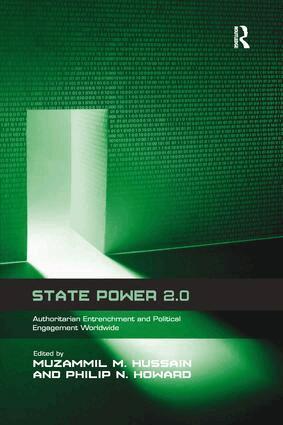
    State Power 2.0

    Authoritarian Entrenchment and Political Engagement Worldwide

    AvMuzammil M. Hussain,Philip N. Howard

    Häftad, Engelska, 2016

    821 kr

    Beställningsvara. Skickas inom 10-15 vardagar. Fri frakt över 249 kr.

    Fler format och utgåvor

    E-bok

    975 kr

    E-bok

    973 kr

    Inbunden

    2 421 kr

    Beskrivning

    Digital media and online social networking applications have changed the way in which dissent is organized with social movement leaders using online applications and digital content systems to organize collective action, activate local protest groups, network with international social movements and share their political perspectives. In the past, authoritarian regimes could control broadcast media in times of political crisis by destroying newsprint supplies, seizing radio and television stations, and blocking phone calls. It is much more difficult to control media in the digital age though there have certainly been occasions when states have successfully shut down their digital networks. What causes state-powers to block internet access, disable digital networks or even shut off internet access? How is it done, what is the impact and how do dissidents attempt to fight back? In this timely and accessible volume a collection of high profile, international scholars answer these key questions using cases from Israel, Iran, Russia, Morocco, Vietnam and Kuwait and assess the political economy of the actors, institutions and regimes involved and effected by the state-management and control of digital networks.

    Produktinformation

    • Utgivningsdatum:2016-09-09
    • Mått:156 x 234 x 12 mm
    • Vikt:294 g
    • Format:Häftad
    • Språk:Engelska
    • Antal sidor:208
    • Förlag:Taylor & Francis Ltd
    • ISBN:9781138250109

    Utforska kategorier

    • Medievetenskap inom Samhälle och politik

    Mer om författaren

    Muzammil M. Hussain is Assistant Professor of Global Media Studies at the University of Michigan’s Department of Communication Studies, and Faculty Associate at the Institute for Social Research’s Center for Political Studies. He tweets from @m_m_hussain. Philip N. Howard is a professor in the School of Public Policy at Central European University . His writings appear at and he tweets from @pnhoward.

    Recensioner i media

    ’Interest in how governments use, manipulate, or even shut down the internet in the service of state power has been growing at a fever pitch. This collection provides an insightful framework for understanding these dynamics as well as an impressive array of individual chapters that will undoubtedly become an essential scholarly resource in this area for years to come.’ Michael Xenos, University of Wisconsin-Madison, USA ’When Time magazine named You as its person of the year in 2006, few could foresee how swiftly both authoritarian and democratic states would learn to control political participation on the internet. This landmark comparative study brings to light the tactics states are using to protect their authority and manage dissent. Amid huge claims about the power of technology to drive political change, this volume provides concrete analysis across a range of national media ecologies and hundreds of events. Paradoxically, by bringing us back down to earth the authors help us understand better how our voices might be heard and change realised.’ Ben O’Loughlin, Royal Holloway, University of London, UK

    Innehållsförteckning

    • Introduction: State Power 2.0, Muzammil M. Hussain, Philip N. Howard, Sheetal D. Agarwal; Part 1 Information Infrastructure and Social Control; Chapter 1 Origins of the Tunisian Internet, Katherine Maher, Jillian C. York; Chapter 2 The State of Digital Exception: Censorship and Dissent in Post-Revolutionary Iran, BabakRahimi; Chapter 3 Information Infrastructure and Anti-Regime Protests in Iran and Tunisia, MatthewCarrieri, Ronald J.Deibert, Saad OmarKhan; Chapter 4 Digital Occupation in Gaza’s High-Tech Enclosure, HelgaTawil-Souri; Chapter 5 Leveraged Affordances and the Specter of Structural Violence, DavidKarpf, StevenLivingston; Part 2 Digital Media and Political Engagement; Chapter 6 Technology-Induced Innovation in the Making and Consolidation of Arab Democracy, ImadSalamey; Chapter 7 Al-Masry Al-Youm and Egypt’s New Media Ecology, David MFaris; Chapter 8 Communicating Politics in Kuwait, FahedAl-Sumait; Chapter 9 Social Media and Soft Political Change in Morocco, MohammedIbahrine; Chapter 10 Leninist Lapdogs to Bothersome Bloggers in Vietnam, CatherineMcKinley, AnyaSchiffrin; Chapter 11 Dynamics of Innovation and the Balance of Power in Russia, GregoryAsmolov; Chapter 12 Anonymous vs. Authoritarianism, Jessica L.Beyer;