• Fri frakt över 249 kr
  • •
  • Snabba leveranser
  • •
  • Billiga böcker
Kundservice

Du är på sajten för privatpersoner.

Företag, bibliotek eller offentlig verksamhet?

Du handlar på classic.bokus.com, där alla dina funktioner finns intakta.
Till classic.bokus.com
Bokus logotyp. Gå till startsidan.
  • Erbjudanden
  • Nyheter
  • Student
  • Topplistor
  • Barn & ungdom
  • Bokus Play
  • E-böcker
  • Pocketböcker
  • Spel & pussel

10% rabatt på allt med kod: NYSTART10 →

Sidfot

Mina sidor

    Hjälp

    • Kundservice
    • Vanliga frågor och svar
    • Frakt och leverans
    • Retur vid ångerrätt
    • Reklamera vara
    • Betalning
    • Köpvillkor
    • Allmänna villkor
    • Information om webbplatsens tillgänglighet

    Om Bokus

    • Om oss
    • Pressrum
    • För studenter
    • För företag
    • För bibliotek och offentlig verksamhet
    • För leverantörer
    • Hållbarhet

    Populärt

    • Aktuella erbjudanden
    • Presentkort
    • Studentlitteratur
    • Nya böcker
    • Topplistor
    • Signerade böcker
    • Engelska böcker

    Inspiration

    • Boktips
    • BookTok
    • Populära bokserier
    • Barnbokskaraktärer
    • Populära författare
    Logotyp för Bokus
    Följ oss på Facebook (extern länk)Följ oss på Instagram (extern länk)Följ oss på YouTube (extern länk)Följ oss på TikTok (extern länk)
    bokus @ CookiesAnpassa cookiesIntegritetspolicyKöpvillkor
    Till Citymail hemsida (extern länk)Till Budbee hemsida (extern länk)Till Postnord hemsida (extern länk)Till Schenker hemsida (extern länk)Till Early Bird hemsida (extern länk)Till Walleys hemsida (extern länk)
    1. Historia och arkeologi
    2. Historia
    3. Afrikas historia

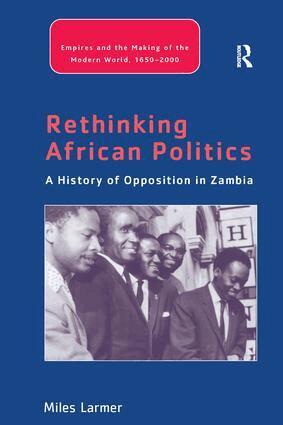
    Rethinking African Politics

    A History of Opposition in Zambia

    AvMiles Larmer

    Häftad, Engelska, 2016

    Del i serien Empire and the Making of the Modern World, 1650-2000

    835 kr

    Beställningsvara. Skickas inom 10-15 vardagar. Fri frakt över 249 kr.

    Fler format och utgåvor

    E-bok

    1 019 kr

    E-bok

    1 019 kr

    Inbunden

    3 270 kr

    Beskrivning

    In 1964 Kenneth Kaunda and his United National Independence Party (UNIP) government established the nation of Zambia in the former British colony of Northern Rhodesia. In parallel with many other newly independent countries in Africa this process of decolonisation created a wave of optimism regarding humanity's capacity to overcome oppression and poverty. Yet, as this study shows, in Zambia as in many other countries, the legacy of colonialism created obstacles that proved difficult to overcome. Within a short space of time democratisation and development was replaced by economic stagnation, political authoritarianism, corruption and ethnic and political conflict. To better understand this process, Dr Larmer explores UNIP's political ideology and the strategies it employed to retain a grip on government. He shows that despite the party's claim that it adhered to an authentically African model of consensual and communitarian decision-making, it was never a truly nationally representative body. Whereas in long-established Western societies unevenness in support was accepted as a legitimate basis for party political difference, in Zambia this was regarded as a threat to the fragile bindings of the young nation state, and as such had to be denied and repressed. This led to the declaration of a one-party state, presented as the logical expression of UNIP supremacy but it was in fact a reflection of its weakening grip on power. Through case studies of opposition political and social movements rooted in these differences, the book demonstrates that UNIP's control of the new nation-state was partial, uneven and consistently prone to challenge. Alongside this, the study also re-examines Zambia's role in the regional liberation struggles, providing valuable new evidence of the country's complex relations with Apartheid-era South Africa and the relationship between internal and external opposition, shaped by the context of regional liberation movements and the Cold War. Drawing on extensive archival research and interviews, Dr Larmer offers a ground-breaking analysis of post-colonial political history which helps explain the challenges facing contemporary African polities.

    Produktinformation

    • Utgivningsdatum:2016-09-02
    • Mått:156 x 234 x 18 mm
    • Vikt:640 g
    • Format:Häftad
    • Språk:Engelska
    • Serie:Empire and the Making of the Modern World, 1650-2000
    • Antal sidor:340
    • Förlag:Taylor & Francis Ltd
    • ISBN:9781138251144

    Utforska kategorier

    • Afrikas historia inom Historia och arkeologi
    • Filosofiska discipliner inom Filosofi och religion
    • Politik och statsskick inom Samhälle och politik

    Mer om författaren

    Dr Miles Larmer is Associate Professor of African History at the University of Oxford. He has written extensively on the history and politics of central and southern Africa, particularly in Zambia and the Democratic Republic of Congo. His current research focuses on the Katangese gendarmes and war in central Africa from the 1960s to the present day.

    Recensioner i media

    ’During the past few years, Miles Larmer [...] has made a noteworthy contribution to the writing of Zambia’s post-colonial history. This important book represents the summation of his efforts so far.’ The Round Table ’... Rethinking African Politics is a welcome, thought-provoking and useful contribution to our knowledge of African opposition movements, and one that has wide-reaching significance for how we think about African history and political change. In short, Larmer's latest monograph deserves to become required reading throughout African studies.’ The Journal of Modern African Studies 'This book is highly recommended to those with political ambitions and interests, to educators, to clergy members, and to all Zambian citizens.' African Studies Quarterly 'With this book, Miles Larmer provides a welcome historical study of postcolonial politics in Zambia.' Journal of African History

    Innehållsförteckning

    • Introduction; Chapter 1 Becoming Zambia – UNIP and the transition to independence in Northern Rhodesia, 1952–1964; Chapter 2 UNIP Rule and Division in Zambia’s First Republic, 1964–1973; Chapter 3 Disunity under the One-party State, 1973–1979; Chapter 4 The Mushala Rebellion; Chapter 5 Intellectual Elites and the 1980 Coup Attempt; Chapter 6 ‘We Have to Think for Other People’: Zambia and South Africa; Chapter 7 The State, Civil Society and Social Movements: Church and Labour in Post-colonial Zambia; Epilogue After UNIP: Political Change and Continuity in Zambia’s Third Republic, 1991–2010; Conclusion Towards a History of Post-colonial Politics in Africa;