• Fri frakt över 249 kr
  • •
  • Snabba leveranser
  • •
  • Billiga böcker
Kundservice

Du är på sajten för privatpersoner.

Företag, bibliotek eller offentlig verksamhet?

Du handlar på classic.bokus.com, där alla dina funktioner finns intakta.
Till classic.bokus.com
Bokus logotyp. Gå till startsidan.
  • Erbjudanden
  • Nyheter
  • Student
  • Topplistor
  • Barn & ungdom
  • Bokus Play
  • E-böcker
  • Pocketböcker
  • Spel & pussel

10% studentrabatt med kod TERM26

Sidfot

Mina sidor

    Hjälp

    • Kundservice
    • Vanliga frågor och svar
    • Frakt och leverans
    • Retur vid ångerrätt
    • Reklamera vara
    • Betalning
    • Köpvillkor
    • Allmänna villkor
    • Information om webbplatsens tillgänglighet

    Om Bokus

    • Om oss
    • Pressrum
    • För studenter
    • För företag
    • För bibliotek och offentlig verksamhet
    • För leverantörer
    • Hållbarhet

    Populärt

    • Aktuella erbjudanden
    • Presentkort
    • Studentlitteratur
    • Nya böcker
    • Topplistor
    • Signerade böcker
    • Engelska böcker

    Inspiration

    • Boktips
    • BookTok
    • Populära bokserier
    • Barnbokskaraktärer
    • Populära författare
    Logotyp för Bokus
    Följ oss på Facebook (extern länk)Följ oss på Instagram (extern länk)Följ oss på YouTube (extern länk)Följ oss på TikTok (extern länk)
    bokus @ CookiesAnpassa cookiesIntegritetspolicyKöpvillkor
    Till Citymail hemsida (extern länk)Till Budbee hemsida (extern länk)Till Postnord hemsida (extern länk)Till Schenker hemsida (extern länk)Till Early Bird hemsida (extern länk)Till Walleys hemsida (extern länk)
    1. Samhälle och politik
    2. Samhälle och kultur
    3. Sociala grupper och identitet
    4. Genusvetenskap

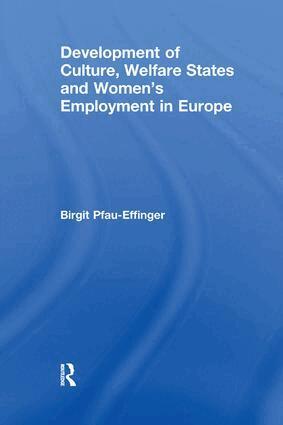
    Development of Culture, Welfare States and Women's Employment in Europe

    AvBirgit Pfau-Effinger

    Häftad, Engelska, 2017

    797 kr

    Beställningsvara. Skickas inom 10-15 vardagar. Fri frakt över 249 kr.

    Fler format och utgåvor

    Inbunden

    2 434 kr

    E-bok

    942 kr

    E-bok

    939 kr

    Beskrivning

    This refreshing volume introduces a theory for explaining cross-national differences in the social practice of women (and men) in the areas of family and employment. This provides a theoretical framework for the ensuing comprehensive cross-national analysis of the degree and forms of labour market integration of women in three European countries - Finland, West Germany and the Netherlands - from the 1950s until 2000. Cross-national differences are explained with a focus on cultural change and the development of welfare state, labour markets, the family and social movements. It is evident that change took place along different development paths that were based on deep-rooted historical differences in the cultural ideals of the family. Such historical differences and their explanations also form part of the analysis. The results of this survey contribute to the further development of cross-national sociology on social change, social and gender inequality, welfare state, labour markets and family structures.

    Produktinformation

    • Utgivningsdatum:2017-03-06
    • Mått:156 x 234 x 21 mm
    • Vikt:453 g
    • Format:Häftad
    • Språk:Engelska
    • Antal sidor:228
    • Förlag:Taylor & Francis Ltd
    • ISBN:9781138258174

    Utforska kategorier

    • Genusvetenskap inom Samhälle och politik
    • Sociologi inom Samhälle och politik
    • Socialt arbete och välfärd inom Samhälle och politik

    Recensioner i media

    ’This book is truly revolutionary. It shows how comparative differences in women's labour force participation result from deep-seated features at the level of social cultures, in how understandings of motherhood, childhood, gendered divisions of labour and family are represented in how women and men behave. This means we can no longer see social policy as simply providing financial incentives or support; it both reflects and must intervene on a much wider and deeper social canvas.’ Professor Simon Duncan, University of Bradford, UK ’Pfau-Effinger’s book boldly steps up to consider the question of how culture matters for women's employment. Moreover, her answers are both theoretical and empirical as she develops a theoretical framework and then applies it to three European societies. In both respects, this book makes an important contribution to the sociology of gender and work.’ International Sociology Review of Books ’Well-researched and clearly written, in spite of the complexity of the task at hand, Development of Culture, Welfare States and Women’s Employment in Europe deserves to be of interest to academic researchers and policy makers, facilitating greater understanding of the factors inhibiting and generating gender, and wider, societal transformations.’ Industrial Relations Journal ’This book makes a useful new contribution to understanding the complex and interrelated factors that influence individual decisions around models of combining paid and unpaid work in twenty-first century western societies.’ Women in Management Review '... the book offers a carefully argued, researched contruibution to gendered debates... The wealth of information it provides ensures access to a considerable amount of background reading.' European Journal of Social Work Vol 10 no 4, December 2007 'This book makes a useful new contribution to understanding the complex and interrelated factors that influence individual decisions around models of combining p

    Innehållsförteckning

    • Contents: Introduction; International differences in women's labour force participation: theoretical approaches; Constructing a theoretical framework for the cross - national comparison: the gender arrangement approach; Designing the empirical analysis; Germany: contradictory modernization- from the housewife to the part-time carer model of the family; The Netherlands: dramatic modernization of the gender arrangement - towards an egalitarian, family - oriented arrangement; Finland: from the family economic model to the dual breadwinner model; Development paths of gender arrangement and labour market integration; Exploring the differences in the development of gender arrangements; Conclusion; Bibliography; Index.