• Fri frakt över 249 kr
  • •
  • Snabba leveranser
  • •
  • Billiga böcker
Kundservice

Du är på sajten för privatpersoner.

Företag, bibliotek eller offentlig verksamhet?

Du handlar på classic.bokus.com, där alla dina funktioner finns intakta.
Till classic.bokus.com
Bokus logotyp. Gå till startsidan.
  • Erbjudanden
  • Nyheter
  • Student
  • Topplistor
  • Barn & ungdom
  • Bokus Play
  • E-böcker
  • Pocketböcker
  • Spel & pussel

10% rabatt på allt med kod NYSTART10 →

Sidfot

Mina sidor

    Hjälp

    • Kundservice
    • Vanliga frågor och svar
    • Frakt och leverans
    • Retur vid ångerrätt
    • Reklamera vara
    • Betalning
    • Köpvillkor
    • Allmänna villkor
    • Information om webbplatsens tillgänglighet

    Om Bokus

    • Om oss
    • Pressrum
    • För studenter
    • För företag
    • För bibliotek och offentlig verksamhet
    • För leverantörer
    • Hållbarhet

    Populärt

    • Aktuella erbjudanden
    • Presentkort
    • Studentlitteratur
    • Nya böcker
    • Topplistor
    • Signerade böcker
    • Engelska böcker

    Inspiration

    • Boktips
    • BookTok
    • Populära bokserier
    • Barnbokskaraktärer
    • Populära författare
    Logotyp för Bokus
    Följ oss på Facebook (extern länk)Följ oss på Instagram (extern länk)Följ oss på YouTube (extern länk)Följ oss på TikTok (extern länk)
    bokus @ CookiesAnpassa cookiesIntegritetspolicyKöpvillkor
    Till Citymail hemsida (extern länk)Till Budbee hemsida (extern länk)Till Postnord hemsida (extern länk)Till Schenker hemsida (extern länk)Till Early Bird hemsida (extern länk)Till Walleys hemsida (extern länk)
    1. Psykologi och pedagogik
    2. Pedagogik
    3. Pedagogisk teori och filosofi

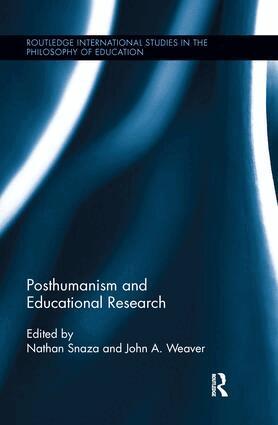
    Posthumanism and Educational Research

    AvNathan Snaza,John Weaver

    Häftad, Engelska, 2016

    Del i serien Routledge International Studies in the Philosophy of Education

    607 kr

    Beställningsvara. Skickas inom 10-15 vardagar. Fri frakt över 249 kr.

    Beskrivning

    Focusing on the interdependence between human, animal, and machine, posthumanism redefines the meaning of the human being previously assumed in knowledge production. This movement challenges some of the most foundational concepts in educational theory and has implications within educational research, curriculum design and pedagogical interactions. In this volume, a group of international contributors use posthumanist theory to present new modes of institutional collaboration and pedagogical practice. They position posthumanism as a comprehensive theoretical project with connections to philosophy, animal studies, environmentalism, feminism, biology, queer theory and cognition. Researchers and scholars in curriculum studies and philosophy of education will benefit from the new research agendas presented by posthumanism.

    Produktinformation

    • Utgivningsdatum:2016-11-18
    • Mått:152 x 229 x 22 mm
    • Vikt:400 g
    • Format:Häftad
    • Språk:Engelska
    • Serie:Routledge International Studies in the Philosophy of Education
    • Antal sidor:218
    • Förlag:Taylor & Francis Ltd
    • ISBN:9781138286979

    Utforska kategorier

    • Pedagogisk teori och filosofi inom Psykologi och pedagogik
    • Läroplaner och kursplaner inom Psykologi och pedagogik
    • Pedagogisk metodik inom Psykologi och pedagogik

    Mer om författaren

    Nathan Snaza is Director of the Bridge to Success Program and member of the English Department at the University of Richmond, USA. His writings have appeared in journals such as Journal of Curriculum and Pedagogy, Angelaki, Educational Researcher and Journal of Critical Animal Studies. John A. Weaver is Professor of Curriculum Studies at Georgia Southern University, USA. He is the author of Educating the Posthuman (2010), Popular Culture: A Primer (2004/8), Rethinking Academic Politics in Germany and The United States (2000) and editor of four other books including (Post) Modern Science (Education) (2001). He is the author of 30 journal articles and book chapters.

    Recensioner i media

    " What is evident by the end of the book is that posthumanism is a philosophical and interllectual form of inquiry - and Weaver challenges the broad field of education to release itself not only from the constraining forces of humanism, but also what Snaza and Weaver called in their introduction methodocentrism. Weaver is boldly stating that education and educational inquiry needs to become more interllectual; posthumanist philosophy and inquiry is one rhizomatic pathway that may unleash possibilities long since forgotten, reminding us of the interconnected nature of humans, animals, objects, and forces within educational inquiry." - Paul William Eaton, The Review of Higher Education, Spring 2016 "In summary, this volume is a valuable contribution both to furthering the discussion on how post-humanism can help change educational theory and practice."- Stefan Herbrechter Coventry University, UK, Educational Philosophy and Theory, 2016

    Innehållsförteckning

    • Foreword by Dennis Carlson Introduction: Education and the Posthumanist Turn Nathan Snaza and John Weaver Part I: Humanism, Posthumanism, and Educational Research 1. Toward a Genealogy of Educational Humanism Nathan Snaza 2. Researching the Posthuman Paradigm: The "Subject" as Curricular Lens Brad Petitfils 3. Posthumanist Education and Animal Interiority Marla Morris 4. Educational Policy-Making for Social Change: A Post-Humanist Intervention Helena Pedersen 5. "Approximate-Rigorous-Abstractions": Propositions of Activation for Posthumanist Research Stephanie Springgay Part II: Attuning to the More Than Human Complexities of the Classroom 6. Ecologies of Praxis: Teaching and Learning Against the Obvious Nikki Rotas 7. Losing Animals: Ethics and Care in a Pedagogy of Recovery Alyce Miller Part III: Ecological Aesthetics 8. Affirmations and Limitations of Rancière’s Aesthetics: Questions for Art and its Education in the Anthropocene Jan Jagodzinski 9. Dark Posthumanism, Unthinking Education, and Ecology at the End of the Anthropocene Jason Wallin Part IV: What Posthumanist Education Will Have Been 10. Undoing Anthropocentism in Educational Inquiry: A Phildickian Space Odyssey? Noel Gough 11. Resisting Becoming a Glomus Body Within Posthuman Theorizing: Mondialisation and Embodied Agency in Educational Research Annette Gough 12. To What Future Do the Posthuman and Posthumanism (Re)turn Us; Meanwhile, How Do I Tame the Lingering Effects of Humanism? John Weaver