• Fri frakt över 249 kr
  • •
  • Snabba leveranser
  • •
  • Billiga böcker
Kundservice

Du är på sajten för privatpersoner.

Företag, bibliotek eller offentlig verksamhet?

Du handlar på classic.bokus.com, där alla dina funktioner finns intakta.
Till classic.bokus.com
Bokus logotyp. Gå till startsidan.
  • Erbjudanden
  • Student
  • Topplistor
  • Barn & ungdom
  • Bokus Play
  • E-böcker
  • Ljudböcker
  • Pocketböcker
  • Spel och pussel

Pocketfynda! Hundratals böcker för 49 kr/st →

Sidfot

Mina sidor

    Hjälp

    • Kundservice
    • Vanliga frågor och svar
    • Frakt och leverans
    • Retur vid ångerrätt
    • Reklamera vara
    • Betalning
    • Köpvillkor
    • Allmänna villkor
    • Information om webbplatsens tillgänglighet

    Om Bokus

    • Om oss
    • Pressrum
    • För studenter
    • För företag
    • För bibliotek och offentlig verksamhet
    • För leverantörer
    • Hållbarhet

    Populärt

    • Aktuella erbjudanden
    • Presentkort
    • Studentlitteratur
    • Nya böcker
    • Topplistor
    • Signerade böcker
    • Engelska böcker

    Inspiration

    • Boktips
    • BookTok
    • Barnbokskaraktärer
    • Populära författare
    Logotyp för Bokus
    Följ oss på Facebook (extern länk)Följ oss på Instagram (extern länk)Följ oss på YouTube (extern länk)Följ oss på TikTok (extern länk)
    bokus @ CookiesAnpassa cookiesIntegritetspolicyKöpvillkor
    Till Citymail hemsida (extern länk)Till Budbee hemsida (extern länk)Till Postnord hemsida (extern länk)Till Schenker hemsida (extern länk)Till Early Bird hemsida (extern länk)Till Walleys hemsida (extern länk)
    1. Naturvetenskap och teknik
    2. Geovetenskap
    3. Miljövetenskap och miljöpolitik

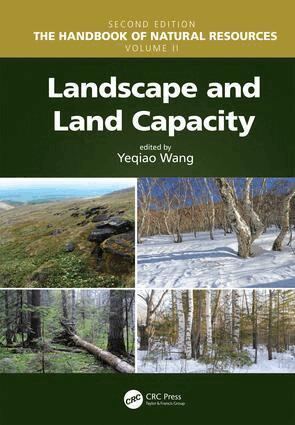
    Landscape and Land Capacity

    AvYeqiao Wang

    Inbunden, Engelska, 2020

    Del i serien Handbook of Natural Resources, Second Edition

    2 634 kr

    Beställningsvara. Skickas inom 10-15 vardagar. Fri frakt över 249 kr.

    Beskrivning

    Authored by world-class scientists and scholars, The Handbook of Natural Resources, Second Edition, is an excellent reference for understanding the consequences of changing natural resources to the degradation of ecological integrity and the sustainability of life. Based on the content of the bestselling and CHOICE-awarded Encyclopedia of Natural Resources, this new edition demonstrates the major challenges that the society is facing for the sustainability of all well-being on the planet Earth. The experience, evidence, methods, and models used in studying natural resources are presented in six stand-alone volumes, arranged along the main systems of land, water, and air. It reviews state-of-the-art knowledge, highlights advances made in different areas, and provides guidance for the appropriate use of remote sensing and geospatial data with field-based measurements in the study of natural resources.Volume 2, Landscape and Land Capacity, covers soils and landscape issues, their diversity and importance, and how soils are related to the landscapes in which they form. It includes discussions on land conservation, land-use and land-cover changes, and urban environments and unravels the complex bond between humans and soils. New in this edition are discussions on habitat conservation and planning, landscape epidemiology and vector-borne disease, and landscape patterns and changes. This volume demonstrates the key processes, methods, and models used through several practical case studies from around the world.Written in an easy-to-reference manner, The Handbook of Natural Resources, Second Edition, as individual volumes or as a complete set, is an essential reading for anyone looking for a deeper understanding of the science and management of natural resources. Public and private libraries, educational and research institutions, scientists, scholars, and resource managers will benefit enormously from this set. Individual volumes and chapters can also be used in a wide variety of both graduate and undergraduate courses in environmental science and natural science at different levels and disciplines, such as biology, geography, earth system science, and ecology.

    Produktinformation

    • Utgivningsdatum:2020-06-10
    • Mått:178 x 254 x undefined mm
    • Vikt:1 030 g
    • Format:Inbunden
    • Språk:Engelska
    • Serie:Handbook of Natural Resources, Second Edition
    • Antal sidor:432
    • Upplaga:2
    • Förlag:Taylor & Francis Ltd
    • ISBN:9781138334083

    Utforska kategorier

    • Miljövetenskap och miljöpolitik inom Naturvetenskap och teknik
    • Agronomi inom Naturvetenskap och teknik
    • Miljöteknik inom Naturvetenskap och teknik

    Mer om författaren

    Dr. Yeqiao Wang is a professor at the Department of Natural Resources Science, College of the Environment and Life Sciences, University of Rhode Island. He earned an MS and a PhD in natural resources management & engineering from the University of Connecticut. From 1995 to 1999, he was an assistant professor in the Department of Geography and Department of Anthropology, University of Illinois at Chicago. He has been on the faculty of the University of Rhode Island since 1999. In addition to his tenured position, he held an adjunct research associate position at the Field Museum of Natural History in Chicago. He has also served as a guest professor and an adjunct professor at universities in the U.S. and China. Among his awards and recognitions, Dr. Wang was awarded the prestigious Presidential Early Career Award for Scientists and Engineers (PECASE) by former U.S. President Clinton in 2000. His research projects have been funded by multiple agencies such as NASA, USDA, USDI, USAID, among others, which supported his scientific studies in various regions of the U.S., in East and West Africa, and in various regions in China. Besides peer-reviewed journal publications, Dr. Wang edited Remote Sensing of Coastal Environments and Remote Sensing of Protected Lands published by CRC Press in 2009 and 2010, respectively. He has also authored and edited over 10 scientific books in Chinese.

    Innehållsförteckning

    • Section I: Landscape Composition, Configuration, and Change 1. Conserved Lands: Stewardship 2. Edge Effects on Wildlife 3. Fires: Wildland 4. Fragmentation and Isolation 5. Land Surface Temperature: Remote Sensing 6. Landscape Connectivity and Ecological Effects 7. Landscape Dynamics, Disturbance, and Succession 8. Land-Use and Land-Cover Change (LULCC) 9. Protected Area Management 10. Protected Areas: Remote Sensing Section II: Genetic Resource and Land Capability 11. Genetic Diversity in Natural Resources Management 12. Genetic Resources Conservation: Ex Situ 13. Genetic Resources Conservation: In Situ 14. Genetic Resources: Farmer Conservation and Crop Management 15. Genetic Resources: Seeds Conservation 16. Herbicide-Resistant Crops: Impact 17. Herbicide-Resistant Weeds 18. Herbicides in the Environment 19. Insects: Economic Impact 20. Insects: Flower and Fruit Feeding 21. Integrated Pest Management 22. Land Capability Analysis 23. Land Capability Classification Section III: Soil 24. Pollution: Point Source 25. Soil Carbon and Nitrogen (C/N) Cycling 26. Soil Degradation: Food Security 27. Soil Degradation: Global Assessment 28. Soil: Erosion Assessment 29. Soil: Evaporation 30. Soil: Fauna 31. Soil: Fertility and Nutrient Management 32. Soil: Organic Matter 33. Soil: Organic Matter and Available Water Capacity 34. Soil: Spatial Variability 35. Soil: Taxonomy 36. Soil: Microbial Ecology 37. Soil Invertebrates: Responses to Forest Types in Changbai Mountains 38. Spatial–Temporal Distribution of Soil Macrofauna Communities: Changbai Mountain Section IV: Landscape Change and Ecological Security 39. Ecological Factors Influencing the Landscape Epidemiology of Tickborne Disease 40. Ecological Security: Changbai Mountains, China 41. Ecological Security: Land Use Pattern and Simulation Modeling 42. Effects of Volcanic Eruptions on Forest in Changbai Mountain Nature Reserve 43. LANDIS PRO Forest Landscape Model 44. Landscape Pattern and Change by Stone Wall Feature Identification 45. Remote Sensing of Urban Dynamics 46. Simulation of Post-Fire Vegetation Recovery 47. Sustainable Agriculture: Social Aspects 48. Sustainability and Sustainable Development 49. Urban Environments: Remote Sensing